Scaling design systems is challenging, especially as organizations grow and team structures evolve. Success often hinges on how teams are organized. This article explores three effective models for managing large-scale design systems: Centralized, Decentralized, and Hybrid. Each model offers unique strengths and weaknesses, depending on your organization’s size, goals, and maturity.
Key Takeaways:
- Centralized Model: A dedicated team maintains consistency across products but may struggle with scalability and staying connected to user needs.
- Decentralized Model: Designers within product teams contribute to the system, ensuring relevance but facing coordination challenges.
- Hybrid Model: Combines a core team with embedded contributors, balancing consistency and flexibility, though it requires strong governance.
Quick Stats:
- 63% of enterprises have mature UI libraries, but many face collaboration gaps.
- 21% of companies remain in the setup phase for over three years due to buy-in and time constraints.
Choosing the right model depends on your organization’s needs and priorities. Below, we break down each model’s pros, cons, and practical considerations.
A Business-Centric Approach to Design System Strategy
1. Centralized Team Model
A centralized team takes charge of managing the design system for the entire organization. Nathan Curtis, Founder of EightShapes, describes it this way:
“A centralized team supports the system with a dedicated group that creates and distributes standardized components for other teams to use but may not design any actual products”.
This model stands apart from a solitary approach, where one team creates tools exclusively for its own use. Instead, it provides a unified framework that introduces unique challenges in scalability, governance, and maintenance.
Scalability
The centralized model shines in its ability to support a broad range of products. A focused team can ensure that UI kits and code libraries remain consistent and up-to-date across multiple projects – sometimes spanning dozens of products. By stepping away from the immediate demands of individual products, this team can concentrate on creating a system that serves the organization as a whole.
Governance
One of the risks of a centralized approach is the potential for a “top-down” system that doesn’t align with actual user needs. To avoid this pitfall, centralized teams must actively participate in product design critiques and collaborative sessions. This involvement allows them to gather feedback on how components perform in real-world scenarios. Without this connection, design systems can stagnate; in fact, 21% of efforts fail to move beyond the setup phase even after three years.
Maintenance Burden
Centralized teams carry the full weight of maintaining the design system. They’re responsible for updating components, documenting changes, and ensuring the system evolves to meet organizational demands. While this centralized control ensures consistency, it also requires careful prioritization between system updates and the development of new features. Balancing these tasks is critical for long-term success. Some teams also rely on a virtual assistant to handle documentation updates, backlog triage, and coordination tasks, freeing designers to focus on higher-impact system work.
2. Decentralized Team Model
In a decentralized setup, designers remain embedded within their respective product teams while also contributing to the broader design system. As Nathan Curtis explains, this approach shifts away from a rigid top-down structure and instead fosters a shared decision-making environment where both practitioners and leaders collaborate.
Scalability
This model thrives on scalability by involving designers across multiple platforms – web, iOS, Android, and native apps – ensuring the design system serves the entire organization, not just a single product. Take Google during the early days of Material Design as an example. They implemented a “committee-by-design” strategy, where a small group of designers from various teams worked together to shape the system’s direction. This kind of structure is particularly well-suited for large organizations managing hundreds of designers across numerous products.
Governance
For a decentralized model to function effectively, governance is key. A well-defined charter outlining roles, responsibilities, and decision-making processes – whether decisions are made by majority vote or through consensus – is essential to prevent bottlenecks. A dedicated Design System Manager can play a critical role here, steering discussions toward actionable outcomes and ensuring alignment across teams.
This governance structure allows the design system to evolve responsively, keeping components relevant and functional.
Flexibility
One of the standout benefits of decentralization is its flexibility. Components are developed based on real-world product needs rather than theoretical assumptions. Designers use their hands-on experience with actual constraints to fine-tune components for production.
Maintenance Burden
However, decentralization comes with its challenges. Coordination becomes more complex, and designers often prioritize immediate product work over updating the design system. Nathan Curtis highlights this issue:
“A federated team needs a centralized component of staff dedicated enough to the cause… Without that fine work, that living style guide can seem quite dead.”
To address this, it’s common for federated team members to allocate about 25% of their time to design system-related work. This commitment requires leadership support to ensure the system doesn’t lose momentum or become fragmented.
Tools like UXPin Merge can also be a game-changer for decentralized teams. By allowing designers to work directly with production-ready components within their design tools, platforms like this help maintain a cohesive and scalable design system, even in a decentralized structure.
sbb-itb-f6354c6
3. Hybrid Team Model
The hybrid team model takes the best of both centralized and decentralized systems, blending structured governance with practical insights from those working directly on products. It pairs a dedicated core team with contributors embedded in product teams. This setup ensures a stable foundation while benefiting from the firsthand experience of designers actively involved in product development. As Nathan Curtis explains:
“We need our best designers on our most important products to work out what the system is and spread it out to everyone else. Without quitting their day jobs on product teams.”
This model addresses the challenges of purely federated systems, where too many contributors can slow decision-making and lead to inconsistent results.
Scalability
For large organizations, the hybrid approach strikes a balance between speed and efficiency. The central team handles documentation, governance, and maintains a single source of truth. Meanwhile, product team contributors bring in practical insights from their day-to-day work. This setup avoids the bottlenecks of a centralized system and the fragmentation often seen in federated models. It’s particularly effective for organizations with established UI libraries, bridging the gap between maintaining system consistency and adapting to real-world needs.
Governance
Strong governance is crucial for hybrid teams to maintain consistency across the system. A clear team charter is essential, outlining how decisions are made – whether by consensus or majority vote. This structured approach ensures clarity in decision-making while fostering creative input from various teams.
Flexibility
The hybrid model promotes flexibility by incorporating product team insights while adhering to a unified design vision. This balance allows for innovation without compromising overall consistency. Tools like UXPin Merge enhance this flexibility by enabling both core and product team members to work with production-ready components directly in their workflow, reducing the risk of misalignment.
Maintenance Challenges
One of the main hurdles in this model is managing the workload between the core team and product teams. Contributors often juggle their primary product responsibilities with design system tasks, which can lead to conflicting priorities. To avoid fragmentation, it’s crucial for the central team to consistently manage documentation and communication. Additionally, allocating dedicated engineering resources – such as rotating engineers from product sprints to focus on system maintenance – can help ensure the design vision aligns with its implementation in code.
Comparing the Three Models
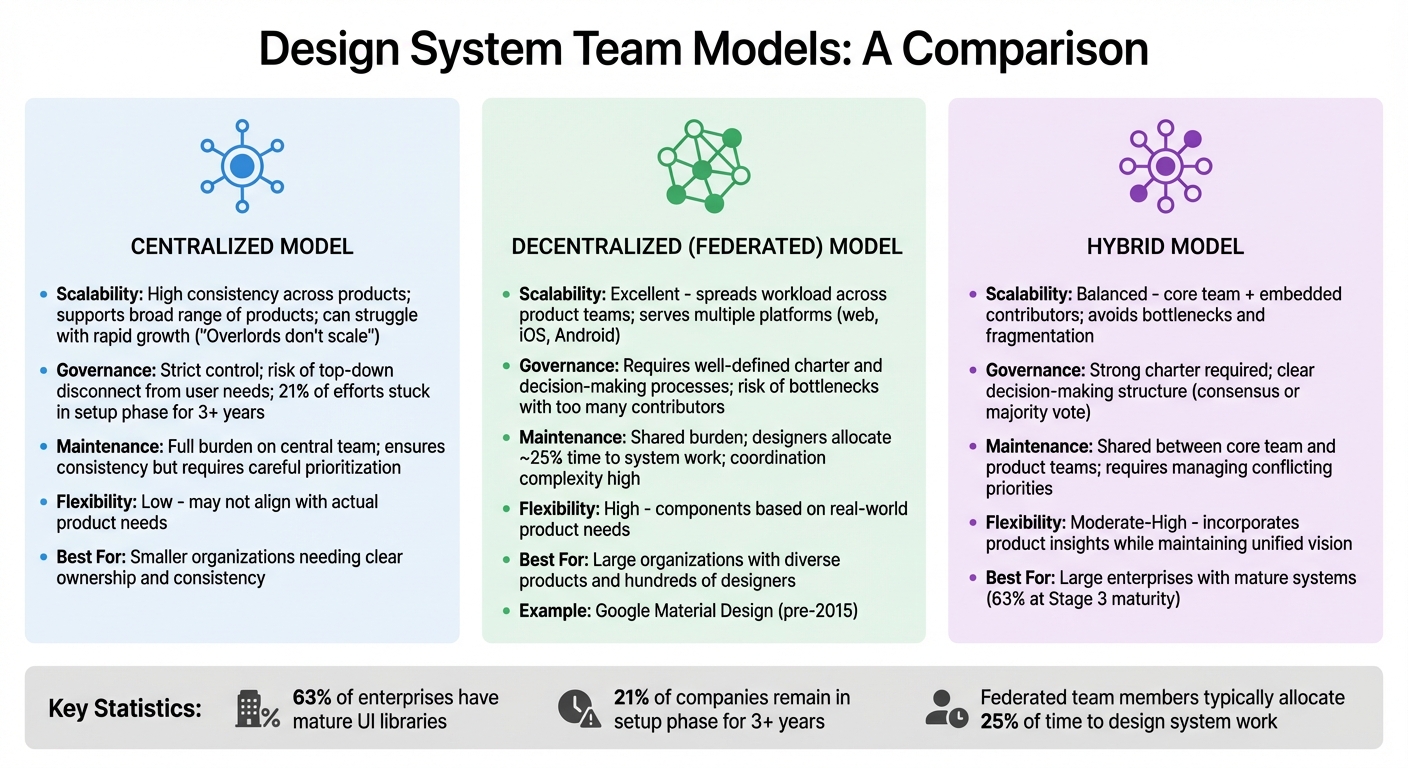
Comparison of Centralized, Decentralized, and Hybrid Design System Team Models
When it comes to scalability and operations, each model has its own strengths and challenges. The centralized model stands out for its ability to maintain consistency and enforce clear governance. However, as Nathan Curtis aptly puts it, “Overlords don’t scale”. This limitation makes it harder for centralized teams to handle rapid growth effectively.
On the other hand, the decentralized (federated) model spreads the workload across various product teams, which can accelerate scaling efforts. But there’s a downside: having too many contributors can lead to slower decision-making processes. The hybrid model aims to strike a balance between these two extremes by combining a dedicated core team with embedded contributors. This blend helps manage the trade-offs between scalability and efficiency, offering a middle ground.
Maintenance and Governance
Maintenance responsibilities vary significantly across the models. Centralized teams handle all upkeep themselves, while decentralized teams juggle system work alongside product-specific demands. Hybrid models share the load, dividing maintenance tasks between the core team and individual product teams.
Governance also plays a crucial role. Centralized teams maintain strict control, but they risk becoming disconnected from the evolving needs of product teams. As Nathan Curtis points out, this detachment can hinder adaptability. Federated teams, meanwhile, need well-defined structures to avoid bottlenecks in coordination.
Flexibility and Real-World Examples
Flexibility depends on how well each model addresses the unique needs of different products. A great example is Google’s Material Design, which emerged from a federated approach before its 2015 launch. Designers from various product teams worked together to shape the system, ensuring it met the demands of multiple platforms. This highlights the ongoing challenge of balancing consistency with the autonomy of individual product teams.
The Evolution of Models
Many organizations evolve through these models as their systems mature. They often start with a decentralized approach, move to a centralized model, and eventually adopt a hybrid framework. This progression reflects growing integration and sophistication. For instance, 63% of enterprise organizations have reached “Stage 3” maturity, where designers use UI libraries that mirror production code components. This evolution underscores how organizations adapt their models to meet increasing demands for scalability and efficiency.
Conclusion
When it comes to team structures, the centralized, decentralized, and hybrid models each bring their own strengths to the table. For smaller organizations, a centralized model often works well, offering clear ownership and a strong sense of consistency. On the other hand, companies managing a wide range of products may find a decentralized model better suited to address diverse, real-world needs.
For large enterprises with more mature systems, the hybrid model strikes a balance. It pairs a dedicated core team with embedded contributors, ensuring consistency while allowing the flexibility needed to adapt to unique product requirements.
It’s important to remember that team structures aren’t set in stone. As your organization grows and systems become more complex, a hybrid approach might offer the best mix of structure and adaptability. The key is to align your model with your current needs while staying open to adjustments as your organization evolves.
FAQs
What’s the best team structure for managing a large-scale design system?
Choosing how to structure your team for managing a large-scale design system hinges on factors like your organization’s size, the complexity of your product, and how teams collaborate. For smaller companies, a centralized team can work well. In this setup, a small group of designers takes charge of maintaining the system, ensuring consistency without needing extensive coordination.
In contrast, larger organizations often find federated or multidisciplinary models more effective. These involve cross-functional teams that can tackle the challenges of scale and complexity more efficiently.
Some companies opt for a hybrid model, blending centralized oversight with contributions from teams across departments. This approach works particularly well for businesses aiming for scalability and fast growth. However, no matter the structure, having clear governance and contribution guidelines is key to maintaining quality and consistency as the system evolves. The right choice ultimately depends on your company’s resources, culture, and goals for the future.
What are the main challenges of managing a hybrid design system?
Managing a hybrid design system isn’t without its hurdles, especially when it comes to maintaining consistency, fostering collaboration, and streamlining decision-making. One of the biggest challenges is keeping everything uniform across teams and components. To achieve this, clear governance policies are a must – they need to strike the right balance between allowing flexibility and maintaining control. Without proper oversight, you risk inconsistencies creeping in, which can lead to fragmentation and make the system harder to use.
Another tricky area is coordination among diverse teams, like designers, developers, and product managers. Smooth collaboration hinges on clear communication, well-defined roles, and structured decision-making processes – whether those processes are centralized or more distributed. It’s also crucial to find a middle ground between encouraging creativity and sticking to established standards. This balance ensures innovation thrives without weakening the system’s overall integrity. With thoughtful planning and the right tools in place, these challenges can be tackled head-on.
Why is governance important for the success of a design system?
Governance plays a key role in the success of a design system by establishing clear processes, decision-making frameworks, and accountability. These elements ensure consistency and scalability while keeping contributions and updates organized. Without proper governance, a growing system can quickly become chaotic or misaligned.
Strong governance also encourages teamwork by clarifying roles, reducing uncertainty, and simplifying workflows. Whether your organization opts for a centralized, federated, or hybrid governance model, having a structured approach is essential. It helps maintain quality, aligns the system with broader organizational objectives, and supports its growth and efficiency over time.