Desirability, Viability & Feasibility Framework: Free Design Review Template (2026)
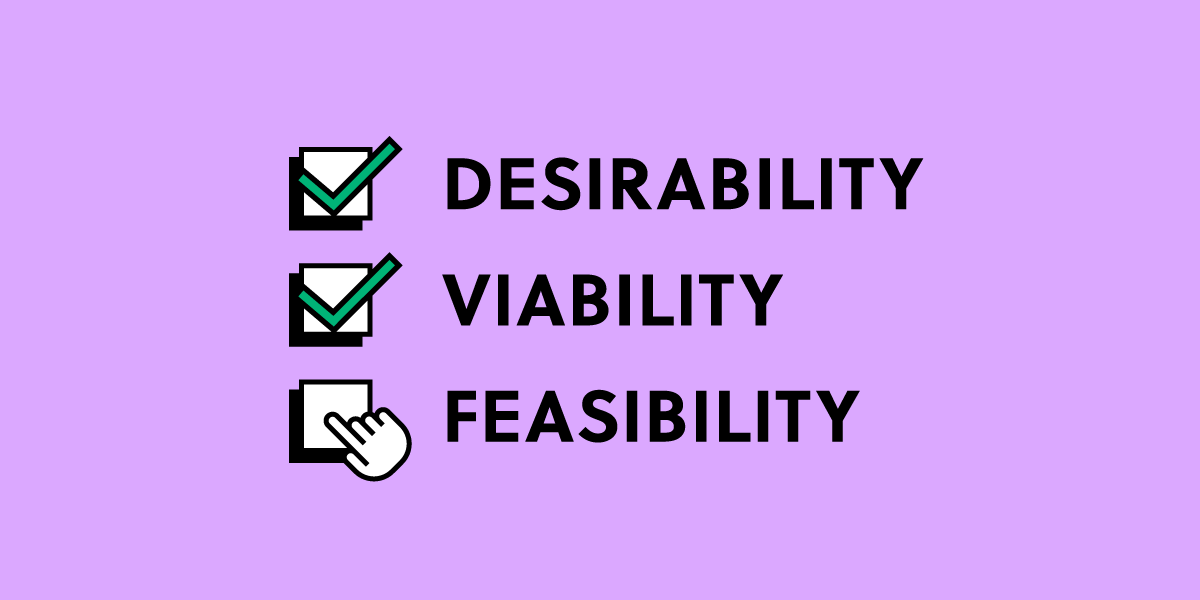
The desirability, viability, and feasibility (DVF) framework is one of the most important evaluation tools in product design. Developed by IDEO, it ensures that design decisions aren’t just user-centered — they’re also practical to build and sustainable as a business. Teams that skip any one of the three lenses frequently ship products that fail: beloved features with no business model, technically brilliant solutions nobody wants, or profitable ideas that can’t actually be built on time.
In this guide, you’ll learn how each lens of the DVF framework works, see real-world examples that illustrate common pitfalls, and get a free design review template you can use in your next sprint to evaluate concepts against all three criteria systematically.
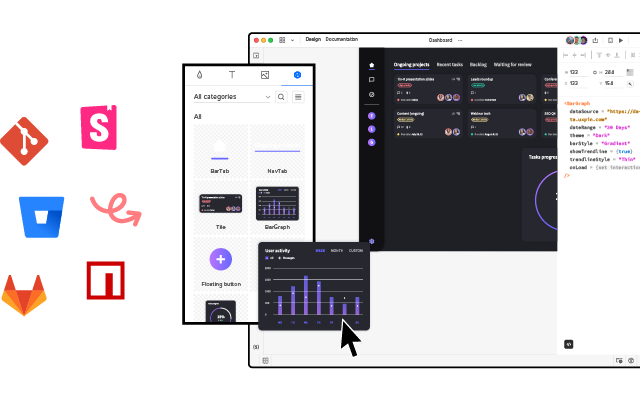
Does your design tool let you take a concept from research through prototyping to development handoff — without switching platforms? UXPin Merge lets teams prototype with production React, Storybook, or npm components, so what stakeholders review in a DVF session is what developers actually build. And with Forge, UXPin’s AI assistant, you can generate multiple concept variants from text prompts in minutes — using your team’s real component library.
What Are Desirability, Viability, and Feasibility in Design?
Desirability, viability, and feasibility is a design thinking methodology for evaluating whether a product idea has a unique value proposition and whether it’s worth investing resources to build.
Think of it as a three-lens stress test for product concepts:
- Desirability: Do users actually want or need this? Is there genuine demand?
- Viability: Does it make business sense? Can the organisation sustain it financially and strategically?
- Feasibility: Can we realistically build it with our technology, talent, budget, and timeline?
A product that misses even one of these three criteria carries significant risk. The power of the DVF framework is that it surfaces weak points early — before engineering resources are committed to concepts that won’t deliver value.
Where Does This Methodology Come From?
IDEO, the global design and innovation consultancy, developed the DVF framework in the early 2000s as a core component of their human-centered design process. The foundational insight was simple but powerful: “great ideas” consistently fail when they satisfy only one or two of the three lenses. The most impactful, durable innovations sit at the intersection of all three.
Today, the DVF framework is used by product teams at companies of every size — from startups validating their first MVP to enterprise organisations evaluating features across large product portfolios.
Desirability: Do Users Want It?
Desirability is the first and most critical filter. If no one wants or needs your product, nothing else matters — not the business model, not the technical architecture.
When evaluating desirability, you’re asking whether your idea solves a real problem — and whether your solution is compelling enough that people will choose it over existing alternatives.
Key Questions for Evaluating Desirability
- Does this product solve a real, validated user pain point?
- Is this a need (essential to a workflow) or a want (nice-to-have improvement)?
- Do competitors already solve this? If so, what makes your approach meaningfully better?
- Would users recommend this to peers? (NPS signal)
- How will using this product make people feel? What’s the emotional value?
How to Research Desirability
- User interviews — Talk to target users about their current pain points, workarounds, and unmet needs
- Surveys and market research — Quantify demand, willingness to pay, and feature priorities
- Prototype testing — Build a high-fidelity prototype and measure emotional response, task completion rate, and stated preference
- Competitive analysis — Map existing solutions and identify gaps or underserved segments
When testing desirability, UXPin’s ability to prototype with production code components means you can put a realistic, fully interactive experience in front of users — not static mockups that leave too much room for imagination to fill in the gaps. Real interactions produce more reliable desirability data.
Desirability Example
Imagine you’re designing a fitness app for workout tracking. Through user interviews, you discover that people don’t just want to log exercises — they want a sense of progress and accountability. A desirable solution would combine workout tracking with milestone celebrations and social features, not just another list of sets and reps. The desirability filter forces you to design for what users actually value, not what seems technically interesting.
Viability: Does It Make Business Sense?
Viability evaluates whether the product can sustain itself as a business. An idea might be deeply desired by users but impossible to monetise, or strategically misaligned with the organisation’s direction.

Key Questions for Evaluating Viability
- Is there a sustainable revenue model (subscription, licensing, usage-based)?
- Does this align with the organisation’s strategic priorities and OKRs?
- What’s the total addressable market (TAM)?
- Can we acquire customers at a reasonable cost (CAC)?
- What’s the expected ROI and payback period?
- Does building this create a competitive moat or strategic advantage?
How to Research Viability
- Business model canvas — Map revenue streams, cost structure, key partnerships, and channels
- Financial projections — Estimate customer acquisition costs, lifetime value, and break-even timeline
- Stakeholder interviews — Validate alignment with business leadership priorities and strategy
- Market sizing — Estimate total addressable, serviceable addressable, and serviceable obtainable market
Viability Example
Your fitness app concept tests well with users (high desirability), but market analysis reveals the consumer fitness app space is saturated with free alternatives. A viable pivot might be to target corporate wellness programmes — a B2B niche where employers pay per seat, contracts are annual, and retention is driven by HR mandates rather than individual motivation. The viability lens forces you to find a sustainable business model before committing to development.
Feasibility: Can We Build It?
Feasibility examines whether the idea is technically and operationally achievable given your available resources, technology stack, talent, and timeline.

Key Questions for Evaluating Feasibility
- Does the required technology exist and is it mature enough for production use?
- Do we have the engineering talent, expertise, and capacity?
- Can we build an MVP within our budget and timeline constraints?
- Are there regulatory, legal, or compliance barriers (GDPR, HIPAA, SOC 2)?
- What third-party dependencies or API integrations are required?
- What’s the maintenance burden after launch?
How to Research Feasibility
- Technical spike — Have engineers prototype the riskiest technical component to validate it works
- Architecture review — Assess whether the proposed solution fits existing infrastructure and tech stack
- Resource audit — Map available skills, budget, and timeline against requirements
- Risk assessment — Identify, rank, and plan mitigations for technical and operational risks
Tools like UXPin Merge can accelerate feasibility assessment by letting designers prototype with the actual production components engineers will use. If a UI works correctly in the prototype — with real props, states, and interactions — it provides strong evidence that it’s buildable. This reduces the gap between “this looks possible” and “this is confirmed buildable.”
Feasibility Example
Your corporate fitness app requires real-time biometric syncing from multiple wearable brands (Apple Watch, Fitbit, Garmin, Whoop). A feasibility review reveals that some wearable APIs are unreliable, rate-limited, or behind expensive licensing paywalls — increasing both cost and technical risk beyond your budget. The feasibility lens leads you to descope the MVP to support only the top three wearable platforms, with expansion planned for later releases.
The DVF Venn Diagram: Finding the Innovation Sweet Spot

The DVF framework is classically visualised as a Venn diagram with three overlapping circles. The “innovation sweet spot” sits at the centre — where all three criteria are satisfied. Here’s what happens when you only hit two out of three:
- Desirable + Viable but not Feasible: Users want it and the business case works, but you can’t build it with current resources or technology. Solution: Simplify the concept, extend the timeline, acquire the missing capability, or partner with a technology provider.
- Desirable + Feasible but not Viable: Users love it and you can build it, but there’s no sustainable business model. Solution: Explore alternative revenue models, strategic partnerships, or adjacent market segments where willingness to pay is higher.
- Viable + Feasible but not Desirable: The business case works and you can build it, but users don’t care enough to adopt it. Solution: Go back to user research, reframe the value proposition, or pivot to a problem users actually have.
Design Review Template: How to Apply DVF to Your Projects
Here’s a practical design review template you can adapt for your team. Use it at key project milestones — after research, after concept design, and before development handoff.
Step 1: Define the Context
- Project name and review date
- Review stage (concept exploration / high-fidelity design / pre-handoff)
- Participants and their roles (design, product, engineering, research)
- Design concept summary (2–3 sentences describing what you’re evaluating)
Step 2: Evaluate Desirability
- What specific user problem does this solve?
- What evidence do we have that users want this? (research data, usability test results, survey responses)
- How does this compare to existing alternatives available to users?
- Confidence level: High / Medium / Low
- Key risks and unknowns:
- Action items to increase confidence:
Step 3: Evaluate Viability
- Does this align with current business strategy and OKRs?
- What’s the expected business impact? (revenue, retention, efficiency, competitive positioning)
- What’s the estimated cost to build and maintain over 12 months?
- Confidence level: High / Medium / Low
- Key risks and unknowns:
- Action items to increase confidence:
Step 4: Evaluate Feasibility
- Can engineering build this with current technology, team capacity, and infrastructure?
- What are the top three technical risks?
- Are there third-party dependencies, API integrations, or compliance requirements?
- Confidence level: High / Medium / Low
- Key risks and unknowns:
- Action items to increase confidence:
Step 5: Decision and Next Steps
- Overall assessment: Proceed / Iterate / Pivot / Stop
- Key risks to mitigate before the next review
- Owner and deadline for each action item
- Date of next review
Tips for Running Better Design Reviews
- Use interactive prototypes, not static mockups. When stakeholders can click through a working prototype, feedback is more precise, edge cases surface faster, and fewer assumptions slip through to development. UXPin’s code-based prototypes behave like the final product, which makes DVF reviews far more productive.
- Generate multiple concepts quickly with AI. When you need to explore several directions before a review, Forge can generate interface concepts from text prompts — using your team’s actual design system components. This means every concept you bring to a DVF review is already grounded in what’s feasible to build.
- Invite the right cross-functional voices. Design reviews work best when design, product, and engineering are all represented. Each discipline naturally owns one lens of the DVF framework.
- Set clear evaluation criteria upfront. Without structure, reviews devolve into subjective opinion sessions. The template above gives everyone a shared language and scoring framework.
- Document decisions, not just feedback. Capture what was decided and why. This context is invaluable later when trade-offs inevitably resurface during implementation.
- Review early and often. Don’t wait until a design is “finished.” Evaluating rough concepts through the DVF lens early saves significant rework downstream.
Run Better Design Reviews With UXPin
Design reviews are only as good as the artefacts you bring to them. With UXPin Merge, your prototypes are built with the same production components your developers use — so stakeholders evaluate real interactions, not aspirational mockups. What you review is what ships.
When you need to explore multiple design directions before a review, Forge generates interface layouts from text prompts, image uploads, or URL references — always using components from your team’s actual design system. This means every concept you bring to a DVF review is already constrained to what’s feasible and brand-consistent. Enterprise teams using UXPin report 8.6x faster design-to-prototype cycles with this workflow.
Start a free trial of UXPin and see how code-backed prototyping transforms your design review process.
Frequently Asked Questions
What is the desirability, viability, and feasibility framework?
The desirability, viability, and feasibility (DVF) framework is a design thinking methodology developed by IDEO. It evaluates product ideas across three lenses: desirability (do users want it?), viability (does it make business sense?), and feasibility (can we build it?). A successful product must score well on all three. Ideas that satisfy only one or two lenses carry significant risk of failure.
How do I use a design review template?
A design review template structures your evaluation around predefined criteria — typically desirability, viability, and feasibility. For each criterion, document the evidence (user research, business metrics, technical assessment), rate your confidence level, identify risks and unknowns, and assign action items with owners. Use the template at key milestones: after research, after concept design, and before development handoff.
What’s the difference between viability and feasibility in design?
Viability asks whether a product makes business sense — can the organisation sustain it financially and strategically? Feasibility asks whether the product can be built with available technology, resources, and timeline. A product can be feasible (technically possible to build) but not viable (no sustainable business model), or vice versa. Both must be satisfied for a product to succeed.
Who should participate in a design review?
A well-rounded design review includes representatives from design (desirability perspective), product/business (viability perspective), and engineering (feasibility perspective). Include a UX researcher if available to present evidence, and invite key stakeholders who will be directly affected by the design decisions.
How often should teams conduct design reviews?
Most effective teams conduct DVF reviews at three stages: after initial research and concept exploration, after high-fidelity design and prototyping, and before development handoff. For complex or high-risk projects, add a review after the first development sprint to catch implementation issues early and validate that design intent translated correctly.
What tools help run effective design reviews?
UXPin is particularly effective for design reviews because teams can interact with fully functional prototypes built with real code components — no static mockups to misinterpret. Forge, UXPin’s AI assistant, can rapidly generate multiple design concepts from text prompts using your production design system, giving reviewers realistic alternatives to compare. Other useful tools include Miro for collaborative workshops and Notion or Confluence for documenting decisions.