


Designing for Trust: How to Combine Microcopy and Social Proof in UX (+Examples)
What’s the biggest benefit of exceptional UX design? It’s not just its ability to help web users achieve their web browsing goals (regardless of their position in the buyer’s journey). Nor is it its capacity to drive conversions and boost profits.
Instead, next-level UX design directly influences brand perception, a key component of any brand’s potential for success. Particularly in competitive industries. It can establish credibility, drive trust, remove customer doubts, or even affect the amount consumers are willing to pay for a specific product or service.
But how do you use UX design to build consumer confidence?
Naturally, there are numerous approaches businesses can opt for when designing for trust. However, social proof — and especially its role as a conversion-supporting element — is one of the most effective methods to elevate UX.
Are you looking to design your digital presence to drive brand trust? Here’s how you can combine microcopy and social proof to earn your prospects’ confidence and nudge leads toward conversion.
UXPin is a solution that helps teams build functional prototypes and design systems, perfect for testing microcopy and social proof elements and how they behave in terms of building brand trust. Try it for free.
Address Leading Cart Abandonment Factors
Conversions constitute the last step within a buyer’s journey (if we exclude the loyalty phase of the sales funnel, that is). Nevertheless, they’re among the most common points within the buyer-brand relationship where things go south.
And the truth is, this isn’t that much of a surprise. Product awareness and understanding can easily generate interest. But without trust, they’re simply incapable of guiding leads toward a purchase decision that feels genuinely safe.
In fact, if you look at the data on why shoppers abandon their carts, you’ll discover that brand trust and perception often play a role in preventing people from clicking the ‘Buy’ button with confidence.
According to research, 19% of people fail to convert because they don’t trust a business with their credit card information — a hesitation driven by real ecommerce payment fraud risk. And 15% don’t become buyers due to unsatisfactory return policies
Of course, the primary reason these last-minute changes of mind happen is that your branding strategy wasn’t sufficiently focused on dependability and reliability. And fixing that type of mistake isn’t something you can achieve overnight.
Nevertheless, you can remedy some of the consequences of inadequate branding with UX design — specifically by combining social proof and microcopy.
By addressing your target audience’s leading reasons for cart abandonment, you can instill them with a sense of safety about your business. More importantly, you can use this tactic to prevent funnel leaks in website areas where trust matters the most — namely, on product pages or within the hero section of your homepage.
For instance, if you check out Sewing Parts Online, you’ll notice how the brand creates a safe-feeling customer journey with trust-building webpage elements.
By prefacing the beginning of the browsing and purchasing process with trust-building promises (expert service, large selection, quick delivery), Sewing Parts online effectively disarms its prospects’ defenses and draws them into its sales funnel. But even more importantly, the business addresses its customers’ primary conversion obstacles (slow and expensive shipping and complicated return policies). It knows full well that doing so creates a safe and user-friendly environment where conversion decisions don’t seem risky but are a natural progression from pain-point awareness to solution.
Don’t Force Conversions. Invite Prospects Into Your Community
In some cases, the biggest reason why consumers aren’t converting into customers isn’t that they don’t recognize the value your business offers. Instead, it’s that they associate conversion-oriented actions with a risk they’re not yet willing to take on.
In such scenarios, one of the biggest benefits of trust-centric UX is that it can help you reframe conversion activities as something much less fear-inducing — being part of a community.
Essentially, any community automatically exerts social influence. It creates a setting in which individuals feel comfortable taking behavioral cues from their peers, seeing specific actions as the “right” choice.
So, by framing conversion activities as joining a community, you’re not asking prospects to take on a risk. Instead, you’re telling them something along the lines of ‘look at all of these people who have successfully solved their pain points by using our product/service. Why not try it out for yourself? It might just be the thing you need.’
In other words, by combining microcopy and UX elements to invite prospects into your brand’s community (instead of pushing them toward conversion), you can create an appealing next step in your audience’s buying journey while still managing risk perception.
For example, you could consider doing something along the lines of Sky and Sol. This brand combines microcopy and UX by emphasizing that it is trusted by 100,000+ happy customers. This approach to trust-building design acts as an effective cue that drives prospects’ desire to become customers. Moreover, the effect is even more pronounced thanks to displaying user-generated visuals within the same website section. This makes potential customers more likely to find the brand’s claims credible and choose to invest in Sky and Sol’s products.
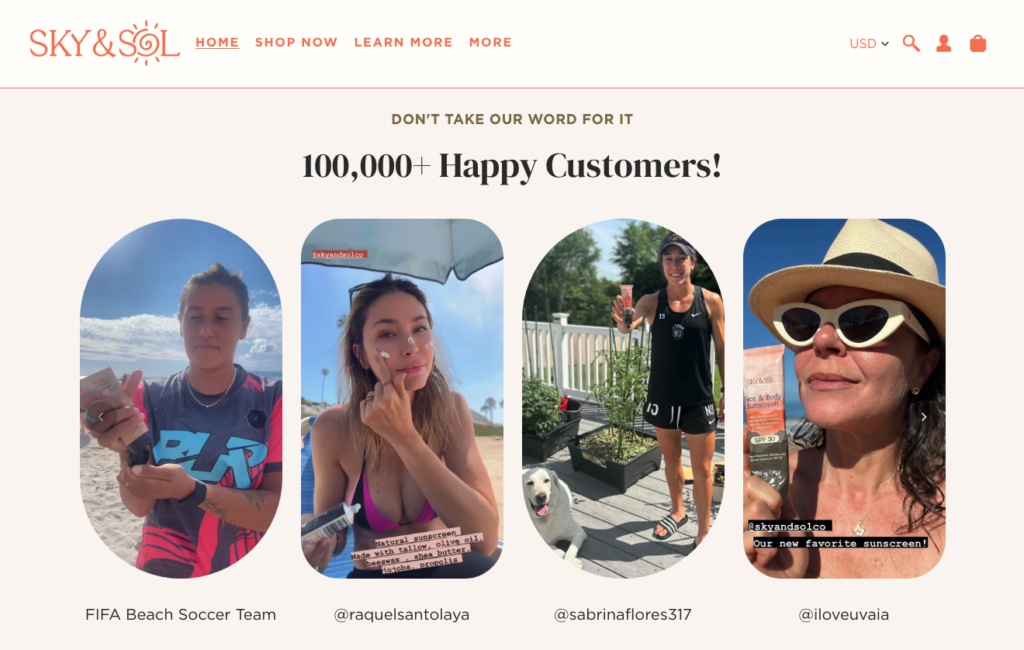
Source: skyandsol.co
Employ Microcopy to Communicate Convenience and User-Centricity
Brand credibility is a top priority for consumers navigating buying journeys in 2026.
According to research, trust is now as important as product quality and price. Furthermore, consumer confidence even leads to lower price sensitivity and higher spending, with data suggesting that 68% of people spend more with brands they trust.
Nevertheless, while trust is a key conversion factor for most people, it’s not the only thing buyers consider before committing to a purchase. Convenience and customer experience play just as important a role in determining consumer behavior.
With this in mind, an effective method to encourage your prospects to convert isn’t just to call their attention to the reliability of your products and services, or the helpfulness of your customer team. Instead, explore opportunities to emphasize user-centricity too.
The standard approach to advertising convenience is an excellent start.
Stating that you offer free shipping and returns is always a welcome message for web visitors (and a solid way to build brand trust via the mediating effect of user-centricity).
Nevertheless, if you want this messaging to truly stand out and earn customer confidence, explore opportunities to use social proof to highlight these claims.
For instance, check out how Gousto does it. Instead of just claiming that its recipe boxes are easy, quick, and convenient to make, this brand quotes satisfied customers who have pointed out these benefits. The social proof thus builds brand trust and emphasizes a sought-after convenience perk, which is precisely what’s needed to nudge web visitors toward a conversion without making them feel like they’ve been aggressively sold a service they’re not convinced is right for their needs.
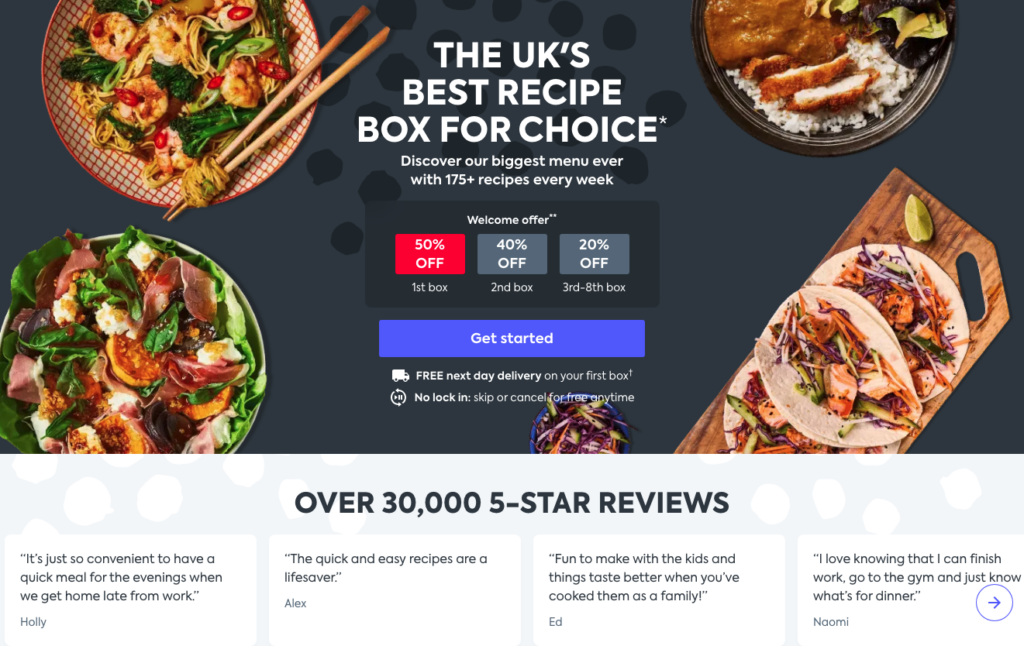
Source: gousto.co.uk
Draw Prospects Into Your Funnel with Low-Risk Experiences
One of the primary reasons why UX design is so important for driving conversions is that it’s a direct predictor of the type of customer experience your prospects can expect to receive from your business.
Seamless, convenient browsing experiences demonstrate your brand’s comprehension of user needs. They’re proof of your organization’s competence to remove customer pain points. And they signal your company’s dedication to customer satisfaction.
Nevertheless, while UX is an excellent predictor of CX, a user-friendly website is not always sufficient to earn consumer trust or encourage conversions — especially in low-trust industries.
So, instead of expecting your target audience to take your word for granted (or make trust-based conclusions on web design alone), explore opportunities to show that they can genuinely rely on your business to address and resolve their needs.
The way microcopy plays into this is that it can be an amazing tool for drawing prospects into your funnel by promising them financially justifiable first-hand experiences. In some cases, that’s even more effective at elevating purchase intent than traditional social proof.
For example, check out how ScentBird does it on its homepage. This business doesn’t invite web visitors to invest in a subscription after a single touch. Instead, it encourages them to try out its service for 50% off. By using a price anchoring strategy (striking out the original value of the subscription and telling customers they can get it for less), ScentBird effectively assigns a higher value to its offer while giving prospects the option to try it out for less. This immediately lowers risk perception, making customers more likely to see the brand as trustworthy and credible.
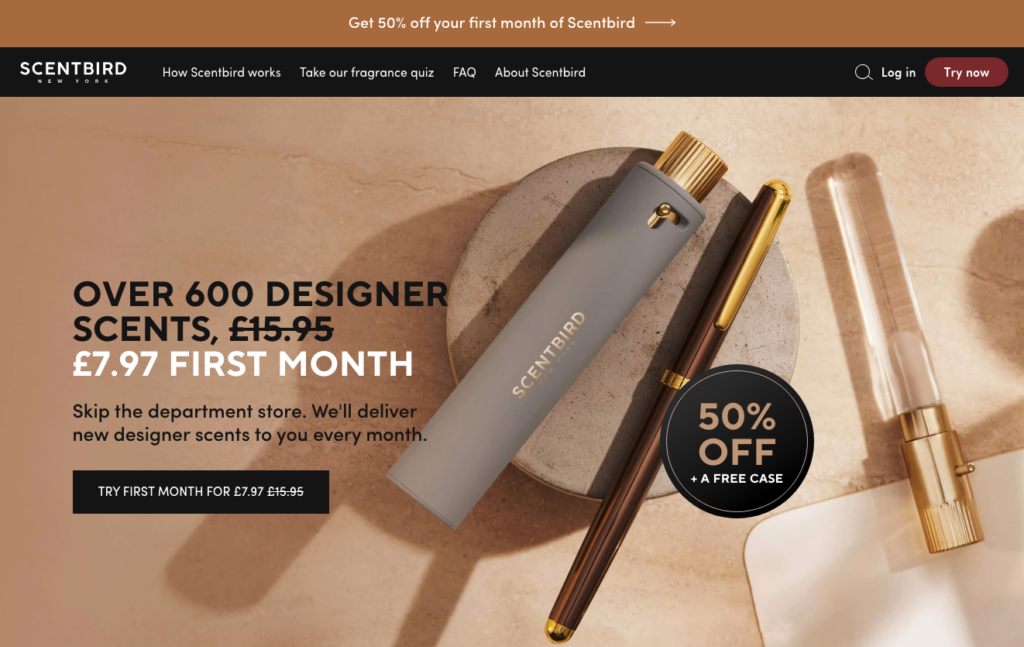
Source: scentbird.com
Create a Sense of an Aspirational Brand
In some cases, the best social proof that can help you earn your target audience’s trust isn’t feedback from your satisfied customers confirming the validity of your claims. Instead, it’s simply the fact that your store is a place people with specific needs go to in order to resolve their pain points. It’s a combination of momentum and desirability.
Think about the concept in the following terms. In the offline world, a line in front of a store can be an important signal that the business is selling something that is valuable to many people. Online, the equivalent of this reputation is hype — those viral products that everyone has to have because they’re popular, unique, and deliver highly sought-after benefits.
If you can employ web design elements that position your brand as aspirational, you can effectively -
- shape your organization’s reputation
- boost its credibility
- guide prospects into your funnel at a faster pace
However, for all of this to happen, you first need to learn how to position your brand and products as aspirational without your approach coming off as forced (and inherently turning your ideal customers away).
Fortunately, social proof and microcopy can be great tools to reach this goal.
By using these elements to communicate your store’s status as the ‘go-to’ space for solving a specific pain point (and by using UGC to show how many people actually use your products and services), you can build an aspirational brand reputation that is solely based on credibility.
For instance, check out how IceCartel does it. This brand sells a unique type of product that falls into the affordable luxury category. But instead of allowing the ‘affordable’ aspect of its offer to determine its value, IceCartel takes a more distinctive approach with its trust-centric design. Essentially, this brand focuses its online presence on showing that its products aren’t cheap pieces. They’re artisan-quality jewelry items that use high-quality man-made materials to give customers valuable items without breaking the bank.
Then, to drive the message home, IceCartel uses a very impressive influencer marketing campaign that features famous hip-hop artists. This shows potential customers that even their idols wear this type of jewelry, meaning that it’s not a trade-off but the smart way to acquire exceptional pieces that deliver the highest value for money.
Align Conversion Actions with Specific Outcomes
Lastly, when it comes to trust-centric UX design and using the combination of social proof and microcopy to earn your ideal customers’ confidence, don’t forget the reason your web visitors are browsing your site in the first place. They’re searching for a solution that will lead to a positive outcome.
So, instead of treating conversion actions as something your prospects need to do, frame them, instead, as an action that will lead to a desired result.
Microcopy can be particularly helpful in this regard, seeing that it plays a direct role in guiding your prospects toward action.
An approach such as this does more than replacing risk with something positive — think about ‘buy now’ vs. ‘get these results.’ It demonstrates your company’s confidence in its ability to resolve customer pain points, which is an extremely important aspect of trust-building.
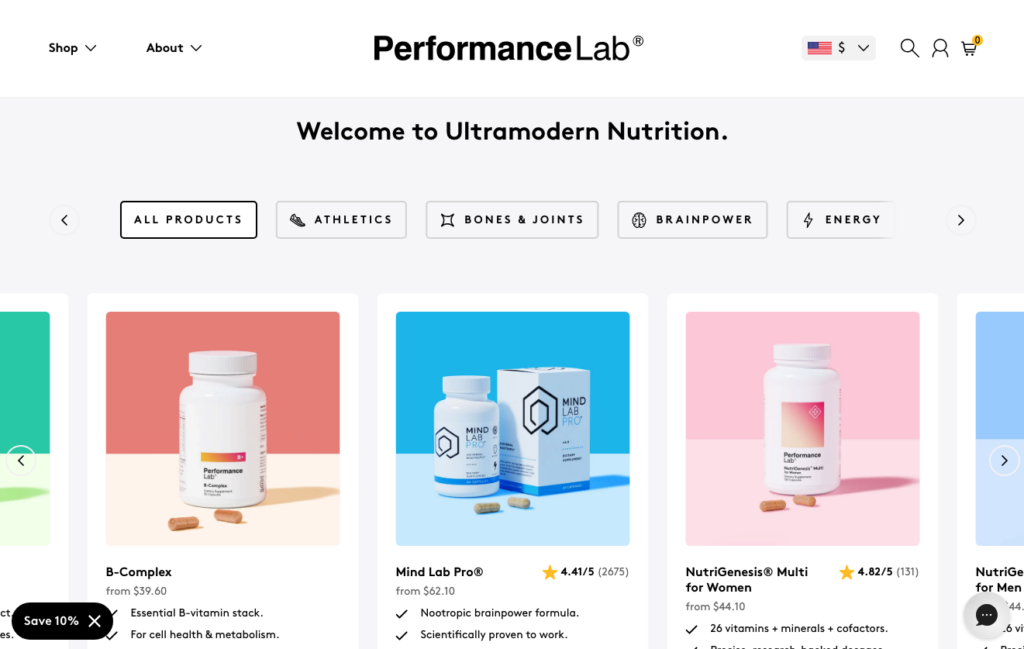
One of the best examples of this UX design strategy in action comes from Performance Lab. This business offers a variety of supplement products that target different customer needs through premium-grade, research-backed ingredients.
However, instead of forcing prospects to browse the brand’s entire inventory of products, PerformanceLab creates a shopping system that aligns perfectly with its target audience’s desired outcomes. By inviting prospects to browse items based on their intended use (such as improving athletic performance or boosting bone and joint health), PerformanceLab automatically aligns web visitors’ conversion actions with specific (desired) outcomes. This builds customer confidence and makes them feel more determined in their belief that these solutions genuinely are the best way for them to reach their health goals.
Source: performancelab.com
Takeaway
As you can see, multiple aspects of web design — and user experience, in particular — can contribute to brand trust. But if you’re searching for opportunities to maximize your brand’s credibility and remove your audience’s conversion obstacles, social proof and microcopy are going to be your most valuable UX design tools.
You can use these elements on their own. Or you can combine them for a more subtle but effective approach to building trust. The choice is entirely up to you.
What does matter, however, is that you don’t just use generic trust-building strategies. Instead, pay close attention to the conversion-related doubts your prospects have. And consider their unique buying journeys and phases where they commonly exit your sales funnel.
That way, you won’t just uncover valuable opportunities for elevating conversion rates through trust marketing. You’ll also create a setting in which your leads feel confident regarding their buying decisions, automatically making them more likely to become customers.