20 Best React Websites and Web App Examples (2026)
React (ReactJS) remains the most widely used front-end library in 2026, powering everything from social media platforms and streaming services to enterprise dashboards and SaaS products. Its component-based architecture makes it easy to build, maintain, and scale complex user interfaces.
We’ve assembled 20 examples of React websites and web applications to showcase the library’s versatility — from household-name consumer apps to high-performance enterprise tools.
Key takeaways:
- React is used by companies of all sizes — from startups to Meta, Netflix, and PayPal.
- The library excels at single-page applications, dashboards, and content-heavy sites.
- React’s ecosystem (Next.js, Remix, React Native) extends its reach to server-rendered sites, static sites, and mobile apps.
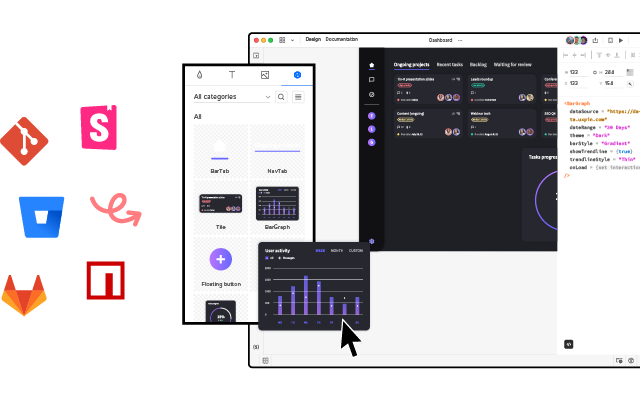
- Teams building React products can use UXPin Merge to design with the same React components that ship to production.
What Can You Build with React?
React developers use the library for everything from marketing sites to complex real-time applications:
- Single-page applications (SPAs) — Gmail, Trello-style apps without page reloads.
- Content platforms — News sites, blogs, social media feeds.
- Dashboards and admin panels — Data-heavy interfaces with frequent state updates.
- E-commerce — Product catalogs, shopping carts, checkout flows.
- Enterprise SaaS — Multi-team products with shared component libraries.
When to Use React (and When Not To)
Use React when: Building complex, interactive web applications with frequent data updates — especially SPAs, dashboards, and products with shared component libraries.
Consider alternatives when: Building a simple static website (HTML/CSS or a static site generator may suffice), or native mobile apps (React Native or Flutter offer better native performance).
20 React Websites and Web App Examples
1. Facebook
Facebook is the most famous React website — parent company Meta created the library in 2012. React was built for the Facebook newsfeed: when someone likes a post, only that component updates instead of the entire page reloading. Meta uses React across its entire product ecosystem.
2. Netflix
Netflix uses React for its browsing interface on desktop and mobile web. The streaming giant chose React for fast rendering and component-based structure, enabling rapid UI feature testing. Netflix also uses React to power Gibbon, its custom rendering framework for TV devices.
3. PayPal
PayPal uses a React-based implementation of Microsoft’s Fluent Design across 60+ internal products. PayPal also uses UXPin Merge, allowing its 5-person UX team to prototype and test with the same React components developers ship — enabling a small team to support over 1,000 developers.
4. Instagram
Instagram’s web application is built entirely with React. The library’s efficient rendering handles image-heavy feeds, stories, reels, and real-time interactions without full page reloads.
5. Airbnb
Airbnb uses React for search, listing, and booking interfaces. Complex filtering, map integration, and dynamic pricing displays benefit from React’s component model. Airbnb has contributed significantly to the React ecosystem through open-source tools.
6. Dropbox
Dropbox rebuilt its web experience with React for better performance. The file management interface — with drag-and-drop, folder navigation, and sharing dialogs — fits naturally with React’s stateful component approach.
7. Twitter / X
Twitter (now X) uses React for its web client. Real-time tweet feeds, notifications, and interactive features like polls and spaces leverage React’s efficient update model for high-frequency data changes.
8. Reddit
Reddit rebuilt its desktop experience using React. Nested comment threads, real-time voting, awards, and subreddit customization create a complex UI that benefits from React’s component isolation.
9. Uber
Uber’s rider and driver web dashboards are built with React, powering real-time map interfaces, trip management, and the Uber for Business corporate travel platform.
10. Shopify
Shopify uses React (via its Polaris design system) for the merchant admin dashboard where millions of store owners manage products, orders, and analytics. Shopify’s Hydrogen framework, built on React, powers custom storefronts.
11. Notion
Notion’s web application leverages React for its flexible block-based editor. Every block — text, table, kanban, calendar, database — is a React component, making drag-and-drop composition possible.
12. Discord
Discord’s desktop and web clients are built with React, managing complex state across chat channels, voice indicators, server lists, and inline embeds — all updating simultaneously.
13. Asana
Asana’s project management web app uses React. Multiple view modes (list, board, timeline, calendar) share the same data but render through different React component hierarchies.
14. Figma
Figma’s interface panels, toolbars, and layer management are built with React (the canvas uses WebGL). React handles the interaction between property panels, component libraries, and collaboration indicators.
15. Stripe
Stripe uses React for its developer dashboard and documentation. Interactive API docs, live code examples, and account management showcase React’s ability to create polished developer-facing products.
16. WhatsApp Web
WhatsApp Web uses React to mirror the mobile messaging experience. Real-time delivery, contact management, and media sharing all run through React components.
17. Repeat
The SaaS platform Repeat uses Next.js (built on React) for its website and web application, featuring immersive animations powered by Next.js’s rendering and asset optimization.
18. Vercel
Vercel — the company behind Next.js — builds its dashboard and website with React. Real-time build logs, domain management, and analytics demonstrate React’s suitability for developer tooling.
19. Linear
Linear is a modern project management tool built with React. Its buttery-smooth interface, keyboard-first navigation, and real-time sync demonstrate what’s possible with optimized React architecture.
20. Codecademy
Codecademy’s interactive learning platform uses React for its in-browser code editor, lesson navigation, and progress tracking — combining real-time code execution with course content management. Treehouse, another online coding education platform, similarly leverages modern web technologies to build interactive learning experiences where students can write and test code directly in their browser while building a job-ready portfolio.
Designing React UIs: From Prototype to Production
React’s component-based architecture creates a gap when design tools use static layers instead of real components. Designers create one version; developers rebuild from scratch.
UXPin Merge eliminates this gap. Designers work with the same React components developers use — configuring props and building interactive prototypes that output clean JSX.
Connect your own library via Git integration or Merge CLI, or start with MUI, shadcn/ui, or Bootstrap.
Need to go faster? UXPin Forge generates React UI layouts from text prompts — constrained to your production design system. AI gets to 80%; professional tools handle the last 20%. Output is production-ready JSX.
Enterprise teams like PayPal use this approach to support 60+ products with a small UX team, achieving up to 50% reduction in engineering time.
Frequently Asked Questions About React Websites
What is ReactJS used for?
ReactJS is a JavaScript library for building user interfaces — primarily web applications. It’s used for SPAs, dashboards, social media platforms, e-commerce sites, and enterprise SaaS products.
Which major companies use React?
Meta (Facebook, Instagram), Netflix, PayPal, Airbnb, Uber, Shopify, Twitter/X, Discord, Reddit, Notion, Stripe, and thousands of others.
Is React good for building websites?
React is excellent for interactive, data-driven websites. For simple static websites, plain HTML/CSS or a static site generator may be simpler. React shines with complex state and frequent data updates.
What is the difference between React and Next.js?
React is a UI library for components and state. Next.js is a framework built on React adding server-side rendering, static site generation, file-based routing, and API routes.
Can designers work with React components?
Yes. UXPin Merge lets designers drag and drop real React components on a canvas, configure props, and build interactive prototypes — without writing code. Output is production-ready JSX.
Is React still relevant in 2026?
Absolutely. React remains the most popular front-end library by adoption, with a massive ecosystem (Next.js, Remix, React Native), strong corporate backing from Meta, and continued innovation through React 19.