

8 Dark Mode Benefits: How Dark Themes Improve Eye Comfort, Battery Life, and UX (2026)
Explore the 8 proven benefits of dark mode — reduced eye strain, battery savings on OLED, better accessibility, and design flexibility. Learn when to use dark vs. light mode, implementation best practices with design tokens, and how to prototype dark themes.

Dark mode is a display setting that uses light-colored text, icons, and UI elements on a dark background. Once a niche preference among developers, dark mode has become a mainstream expectation — offered system-wide on iOS, Android, macOS, and Windows, and supported by virtually every major application.
But dark mode isn’t just a cosmetic toggle. It has measurable benefits for eye comfort, battery life, accessibility, and design flexibility. Whether you’re building a consumer app, a SaaS dashboard, or an enterprise product, understanding when and how to implement dark mode is essential for modern UI design.
This guide covers the 8 proven benefits of dark mode, when light mode is the better choice, implementation best practices using design tokens, and how to prototype and test dark mode interfaces effectively.
Key takeaways:
- Dark mode reduces eye strain in low-light environments and cuts blue light exposure.
- On OLED screens, dark mode can extend battery life by 30–50%.
- Users expect dark mode — over 80% of smartphone users have dark mode enabled at least some of the time.
- Proper dark mode uses dark grays (not pure black) and design tokens for maintainable theming.
- Both light and dark modes have optimal use cases — the best products offer both and let users choose.
What Is Dark Mode?
Dark mode (also called dark theme or night mode) is a color scheme that reverses the traditional light-background, dark-text paradigm. Instead, it presents light text and UI elements on dark or near-black backgrounds.
Most modern operating systems — Windows, macOS, iOS, and Android — offer system-wide dark mode settings that apps can inherit automatically. Many applications also provide independent dark mode toggles, and some automatically switch between light and dark based on time of day or ambient light conditions.
While the simplest implementation is a white-to-black color swap, well-designed dark mode goes much further — using carefully chosen dark grays, adjusted contrast ratios, and desaturated accent colors to create a comfortable, readable, and visually appealing experience.
The 8 Key Benefits of Dark Mode
1. Reduced Eye Strain in Low-Light Environments
Bright white screens in dark rooms create a harsh contrast between the display and the surrounding environment. This forces the pupils to constrict, leading to eye fatigue and discomfort during extended use. Dark mode significantly reduces this contrast, making screen use more comfortable in low-light settings.
This benefit is particularly relevant for products used in the evening or at night — media apps, messaging platforms, reading apps, and dashboards monitored in dimly lit control rooms.
2. Less Blue Light Exposure
Screens emit blue light, which research has linked to disrupted melatonin production and sleep patterns. Blue light can suppress melatonin for roughly twice as long as other wavelengths, interfering with circadian rhythms.
Dark mode reduces the overall light output of a screen, including blue light. While it’s not a substitute for reducing screen time before bed, dark mode meaningfully decreases blue light exposure — especially for apps and sites that users access in the evening.
3. Significant Battery Savings on OLED Screens
On devices with OLED or AMOLED displays — which include most modern smartphones and an increasing number of laptops and tablets — black pixels are literally turned off, consuming zero power. Testing has shown that dark mode can extend battery life by 30–50% compared to light mode on OLED screens at typical brightness levels.
This is a meaningful real-world benefit: users on OLED devices who enable dark mode consistently see longer battery life, which is why both Apple and Google recommend dark mode as a battery-saving feature.
Note: LCD screens don’t benefit from this effect because their backlight runs continuously regardless of what’s displayed.
4. Better Accessibility for Light-Sensitive Users
Users with photophobia, migraines, or certain visual impairments can find bright screens physically uncomfortable or painful. Dark mode provides an alternative that makes digital products usable for a broader audience.
Some users with certain types of low vision find light-on-dark text easier to read. Offering a dark mode option is an accessibility best practice that broadens your product’s reach and demonstrates inclusive design.
5. Enhanced Visual Design Opportunities
Dark backgrounds create unique design possibilities that light mode doesn’t offer:
- Colors pop more: Saturated accent colors — blues, greens, oranges, pinks — appear more vivid against dark backgrounds than against white.
- Depth and elevation: Material Design’s dark theme guidance uses lighter surface colors to indicate elevation, creating a natural sense of depth without shadows.
- Image-heavy layouts shine: Photography and media content looks more immersive on dark backgrounds because there’s no competing white space.
- Focus on content: Dark interfaces naturally reduce visual noise from chrome (headers, navigation, toolbars), directing attention to the content area.
6. User Preference and Expectation
Dark mode is no longer a niche feature — it’s a baseline expectation. Surveys consistently show that over 80% of smartphone users have dark mode enabled at some point during the day, with the majority preferring it for evening and nighttime use. About 70% of software developers use dark themes in their IDEs, and this preference has spread to mainstream consumer apps.
Platforms like YouTube, Spotify, Netflix, Slack, Discord, and virtually every social media app now default to or prominently feature dark mode. If your product doesn’t offer it, users notice.
7. Reduced Visual Noise for Content-Focused Interfaces
Dark interfaces naturally de-emphasize the UI chrome — navigation bars, sidebars, toolbars — and direct the user’s focus toward primary content. This makes dark mode particularly effective for:
- Video and media consumption (Netflix, YouTube)
- Code editors and development environments
- Photo and portfolio displays
- Presentation tools and slideshow apps
By reducing the visual weight of non-content elements, dark mode lets the actual content take center stage.
8. Better Readability for Data-Dense Dashboards
Analytics dashboards, monitoring tools, and data visualization interfaces are often used in dim environments (control rooms, trading floors, NOCs). Dark mode improves readability in these contexts by reducing overall screen glare while allowing charts, graphs, and status indicators to stand out clearly against the dark background.
Colored status indicators (green/yellow/red) and data visualization elements are more distinguishable on dark backgrounds, which is critical for interfaces where quick visual scanning matters.
Light Mode vs. Dark Mode: When to Use Each
Dark mode isn’t universally superior. Both modes have optimal use cases, and the best products offer both options with a seamless toggle.
When Light Mode Works Better
- Bright environments: In well-lit rooms or outdoor conditions, light mode provides better readability and less screen glare.
- Long-form reading: Research suggests that dark text on light backgrounds is easier to read for extended periods, particularly for users with normal vision in daylight conditions.
- Color-critical work: Tasks requiring precise color discrimination — photo editing, illustration, branding work — are generally more accurate on light backgrounds.
- Document-centric interfaces: Products centered around documents (word processors, spreadsheets, email) traditionally use light mode to mimic paper, which many users find familiar and comfortable.
When Dark Mode Works Better
- Low-light environments: Evening use, bedrooms, theaters, dimly lit offices — dark mode reduces eye strain and harsh light.
- Media consumption: Video, photography, gaming, and music apps benefit from dark backgrounds that put content front and center.
- Dashboards and monitoring: Data dashboards, analytics tools, and control room displays are often used in dim environments and benefit from dark themes.
- Mobile-first products: On OLED devices, dark mode conserves battery — a practical benefit for mobile users.
- Developer tools: Code editors, terminals, and technical interfaces overwhelmingly default to dark themes.
Dark Mode Design Best Practices
Implementing dark mode well requires more than inverting colors. These principles separate good dark mode from bad:
Don’t Use Pure Black (#000000)
Pure black backgrounds with pure white text create excessive contrast that causes visual vibration — a halation effect where white text appears to bleed into the black background. Use dark grays (e.g., #121212 or #1E1E1E) instead of pure black, and off-white (#E0E0E0) instead of pure white for body text.
Use Design Tokens for Theming
Implement dark mode through design tokens — semantic color variables that map to different values in light and dark contexts. For example, color-surface-primary might resolve to #FFFFFF in light mode and #1E1E1E in dark mode.
This approach makes theme switching reliable and maintainable across the entire design system. Modern design and development workflows rely on tokens to ensure every component renders correctly in both themes without manual overrides.
Adjust Elevation and Depth
In light mode, depth is typically communicated through shadows. In dark mode, shadows are invisible against dark backgrounds. Instead, use lighter surface colors to indicate elevation — a technique formalized in Material Design’s dark theme guidelines.
For example, a card at elevation 1 might use #1E1E1E, while a dialog at elevation 3 uses #2C2C2C. This creates a clear spatial hierarchy without relying on shadows.
Desaturate Colors in Dark Mode
Highly saturated colors that look balanced against a white background can vibrate uncomfortably against dark surfaces. Reduce saturation by 10–20% for accent colors in dark mode, and test readability across all background levels.
Handle Images and Illustrations Thoughtfully
- Apply a subtle brightness reduction (85–90% opacity overlay) to full-color images so they don’t glare in dark contexts.
- For illustrations with white backgrounds, provide dark mode variants or use transparent backgrounds.
- Test all icons and logos in both themes — ensure they remain visible and on-brand.
Test Both Themes Equally
Dark mode shouldn’t be an afterthought. Test every screen, state, and edge case in both light and dark themes. Common issues to check:
- Contrast ratios meet WCAG 2.1 AA minimums in both themes
- Focus indicators are visible in dark mode
- Disabled states are distinguishable from active states
- Error, warning, and success states remain clear
- Placeholder text is readable but distinct from input text
How to Prototype Dark Mode Interfaces
Testing dark mode in a prototype — before committing to development — catches contrast issues, readability problems, and visual inconsistencies early.
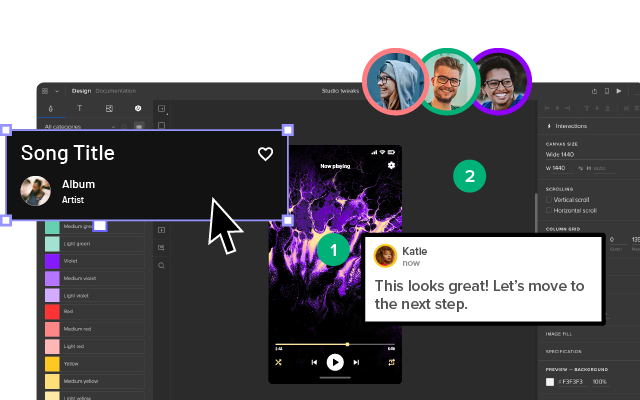
UXPin Merge is particularly well suited for dark mode prototyping because it lets you work with production React components that include built-in theme variants through design tokens. When you switch themes, every component updates correctly — just as it would in production.
For rapid exploration, UXPin Forge can generate dark mode layouts from a text prompt: “a dashboard with a sidebar, data table, and chart — dark theme.” Because Forge uses your actual design system components, the output respects your token-based theming, and you can iterate conversationally — “increase the contrast on the table rows” or “make the sidebar darker.”
The output is exportable as production-ready JSX, so the prototype translates directly into development without a handoff gap. Teams using this workflow report 8.6x faster design-to-prototype cycles.
Dark Mode Implementation Checklist
Use this checklist when adding dark mode to your product:
- ☐ Define a semantic token system with light and dark values
- ☐ Use dark grays (#121212–#1E1E1E) for surfaces, not pure black
- ☐ Use off-white (#E0E0E0) for body text, not pure white
- ☐ Desaturate accent colors by 10–20% for dark backgrounds
- ☐ Replace shadow-based elevation with tonal surface variation
- ☐ Test all contrast ratios against WCAG 2.1 AA minimums
- ☐ Provide dark mode variants for illustrations and icons with opaque backgrounds
- ☐ Respect the user’s system preference (
prefers-color-scheme) - ☐ Offer an in-app toggle for manual override
- ☐ Test every screen and state in both themes before release
- ☐ Document token mappings so the team can extend the system
Ready to prototype your product in both light and dark modes? Try UXPin for free and design with production components that include built-in theming support.
Frequently Asked Questions
What are the main benefits of dark mode?
The 8 main benefits of dark mode are: reduced eye strain in low-light environments, less blue light exposure for better sleep, significant battery savings on OLED screens (30–50%), improved accessibility for light-sensitive users, enhanced visual design opportunities with vivid accent colors, meeting user expectations, reduced visual noise for content-focused interfaces, and better readability for data-dense dashboards in dim environments.
Does dark mode actually save battery?
Yes, but only on OLED and AMOLED screens. On these displays, black pixels are physically turned off, consuming zero power. Testing shows dark mode can extend battery life by 30–50% at typical brightness levels. LCD screens do not benefit because their backlight runs continuously regardless of what’s displayed.
Is dark mode better for your eyes?
Dark mode reduces eye strain in low-light environments by minimizing the contrast between the screen and dark surroundings. It also reduces overall blue light exposure. However, for extended reading in well-lit environments, light mode with dark text on a light background is generally easier on the eyes for most users.
When should I use light mode instead of dark mode?
Light mode works better in bright environments (outdoor or well-lit rooms), for long-form reading, for color-critical work (photo editing, illustration, branding), and for document-centric interfaces (word processors, spreadsheets, email). The best practice is to offer both modes and let users choose based on their context and preference.
How do I implement dark mode correctly?
Use dark grays (#121212 or #1E1E1E) instead of pure black, off-white (#E0E0E0) instead of pure white for text, implement theming through design tokens (semantic color variables), desaturate accent colors by 10–20%, test all components in both themes, and ensure sufficient contrast ratios for accessibility (WCAG 2.1 AA).
How do I prototype a dark mode interface?
Use a design tool that supports theming and component states. UXPin Merge lets you work with production React components that include built-in dark mode variants via design tokens. UXPin Forge can generate dark mode layouts from text prompts using your actual design system, so you can test both themes with real components before development begins.