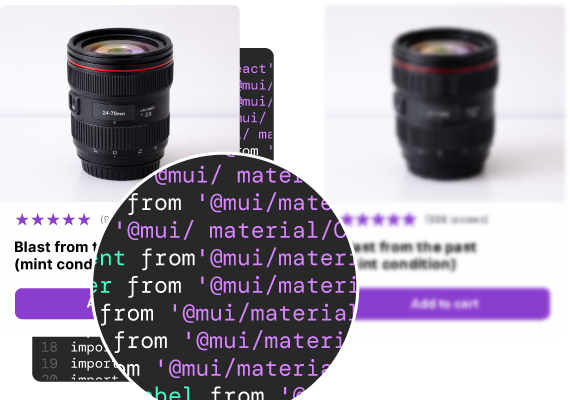
v0 generates UI locked to the shadcn/ui library. UXPin generates with any React library — or your own. Here's what that means for your team.
50%
reduction in engineering time
8.6x
faster prototyping
3
designers supporting 60 products
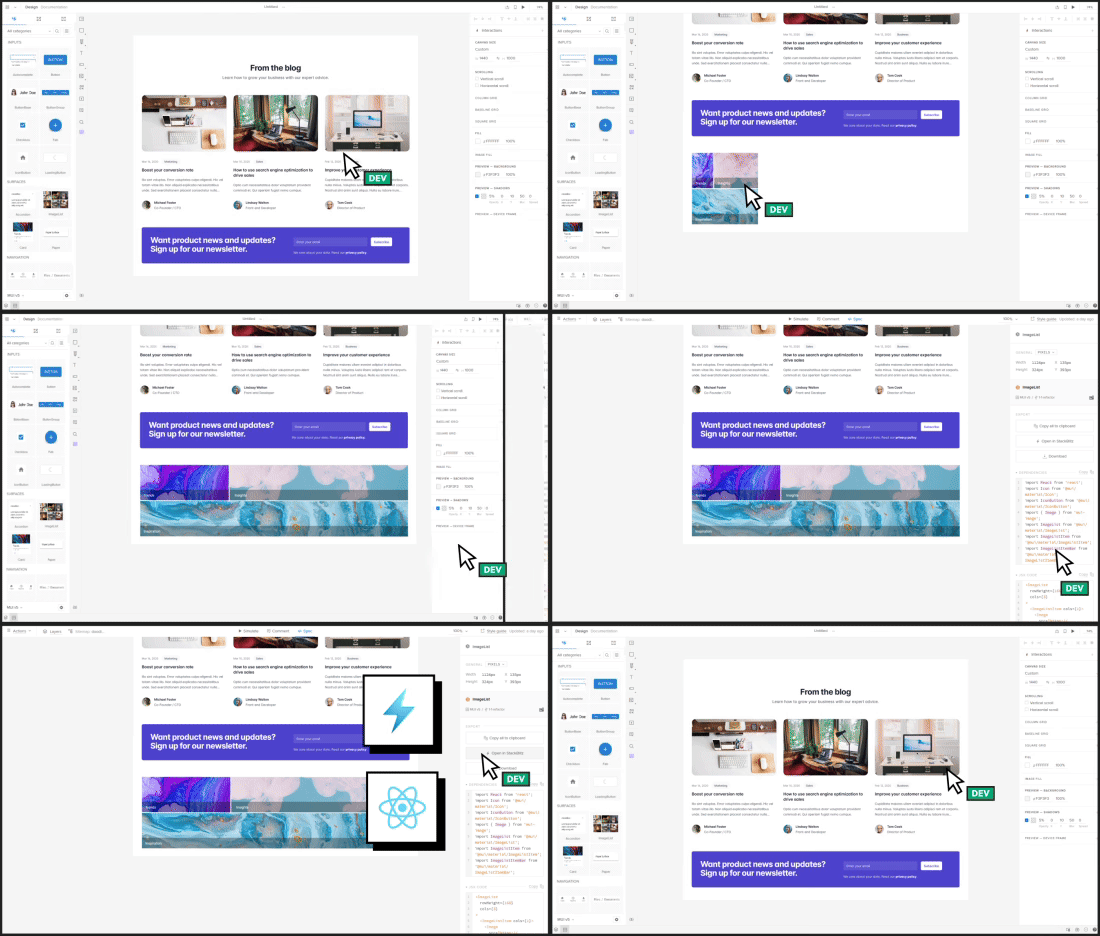
UXPin is a connected system, not a single tool. Your real React component library syncs in through Merge; Forge generates with those exact components using AI; Wire turns the result into a working, shippable product. The three talk to each other — one source of truth, your components, flowing through design, AI generation, and build — and they come together in one environment, not metered or sold as separate add-ons. Most tools in this space do one thing. UXPin connects the whole path from design to working product.
v0 by Vercel is a developer-first UI generator built around shadcn/ui. It generates component code quickly, but within shadcn's conventions. UXPin generates with whatever library you use — MUI, Ant Design, Bootstrap, shadcn, or your own custom library synced via Git.
That's not a feature difference. It's an architecture difference. And it determines whether the AI fits your system or asks your system to fit it.
Every row is a question you're actually asking — not a feature checkbox.
|
|
|
|
|---|---|---|
| Suite or point tool | Connected suite — Merge, Forge & Wire, included together | Point tool — component generator |
| Canvas / surface | Visual canvas rendering real components | Chat + code preview |
| AI generates with | Any React library, or your own via Merge | shadcn/ui only |
| Component libraries | MUI, shadcn, Ant Design, Bootstrap, custom | shadcn/ui |
| Design system input | Your production library via Git or Storybook | shadcn conventions |
| Post-AI refinement | Full design tools on code-backed components | Code editing |
| Developer output | Production JSX referencing your library | React with shadcn imports |
| DS governance | Production components + Design System Guidelines | Limited to shadcn patterns |
| Visual design tools | Full design suite | None |
| Framework lock-in | Library-agnostic | shadcn / Next.js oriented |
| AI models | GPT + Claude, bring your own key | Managed |
| IDEAL USER | Teams on any library shipping production UI | Developers using shadcn/ui |
Suite or point tool
Canvas / surface
AI generates with
Component libraries
Design system input
Post-AI refinement
Developer output
DS governance
Visual design tools
Framework lock-in
AI models
IDEAL USER
Where the architectural difference plays out in practice.
PILLAR 1
AI that uses your real components
v0 generates with shadcn/ui. If shadcn is your library, that's a clean fit. If it isn't — if you use MUI, Ant Design, or a custom system — v0's output is in someone else's conventions, and adapting it to your library is manual work. UXPin's Forge generates with whatever library you've synced. The AI is constrained to your components, so the output is in your system from the first prompt, regardless of which library you use.
PILLAR 2
Professional design tools for the last mile
v0 is a code-generation interface. There's no visual design surface — refinement happens in code. UXPin pairs AI generation with professional design tools on a shared canvas. Designers refine visually; developers work in code; both operate on the same real components.
PILLAR 3
Production code output
UXPin exports production-ready JSX referencing your actual component library. Real imports, real props, working state management. Developers copy it and integrate directly. Nothing to interpret, nothing to rebuild. v0 also exports real code — but always with shadcn imports. The difference is whose components the code references. UXPin references yours.
import Button from '@mui/material/Button';
import Card from '@mui/material/Card';
import TextField from '@mui/material/TextField';
Fair and specific. Both tools have real strengths — here's where each wins.
Choose UXPin if...
You use any library other than shadcn — MUI, Ant Design, Bootstrap, or custom
You want visual design tools alongside AI generation
Design system governance matters
You need production JSX referencing your own library
Choose v0 if...
Your team uses shadcn/ui as its component library
You want fast, developer-oriented component generation
You're working within the Next.js / Vercel ecosystem
Use both if: A shadcn-based team might use v0 for quick component scaffolding and UXPin for full-screen design, governance, and production design work with the broader design system.
When I used UXPin Merge, our engineering time was reduced by around 50%. Imagine how much money that saves across an enterprise-level organization with dozens of designers and hundreds of engineers.
Larry Sawyer
Lead UX Designer
50%
reduction in engineering time
8.6x
faster prototyping
3
designers supporting 60 products
See the difference for yourself
Generate a dashboard in v0. Generate the same dashboard in UXPin Forge with your component library. Compare the output. Compare what developers can do with each.