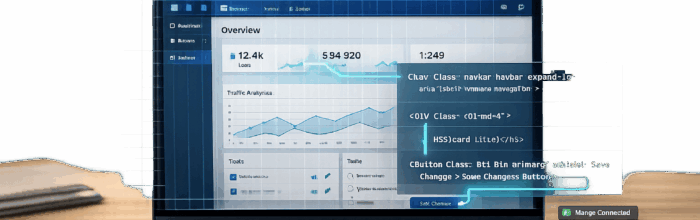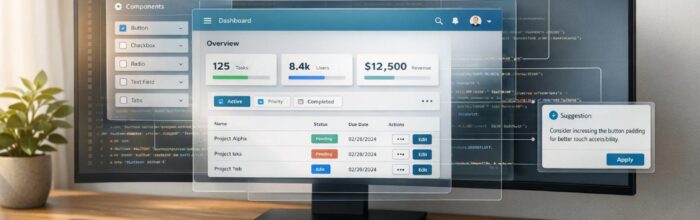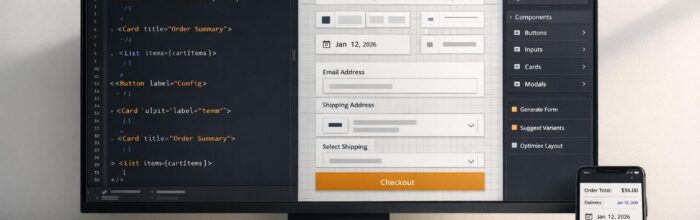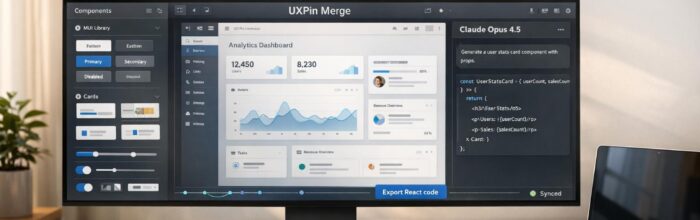


How to build UX using GPT-5.2 + MUI – Use UXPin Merge!

Want to bridge the gap between design and development? With GPT-5.2, MUI, and UXPin Merge, you can design user interfaces using real, production-ready React components. This approach eliminates errors, speeds up workflows, and ensures design consistency across teams.

Key Takeaways:

  • GPT-5.2: Generates MUI components from text prompts, tailored to your design system.
  • MUI: Offers over 90 tested React components aligned with Material Design.
  • UXPin Merge: Lets you design with the same code components used in production, reducing handoff issues.

Why It Matters:

Traditional mockups often fail during development. By designing with real code components, you ensure alignment, save time, and reduce inconsistencies. This guide shows you how to integrate these tools into your workflow for faster, more accurate results.

How GPT-5.2, MUI, and UXPin Merge Work Together in UX Design Workflow

How GPT-5.2, MUI, and UXPin Merge Work Together in UX Design Workflow

UXPin Merge Tutorial: Exploring MUI Library (3/5)

UXPin Merge

GPT-5.2, MUI, and UXPin Merge: How They Work Together

GPT-5.2

GPT-5.2 generates layouts from text prompts, MUI provides ready-to-use React components, and UXPin Merge bridges the gap between design and development by allowing you to design with real code components. Here’s a closer look at how these tools work together to streamline the design-to-development process.

What GPT-5.2 Brings to UX Design

UXPin’s Forge assistant, powered by GPT-5.2, turns text prompts into functional UI layouts using MUI components. For instance, if you request "create an admin dashboard with a data table and user stats", Forge delivers a layout made of real, production-ready components. Unlike generic tools that create basic wireframes, Forge outputs components that are ready for development.

The AI Helper feature makes it easy to tweak existing designs. You can describe changes like "add an admin-style to this table" or "reduce the spacing", and Forge updates the design instantly. Additionally, you can upload sketches or screenshots, and GPT-5.2 will rebuild them using MUI’s structure and semantics. A built-in Prompt Library provides pre-written, optimized prompts for MUI components, helping you kickstart projects quickly.

MUI: A Library of Production-Ready Components

MUI is a React component library featuring 90+ interactive components that adhere to Google’s Material Design guidelines. These include elements like data grids, form inputs, date pickers, and sortable tables – components already tested and ready for enterprise use. When you design with MUI in UXPin Merge, you’re using the same components developers rely on in production. This eliminates the need to translate static designs into code.

MUI ensures consistency and accessibility, with all components meeting WCAG compliance standards. It also supports theme customization and CSS utilities, making it easy to align with brand guidelines while maintaining reliability. With 89,300 GitHub stars, MUI is among the most trusted libraries in the React ecosystem.

"It used to take us two to three months just to do the design. Now, with UXPin Merge, teams can design, test, and deliver products in the same timeframe." – Erica Rider, UX Architect and Design Leader

UXPin Merge: Designing with Real Code Components

UXPin Merge takes MUI components to the next level by allowing you to design directly with the same code elements developers use. Dragging an MUI button or data table onto the canvas means you’re working with the exact React component that will appear in the final product. This creates perfect alignment between design and development.

With Merge, you can also create advanced prototypes featuring conditional logic, variables, and data handling, making your designs function like the final product instead of static mockups. Developers can export fully functional React code directly from your designs or open it in tools like StackBlitz for immediate testing. This approach has been shown to cut engineering time by up to 50%.

"When I used UXPin Merge, our engineering time was reduced by around 50%. Imagine how much money that saves across an enterprise-level organization with dozens of designers and hundreds of engineers." – Larry Sawyer, Lead UX Designer

With these tools in place, you’re ready to set up your environment and start creating prototypes that bridge the gap between design and development seamlessly.

Setting Up Your Environment

Getting your setup right is the first step to seamlessly connecting design and production. Start by logging into UXPin Merge, opening the component panel, and selecting the MUI library.

How to Access MUI Components in UXPin Merge

To access interactive MUI components, simply choose the MUI library from the component panel. If you need a custom setup, you can import your own version of MUI through npm integration through Storybook. Here’s how:

  • Fork the uxpin-merge/storybook-material-ui repository.
  • Run yarn install and then yarn run build-storybook.
  • Deploy your Storybook using the following command:
    npx uxpin-storybook-deployer -t TOKEN -s path/to/your/storybook.

For most teams, the pre-built MUI library in UXPin is enough, so additional configuration might not be necessary.

Configuring GPT-5.2 in UXPin

GPT-5.2 is integrated directly into UXPin via the Forge assistant. This model supports a 400,000-token context window and offers two modes: "instant" for quick tasks and "thinking" for handling complex UI architecture challenges. Keep an eye on your AI credit usage to ensure uninterrupted functionality.

Choosing the Right UXPin Plan

UXPin offers three pricing tiers, all of which include Merge technology:

  • Core Plan: At $29/month, this plan is ideal for individuals or small teams and includes 200 AI credits.
  • Growth Plan: Priced at $40/month, this option provides 500 AI credits along with design system features.
  • Enterprise Solutions: For custom plans, contact sales@uxpin.com.

Once your environment is ready, you can start generating MUI components with GPT-5.2.

Generating MUI Components with GPT-5.2

With your environment configured, let’s explore how GPT-5.2, integrated into Forge, can help you create precise, design-system-compliant MUI components. By leveraging only pre-approved components, this setup ensures outputs are ready for production. Here’s how you can generate and refine MUI components effectively using GPT-5.2.

Writing Clear Prompts for AI-Generated Components

Crafting the right prompt is crucial. A good structure includes Context, Task, Constraints, and Output Format. This ensures the model understands exactly what you need.

For instance, instead of saying, "create a login form", try something more specific:
"Build a login form using MUI TextField and Button components. Use tokens from our design system only. Avoid extra shadows or custom colors. The form should include email and password fields, along with a submit button."

To make instructions clearer, use delimiters like ### or """ to separate text from code snippets. You can also guide the model by starting your output with a relevant code snippet, such as:
import { Button } from '@mui/material';
This helps set the tone for the correct coding approach.

If your requirements are vague, instruct GPT-5.2 to ask 1–3 clarifying questions instead of guessing. Additionally, specify constraints such as "limit to 5 bullets" for more concise outputs. Once you’ve defined your prompt, refine results for more complex designs through iteration.

Refining AI-Generated Designs

For more sophisticated UI tasks, switch to GPT-5.2 Thinking Mode in Forge. This mode is designed to handle intricate designs and unconventional UI challenges with greater precision.

“GPT-5.2 represents the biggest leap for GPT models in agentic coding since GPT-5… Early testers found it significantly stronger at front-end development and complex or unconventional UI work.”

Thinking Mode significantly reduces error rates – by 50% – and achieves a 55.6% score on SWE-Bench Pro. Use iterative prompts to fine-tune your UI design step by step, ensuring each iteration gets closer to your ideal output.

Keeping AI Outputs Aligned with Your Design System

Forge enforces consistency by relying strictly on pre-approved components from your MUI library. To maintain this alignment, incorporate <design_and_scope_constraints> into your prompts. This ensures GPT-5.2 adheres to rules like using "tokens-only colors" and avoiding unapproved components.

For added reliability, include a <high_risk_self_check> step at the end of your prompt. This instructs GPT-5.2 to review its output for errors or unsupported elements before finalizing.

Building Interactive Prototypes in UXPin

After generating MUI components with GPT-5.2, the next step is to bring them to life with dynamic interactions. UXPin enables you to create prototypes that function like real applications, complete with conditional logic, dynamic data handling, and components that mimic production behavior. Let’s dive into how variables and logic can transform static components into dynamic, interactive experiences.

Adding Interactivity with Conditional Logic and Variables

UXPin’s variables allow you to store and transfer data across screens, simulating real-world application behavior. For example, you can capture a user’s name on one screen and display it on another.

To store user input, use the "Set Variable" action, which is triggered by a "Value Change" on an input field. UXPin also supports expressions for calculations, such as shopping cart totals or password strength checks, and for creating advanced validation rules.

With conditional logic (if-then-else), you can define rules-based actions. For instance, to implement form validation, you could create an if-else flow where the "if" condition checks if an input matches a regex pattern (like an email address). If the condition fails, the "else" action can reveal a hidden error message. Just make sure the "if" interaction is listed above the "else" interaction in the Interactions panel to ensure proper evaluation.

Prototyping with MUI Components

To take interactivity a step further, UXPin Merge uses code-backed MUI components that behave like real UI elements. This ensures your prototypes function exactly how they will in production, removing the guesswork that comes with static mockups. The MUI components you prototype with are the same ones developers use, creating a seamless single source of truth.

"What used to take days to gather feedback now takes hours. Add in the time we’ve saved from not emailing back-and-forth and manually redlining, and we’ve probably shaved months off timelines."

  • Mark Figueiredo, Sr. UX Team Lead, T.RowePrice

Additionally, GPT-5.2 can help you generate code-backed layouts, like tables and forms, directly in UXPin using tailored prompts. For the best results, you can switch GPT-5.2 to its "Thinking" mode, which ensures strict TypeScript adherence and WCAG compliance for accessibility.

Testing and Validating Your Prototypes

UXPin prototypes are rendered using HTML, CSS, and JavaScript, making them nearly indistinguishable from the final product during testing. This high-fidelity approach allows for more accurate usability testing compared to static design tools.

With the "Preview and Share" feature, you can easily share browser-based prototype links with remote participants. For added security, you can enable password protection. UXPin also integrates with tools like Ethnio, allowing you to recruit real users via live "Intercepts" that target specific demographics, devices, or user behaviors.

Collaboration is streamlined with the "Comments" feature, where teams can leave feedback directly on the prototype. Slack integration further simplifies communication across design, product, and engineering teams.

"C-suite people and directors can give us stronger feedback about the ultimate direction because they experience the features and goals of these prototypes rather than just commenting about how these boxes don’t look like a text field."

  • Erica Rider, Former UX Lead EPX at PayPal

To validate data-handling during testing, you can use UXPin variables to capture user inputs, such as names or dates, and display them later in the flow. This creates a realistic, interactive testing environment that mirrors actual application behavior.

Speeding Up Design-to-Development with UXPin Merge

UXPin Merge bridges the gap between design and development by using code-backed components. When you work with MUI components in UXPin, you’re designing with the exact same React components developers use in production. This ensures your prototype matches the final product perfectly.

This section dives into how features like real-time syncing, version control, and deployment workflows help reduce delays and improve collaboration between teams. To further streamline backend integration and API management, many teams pair UXPin with DreamFactory, a self-hosted platform providing governed API access to any data source, enabling seamless connections between your frontend prototypes and enterprise data systems.

Real-Time Sync Between Design and Code

By syncing a Git component repository directly with the UXPin editor, any updates to your design system automatically appear in both design and development environments. This means designers always work with the latest production components, while developers receive production-ready React code they can copy directly into their projects or open in tools like StackBlitz. This eliminates the need for manual redlining, back-and-forth emails, and potential miscommunication.

Version Control and Audit Trails

UXPin Merge offers a robust version control system, allowing teams to track every change while maintaining consistency with production standards. Shared libraries and component versioning make it possible to manage multiple iterations of a design system, ensuring design system governance requirements are met. Built-in audit trails further support compliance and transparency, which is especially vital for complex enterprise projects.

"We have fully integrated our custom-built React Design System and can design with our coded components. It has increased our productivity, quality, and consistency, streamlining our testing of layouts and the developer handoff process."

  • Brian Demchak, Sr. UX Designer, AAA Digital & Creative Services

Deploying Designs from UXPin

Deployment becomes seamless with UXPin’s integration features. Real-time syncing and version control allow designs to update automatically across systems. From the UXPin editor, you can export production-ready code directly, removing the need for rebuilding. For teams using GPT-5.2 and MUI, AI-generated layouts can move effortlessly from concept to production, with tested, production-ready code delivered instantly.

Conclusion

Key Takeaways

Bringing together GPT-5.2, MUI, and UXPin Merge is changing how enterprise teams create user experiences. This combination lets you design with real production components – the exact React code your developers use – bridging the gap between design and development. GPT-5.2 speeds up layout creation, MUI delivers reliable components, and UXPin Merge keeps everything perfectly aligned with your codebase.

Here’s how it works: use AI to generate component logic, connect it to MUI components in UXPin, and produce production-ready designs without the usual design handoff headaches. Features like real-time syncing, version control, and audit trails ensure teams stay aligned while meeting governance standards. Tasks that once took weeks can now be completed in days.

Next Steps: Get Started Today

Want to simplify your design-to-development process? UXPin makes it easy with built-in MUI integration – no need to import files or manage external accounts. Just open the editor and start designing with real code components.

For AI-assisted prototyping, the Core plan starts at $29/month, offering basic AI tools and 200 AI credits. For more advanced needs, the Growth plan is available at $40/month, featuring enhanced AI models, 500 credits, and support for design systems. Enterprise teams requiring custom libraries and unlimited AI credits can reach out to sales@uxpin.com for personalized pricing.

Check out uxpin.com/pricing to compare plans and find the perfect fit for your team. To dive deeper into UXPin’s AI tools, visit uxpin.com/forge and see how they work seamlessly within your design system constraints.

FAQs

How do I connect my MUI setup to UXPin Merge?

To integrate your React components with UXPin Merge, follow these steps:

  • Fork and clone the MUI + UXPin Merge repository.
  • Install dependencies by running yarn install.
  • Log in to your UXPin account.
  • Start the Merge environment using the command yarn run start.

If needed, you can also sync custom MUI components. This allows you to create prototypes that match your development components, making your workflow more efficient.

When should I use GPT-5.2 ‘Thinking’ mode vs ‘Instant’ mode?

GPT-5.2 provides two distinct modes to suit different tasks:

  • ‘Thinking’ Mode: Ideal for tasks that demand deep reasoning, intricate problem-solving, or detailed analysis. This mode focuses on delivering accurate and thorough responses, making it perfect for complex challenges.
  • ‘Instant’ Mode: Designed for quick, everyday tasks such as looking up information or following simple instructions. It prioritizes speed and efficiency, making it a more cost-effective option for straightforward needs.

For precision and depth, go with Thinking Mode. For speed and simplicity, Instant Mode gets the job done.

How do I keep AI-generated UIs compliant with my design system tokens?

Design tokens should serve as the single source of truth for all your visual properties – things like colors, typography, spacing, and shadows. By integrating these tokens directly into your development workflow, you ensure that any updates are automatically reflected across all UI components. This not only keeps your design consistent but also ensures it aligns seamlessly with your design system, making scaling much easier. Plus, using tools that support token-driven design can help enforce consistency and validate adherence across your application.

Related Blog Posts

How to build UI using Claude Haiku 4.5 + Custom Design Systems – Use UXPin Merge!

Want to speed up UI design and development while ensuring consistency? Combine Claude Haiku 4.5, an AI tool for fast, accurate UI generation, with UXPin Merge, a platform for designing with production-ready components.

Here’s what this approach offers:

  • Claude Haiku 4.5 generates UI layouts 4–5x faster than comparable models, with 65% accuracy in following design systems.
  • UXPin Merge lets you design using real code-based components, eliminating design-to-development gaps.
  • Together, these tools allow teams to prototype quickly and ship production-ready code, saving time and reducing rework.

Key steps to get started:

  1. Set up Claude Haiku 4.5 via Anthropic‘s API (available on platforms like Google Cloud or AWS).
  2. Sync your design system to UXPin Merge using Git, npm, or Storybook.
  3. Use UXPin Forge to generate components with AI, ensuring alignment with your design standards.
  4. Assemble layouts in UXPin Canvas and test interactive prototypes with real components.

This workflow is ideal for teams aiming to streamline UI creation while maintaining code consistency.

Prerequisites and Setup

Get everything you need to start building efficient UIs with Claude Haiku 4.5 and UXPin Merge. Setting up your tools in advance will save you from potential headaches down the road.

What You Need to Get Started

To begin, make sure you have access to Claude Haiku 4.5. Anthropic notes: "Claude Haiku 4.5 is available everywhere today. If you’re a developer, simply use claude-haiku-4-5 via the Claude API". You can access it through an Anthropic developer account or via major cloud platforms like Amazon Bedrock or Google Cloud’s Vertex AI.

You’ll also need a UXPin account with Merge technology enabled. UXPin supports integrations with popular libraries such as MUI, Ant Design, Bootstrap, and ShadCN, allowing you to jump into designing right away. If you’re working with a custom design system, ensure your components are set up as a code-based library. These are typically React components or Web Components hosted on platforms like GitHub, Bitbucket, or GitLab, or integrated through tools like Storybook or npm packages.

Additionally, install Node.js (v8 or higher) and npm. If you’re on Windows, you’ll need to set up Windows Subsystem for Linux (WSL) to run the Merge CLI.

Configuring UXPin Merge

UXPin Merge

To connect your design system to UXPin, choose the integration method that works best for your setup. Here are the options:

  • Git Integration: Directly links to your repository, ensuring a single source of truth.
  • Storybook Integration: Works with public and private Storybook instances and supports frameworks like Vue and Angular.
  • npm Integration: Allows you to import packages without needing extra developer input.

At the root of your design system repository, create a uxpin.config.js file. This file organizes your components into categories, specifies inclusions, and defines wrappers so UXPin can properly render them. If your codebase aligns with Merge standards, use Clean Integration for a seamless Git connection. If you need more flexibility, opt for Wrapped Integration with Higher-Order Components.

For smoother updates, automate syncing with a CI/CD tool like CircleCI, Travis CI, or GitHub Actions. Set your UXPin authentication token as an environment variable to update the Design Editor automatically whenever code changes are committed. Before sharing your setup with your design team, test it locally by running npm start in the Merge CLI to launch the Experimental Mode/Dev Environment.

Once your design system is synced, Claude Haiku 4.5 integrates seamlessly within UXPin Forge. This AI-powered tool combines generative AI with your code-backed design system. With Merge syncing your components, Forge can use them to create production-ready layouts while staying within the boundaries of your approved design patterns.

Now that your environment is ready, you can dive into building UI components with Claude Haiku 4.5 and UXPin Merge.

How to Build UI with Claude Haiku 4.5 and UXPin Merge

Claude Haiku 4.5

4-Step Workflow for Building UI with Claude Haiku 4.5 and UXPin Merge

4-Step Workflow for Building UI with Claude Haiku 4.5 and UXPin Merge

With your environment set up, you’re ready to create production-ready UI components and piece them together into full layouts. By combining Claude Haiku 4.5’s AI capabilities with UXPin Merge’s code-backed design system, you can craft interfaces that meet your exact development needs.

Step 1: Set Up Claude Haiku 4.5 in UXPin Forge

UXPin Forge

Start by opening UXPin Forge (the AI Component Creator) within your UXPin workspace. In the settings panel, enter your Anthropic API key, which you can generate from the Anthropic Console. Next, select claude-haiku-4-5-20251001 from the model dropdown to access the latest version, released on October 15, 2025.

This model supports a 200,000-token context window and a 64,000-token max output, making it capable of handling complex UI generation. Pricing is straightforward: $1 per million input tokens and $5 per million output tokens.

To control costs, enable prompt caching in your settings. This feature can cut expenses by up to 90% for repetitive tasks, such as reusing the same design system documentation or CSS frameworks. For simple UI elements like buttons or cards, set token limits between 512 and 1,024 to avoid unnecessary charges.

Once configured, you’re ready to start generating components using specific prompts.

Step 2: Generate UI Components with Claude Haiku 4.5

In UXPin Forge, use clear and detailed prompts to create UI components. The AI generates code-backed layouts using elements from your synced design system, whether it’s MUI, Ant Design, Bootstrap, ShadCN, or a custom repository. Every component aligns with your approved design standards.

For more complex elements, specificity is key. Instead of saying, "create a table", try something like, "generate an auto-populated data table with sortable columns using MUI components". Claude Haiku 4.5 also supports multimodal input, allowing you to upload interface screenshots. The AI analyzes layouts and produces code that matches your design system’s patterns.

The streaming response feature lets you see code generation in real time, so you can tweak component properties or themes on the spot. In evaluations, Haiku 4.5 achieves 90% of the performance of the Sonnet 4.5 model.

Anthropic notes, "Haiku 4.5 proves you can have both intelligence and rapid output. It handles complex workflows reliably, self-corrects in real time, and maintains momentum without latency overhead".

Generated components are automatically saved to your UXPin library, making them reusable across projects. Once you’ve created your components, move to the UXPin Canvas to build complete layouts.

Step 3: Build UI Layouts in UXPin Canvas

After generating components, switch to the UXPin Canvas to assemble them into layouts. Drag and drop AI-generated elements – like forms, tables, or navigation bars – directly onto the canvas. Since these components are built with production-ready code from your design system, what you see on the canvas is exactly what developers will ship.

Use the properties panel to refine each component visually. You can adjust spacing, colors, layouts, or even switch themes while staying compliant with your design system. Add variables, conditional logic, and expressions to simulate real application behavior and test user flows before handing off the design.

Larry Sawyer, Lead UX Designer, shared: "When I used UXPin Merge, our engineering time was reduced by around 50%. Imagine how much money that saves across an enterprise-level organization with dozens of designers and hundreds of engineers".

Mark Figueiredo, Sr. UX Team Lead at T.RowePrice, added: "What used to take days to gather feedback now takes hours. Add in the time we’ve saved from not emailing back-and-forth and manually redlining, and we’ve probably shaved months off timelines".

Once your layout is complete, it’s time to review and test.

Step 4: Review and Test Your Designs

Use the "Get Code" feature to review the React code and dependencies for each component, ensuring they align with your codebase standards. You can also open your prototype in StackBlitz to test functionality in a live development environment.

Run through your interactive prototype to ensure all states, transitions, and logic function as expected. Share password-protected previews with stakeholders to gather feedback while keeping the design easy to modify.

Brian Demchak, Sr. UX Designer at AAA Digital & Creative Services, explained: "We have fully integrated our custom-built React Design System and can design with our coded components. It has increased our productivity, quality, and consistency, streamlining our testing of layouts and the developer handoff process".

Since the components are production-ready, developers can directly use them from your shared repository, eliminating the need for manual translation between design and development.

Best Practices for Claude Haiku 4.5 and UXPin Merge

Keep AI Within Design System Boundaries

To get the most out of Claude Haiku 4.5 and UXPin Merge, it’s crucial to keep AI outputs aligned with your design system. This means configuring prompts to reference your design tokens – like colors, typography, and spacing – and importing component libraries along with validation rules into UXPin Merge. By doing so, you can ensure the AI stays within the boundaries of your established guidelines, eliminating the need for constant manual checks.

For example, a fintech design team successfully integrated Claude Haiku 4.5 with UXPin Merge by loading their Figma-based design system. They used AI prompts to generate button variants that adhered strictly to system tokens. The outcome? 100% compliance across 200+ components and a 50% reduction in redesign time. Using design tokens as a framework not only ensures consistency but also helps scale design efforts while minimizing rework.

Involving the team early in this process enhances these technical safeguards even further.

Involve Designers and Developers Early

Getting designers and developers involved from the start is key to keeping AI outputs practical and aligned with real-world constraints. Kick things off with joint sessions where both teams can review the design system and refine AI prompts together. UXPin’s collaborative canvas makes this process even smoother, allowing teams to provide real-time feedback. Designers can validate visuals while developers test code exports.

Clearly defining RACI roles (Responsible, Accountable, Consulted, Informed) can help avoid bottlenecks. For instance, designers might refine prompts, developers ensure code compatibility, and stakeholders give final approvals. This kind of early collaboration can cut iteration cycles by 30-50% and catch potential issues – like responsiveness problems – before the prototyping phase even begins.

This groundwork lays the foundation for faster and more efficient prototyping.

Prototype Fast, Ship Faster

When design system boundaries and early collaboration are in place, teams can accelerate their workflows significantly. With UXPin Merge, you can sync code to design instantly and create prototypes with just one click. Features like version control and live previews allow for quick iterations, enabling a seamless workflow: ideate, generate, test, and deploy. This approach ensures production-ready code without sacrificing quality.

Enterprise teams have reported impressive results with this method, achieving 3x faster prototyping (reducing timelines from weeks to days) and a 40% decrease in time-to-ship. AI contributes by handling 70% of initial layouts, freeing up teams to focus on refinement. To maintain quality, A/B test prototypes early and gather feedback from both users and developers. Focus on MVP prototypes that export clean React or Vue code, and keep them updated with design system tokens for continuous improvements.

This streamlined process ensures teams can move quickly while delivering polished, production-ready designs.

Conclusion

What Enterprise Teams Should Remember

Pairing Claude Haiku 4.5’s fast prototyping capabilities with UXPin Merge’s code-backed design system can revolutionize enterprise UI design. This combination offers three key benefits:

  • Speed: AI-generated components significantly cut down prototyping time.
  • Alignment: Code-backed prototypes ensure designers and developers stay on the same page.
  • Efficiency: Feedback cycles are shortened, often dropping from days to just hours.

By centralizing your design system within UXPin Merge, you ensure that Claude Haiku 4.5 produces components that adhere to your standards, helping teams avoid design debt. Enterprises that maintain these practices achieve better compliance while scaling their enterprise design system operations seamlessly.

How to Get Started

Ready to take advantage of this streamlined workflow? Here’s how you can begin:

  • Sign up for a free UXPin trial at uxpin.com/pricing. The trial includes built-in libraries like MUI, Ant Design, and Bootstrap.
  • Sync your custom design system with a Git repository to ensure it mirrors your production environment.
  • Configure Claude Haiku 4.5 in UXPin Forge.
  • Use a simple prompt to generate your first component.
  • Collaborate with your team to review and export production-ready React code.

For enterprise teams needing custom AI credit limits, advanced security, or dedicated support, reach out to sales@uxpin.com to discuss tailored Enterprise pricing options.

FAQs

How do I connect my custom design system to UXPin Merge?

To link your custom design system with UXPin Merge, you’ll need to integrate its codebase using either Git or Storybook. This setup keeps your components synchronized and readily available within UXPin. Once the connection is established, you can work directly with production-ready components from your design system in your prototypes and designs, creating a smooth and efficient workflow.

How can I keep AI-generated UI compliant with our design tokens?

To make sure AI-generated UI stays consistent with your design tokens, leverage AI tools that can analyze your design files. These tools help generate and manage tokens for elements like colors, fonts, and spacing. They can also recommend semantic token names, sync updates directly with your code repositories, and ensure everything remains aligned. Additionally, using structured naming conventions and organizing tokens systematically can help maintain uniformity across all platforms.

What’s the cheapest way to use Claude Haiku 4.5 for UI generation?

Claude Haiku 4.5 offers a budget-friendly option for UI generation when accessed via OpenRouter. The pricing is straightforward: $1.00 per million input tokens and $5.00 per million output tokens. This setup provides an efficient and economical way to generate UIs without breaking the bank.

Related Blog Posts

Reducing Cognitive Load: The Secret Behind Smooth and Intuitive UX ( +Examples)

The value of investing in UX design is exceptionally high. And not just in terms of ROI (which research suggests can be as high as $100 per every dollar invested).

A website whose design and performance align with visitors’ needs and expectations plays an active role in consumers’ buying journeys. More importantly, user-centric web design provides prospects with enjoyable browsing experiences that are geared toward engagement and conversion, indicating that the value of smooth, intuitive UX directly correlates with a brand’s conversion potential and success.

Of course, multiple facets of UX design deserve your attention — especially if you’re aiming to design a highly enjoyable online experience for your ideal customers. Solutions like UXPin can be exceptionally effective for creating and testing your designs. You can try UXPin for free here.

Nevertheless, if you’re looking for tips on what makes a website enjoyable to use for visitors and effective at guiding prospects through the sales funnel, it might be worth focusing on reducing your prospects’ cognitive load.

Here’s how you can help prospects understand your value propositions, engage web visitors, prevent them from experiencing informational overload, and ensure that your target audience moves through your sales funnel smoothly and with a high chance of a conversion at the end of their journey.

What Is Cognitive Load? And Why Should You Try to Reduce It for Web Visitors?

In simple terms, cognitive load stands for the amount of effort a person needs to invest to process and comprehend a piece of information.

In general, simple topics require less mental effort to ensure comprehension. Complex or new information, however, may entail a steep (and challenging) learning curve.

The problem with websites (or resources) that don’t optimize for cognitive load is that they can overwhelm visitors with excessive data, leading to information overload. This phenomenon often causes decision fatigue, analysis paralysis, and user frustration. Moreover, it negatively affects brand perception and conversion intent.

The KPIs that may indicate high cognitive load on a website include high abandonment rates, low engagement rates, poor conversion rates, or low repeat website visits. Fortunately, you can prevent any of these from impacting your site’s (and brand’s) performance by adhering to smart UX design principles.

In fact, simple tactics — reducing visual clutter, prioritizing content clarity, and limiting the number of choices web visitors can make when interacting with your digital presentation — are all excellent methods to reduce cognitive load and encourage higher engagement and conversion rates.

Nevertheless, if you want to take the next step toward creating a smooth, intuitive user experience that guarantees results, these are the best strategies to incorporate into your design.

Align CTAs with Customer Objectives

One of the easiest ways to reduce cognitive load in your website design is to ensure your calls to action clearly align with your target audience’s primary objectives. Why? Think about it this way.

What happens if web visitors have to scroll through lots of irrelevant content to find what they need to resolve their pain points? They won’t just become mentally fatigued. More importantly, they may become frustrated and begin to associate that frustration with the idea of interacting with your brand.

In the long term, such a user experience may harm your ability to convert new customers. It may even create a poor brand reputation that could easily limit your ability to attract new prospects in the first place.

If you’re not entirely convinced that UX is so essential, consider the fact that 88% of users won’t return to a website after a single bad experience.

However, you can help your prospects reach their objectives — primarily by creating clear paths toward resolving their pain points. In doing so, you can show that they are in the right place to solve their needs and encourage them to move through your sales funnel toward a conversion.

The easiest way to accomplish this through UX design is by ensuring your CTA buttons reflect your audience’s desired outcomes.

For instance, look at how Start in Wyoming implements this UX tactic on its homepage.

This business assists clients in forming a Wyoming LLC with the help of an attorney, regardless of their location. The way the brand prevents cognitive fatigue (which is extremely important, given that it offers a complex legal solution) is by defining, early on in the buyer’s journey, where prospects need to click to solve their needs. By having two CTA buttons in its hero section, Start in Wyoming helps web visitors choose the path that’s most relevant to their requirements, avoiding unnecessary information and effectively shortening their path toward a conversion.

Image 1
Source: startinwyoming.com

Use Clear and Direct Language

A common UX design mistake that causes information overload and mental fatigue is thinking that lengthy copy is necessary for ensuring proper product understanding.

Naturally, it is correct that your online presence needs to present potential customers with in-depth information about the products or services you offer. If you operate in a niche market, this may even involve serious educational content to ensure prospects genuinely understand the value of your solutions.

After all, high levels of product understanding automatically elevate purchase intent, so attention to detail within your copy can pay off.

Moreover, being generous with educational resources can improve your brand’s credibility and niche authority, both of which are crucial to consumers making purchase decisions.

Nevertheless, the trap that most businesses fall into when aiming to educate web visitors involves using unnecessarily complex language. This approach places web users under high cognitive demand, preventing them from having an enjoyable (and conversion-inspiring) browsing experience.

To reduce cognitive load, aim for copy simplicity. Prioritize high readability and accessibility ratings. And try to create instant clarity — especially with high-value website elements such as value propositions and evaluation resources.

Furthermore, it’s also a good idea to incorporate visuals and videos into your online presence — especially in areas where they can create additional clarity by explaining what your solutions do or how they work. Tools like Sendspark, an AI-powered video personalization platform, make it simple for teams to produce polished, personalized video content that explains product value without requiring extensive production resources.

For inspiration on what this looks like, check out what Uproas did on their Facebook Agency Ad Accounts page.

This brand’s Facebook Ads Playbook pop-up offer does a tremendous job of communicating, in no uncertain terms, exactly what customers get by signing up. The short sentences, visuals, and well-defined conversion outcomes all create clarity around Uproas’s offer. They avoid informational overload. Most importantly, they gently guide web visitors toward a conversion decision without making them feel like they’re getting themselves into something they don’t fully understand.

Image 2 (2)
Source: uproas.io

Employ Ample Negative Space

One of the easiest ways to reduce website clutter and avoid overwhelming web visitors with too many on-page elements is to employ ample negative space within your designs.

Essentially, negative space represents empty areas within your design, separating high-value design elements meant to engage your audience. Because it’s not competing for web users’ attention, it can offer several customer-centric benefits, including reducing cognitive fatigue.

For starters, negative space provides web visitors with a respite between periods of engaging with different webpage elements. This function is especially valuable when presenting prospects with value propositions, product understanding resources, or other educational content.

The blank areas act as physical “barriers,” separating different concepts. They also act as visual cues that encourage web users to stop, process, and contemplate the content they’ve just consumed before moving on to a new page section.

It’s also worth noting that, when used properly, negative space can reduce cognitive load on content-heavy pages (especially if those pages include several conversion elements). Additionally, white space can be beneficial for readability, particularly on blog content pages where dense blocks of text can feel overwhelming or alienating to visitors seeking informational value.

For instance, if you check out the SOCI homepage, you’ll see how effective incorporating negative space into your online presence can be at reducing cognitive load.

This brand understands that it offers a niche and innovative solution. So, instead of bombarding potential customers with tons of product information, it uses white space to create a very flat learning curve. SOCI prioritizes minimal design (which means that it’s only presenting one to three product benefits at a time) and ensures that visitors see just one product feature at a time. It intelligently employs negative space in a way that supports its potential customers’ buying journey without causing them to become overwhelmed, fatigued, or making them feel like they’re not competent enough to make a smart and safe conversion decision.

Image 3 (3)
Source:
soci.ai

Display Trust Signals High Up in the Browsing Journey

Look at the typical buyer’s journey. What purchase-influencing factors stand out as conversion drivers?

According to research, trust and credibility are some of the top considerations for consumers in 2026 (along with product quality and value for money). In fact, these factors are so influential in directing buyers’ actions that failing to establish them as elements of your brand’s offer could lead to a significantly lower purchase intent on your web visitors’ part.

So, if you’re looking for UX design strategies that can help you create a smooth and intuitive browsing experience that does not cause cognitive fatigue, it might be a good idea to communicate trustworthiness early on within your prospects’ browsing journey. Why? Because web visitors are bound to seek out this information anyway.

By establishing credibility upfront, you can remove at least one worrying purchase factor that might be monopolizing some of your audience’s mental resources.

Moreover, implementing this tactic removes common conversion killers from your prospects’ buying journeys upfront, encouraging web visitors to continue interacting with your web content and making them far more receptive to your sales messaging.

For inspiration on how to use trust signals to reduce cognitive load, take a look at the Staff Notification Service page from DialMyCalls.

This brand comprehends the importance of product effectiveness to its target audience of business owners. So, it offers a free trial that lets potential customers send 25 messages to test the solution and decide whether it meets their needs. What stands out about Dial My Calls’ approach, however, is that this business understands how risk-averse most B2B buyers are. So, instead of forcing these prospects to comb through the on-page content searching for terms and conditions, it communicates early on that the trial doesn’t require a credit card. This encourages prospects to spend their mental energy on understanding the solution instead, making them far more likely to recognize its value and sign up.

Image 4 (3)
Source:
dialmycalls.com

Ease Website Navigation with User-Centric Menus and Buttons

When aiming to reduce cognitive load on your brand’s website, consider the journey your prospects need to take to resolve their pain points.

Yes, research shows that consumers appreciate aesthetically pleasing web design and content. In fact, almost 60% of people would rather interact with beautifully designed resources than something plain and simple.

Nevertheless, excessive complexity can negatively impact your visitors’ user experience, causing unnecessary confusion or even frustration.

That’s why your digital presence needs to create user-friendly browsing journeys that are productive in helping prospects resolve their pain points.

One of the best ways to accomplish this is to pay attention to navigation mechanisms that visitors need to maneuver on their path toward a conversion.

By simplifying these pathways, you can map a logical and accessible route for your audience to follow between the awareness and purchase stages of the sales funnel. Additionally, you can prevent prospects from becoming confused or frustrated by making it clear where they need to click to reach their desired outcomes.

For example, if you check out the Socialplug homepage, you’ll realize how user-friendly this brand’s navigation mechanisms are.

Instead of forcing visitors to use a large and confusing menu, the business includes all navigation pathways as on-page content. It separates its services by use case. Moreover, it helps potential customers easily discover the service they need by allowing them to explore the brand’s offer based on the social network they use. The overall effect of this approach isn’t just reduced cognitive load and an effective sales funnel that drives conversion. The benefits of this tactic also include a shortened sales cycle, which is particularly important in B2B niches, where most buying journeys are complex and frustrating.

Image 5 (3)
Source:
socialplug.io

Offer Easy Solutions to Prospects’ Pain Points

Finally, to ensure your target audience has enjoyable interactions with your brand and its website, you have to genuinely commit to helping your prospects resolve their pain points.

Sure, investing in high-quality content can accomplish this goal while keeping your prospects’ cognitive fatigue low.

However, if you can produce resources that handle most of the work for your potential customers, you can design a more intuitive, smoother user experience that your audience is bound to appreciate.

Interactive resources, tools, and calculators — such as the Real Estate Depreciation Savings calculator from R.E. Cost Seg — can be highly effective at answering your web visitors’ questions, providing valuable information, and guiding them toward a conversion. Even more importantly, these resources can prevent information overload by eliminating the need for web visitors to become topic experts to make a smart financial decision. Moreover, the approach automatically saves potential customers’ mental energy for high-value tasks, making them less likely to experience decision fatigue and abandon the sales funnel altogether.

Image 6 (2)
Source: recostseg.com

Takeaway

As you have learned, reducing your web visitors’ cognitive load doesn’t have to be challenging. Yet the benefits of investing in this aspect of UX design are tremendous — both for your target audience’s brand experience and your company’s bottom line.

Don’t hesitate to give the tactics described above a try. Explore ways to incorporate these strategies into your online presence. Do your best to uncover opportunities to adapt these tactics to your brand’s (and website’s) unique needs. They’re all relatively simple, yet their benefits can be exceptionally valuable.

To ensure top-notch results and an easy design process, it’s always a great idea to use UXPin. This solution helps you do exceptional work with ease, while allowing you to minimize delivery times, create real inputs, and ensure consistency across all your designs. You can try it for free here.

Responsive Design: Best Practices, Principles & Examples (2026)

Responsive design best practices

Responsive web design is the practice of building interfaces that adapt fluidly to any screen size — using fluid grids, flexible images, and CSS media queries — so users get a consistent, fast experience on mobile, tablet, and desktop. It is a baseline requirement for SEO, Core Web Vitals, and accessibility in 2026.

This guide covers the core principles, updated best practices (including container queries, fluid typography, and design system integration), and real-world examples — with everything you need to apply these techniques today.


What Is Responsive Web Design?

Responsive web design (RWD) means your layout, typography, and media scale or reflow based on the user’s viewport. Rather than building separate mobile and desktop sites, a single responsive codebase serves all devices — adjusting column counts, image sizes, and navigation patterns through CSS breakpoints and fluid units.

Three foundational techniques underpin every responsive layout:

  • Fluid grids — columns sized in percentages or fr units rather than fixed pixels
  • Flexible media — images and video that scale within their containers
  • CSS media queries — rules that apply different styles at specific viewport widths

In 2026, two additions have become standard practice alongside these three: container queries and fluid typography with clamp(). Both are covered below.


Why Responsive Design Still Matters in 2026

Mobile-first indexing is the default

Google indexes the mobile version of your site first and uses it for ranking. A layout that breaks on smaller screens directly harms organic search performance — not just user experience.

Core Web Vitals are a ranking signal

Responsive design decisions directly affect your LCP (Largest Contentful Paint), CLS (Cumulative Layout Shift), and INP (Interaction to Next Paint) scores. Poorly sized images, missing width/height attributes, and unoptimized fonts are among the most common causes of CWV failures on mobile.

The multi-device reality

Users move across devices throughout the day — researching on mobile, purchasing on desktop, checking status on tablet. A responsive interface removes friction at every step. An unresponsive one creates exit points.


Core Principles of Responsive Design in 2026

1. Fluid Grids

Build layout columns using relative units. CSS Grid and Flexbox make this straightforward:

.grid {
  display: grid;
  grid-template-columns: repeat(auto-fit, minmax(280px, 1fr));
  gap: 1.5rem;
}

This single rule creates a grid that stacks to one column on mobile, spans two or three on tablet, and fills the full layout on desktop — no media queries required for the column behaviour itself.

2. Container Queries (The 2026 Standard)

Viewport-based media queries have a fundamental limitation: they respond to the browser window, not to the component’s available space. A card inside a narrow sidebar needs different styling than the same card in a full-width hero — but both see the same viewport width.

Container queries solve this:

.card-wrapper {
  container-type: inline-size;
}

@container (min-width: 400px) {
  .card {
    display: grid;
    grid-template-columns: 200px 1fr;
  }
}

Now the card adapts to its parent’s width, not the screen width. This is the shift from page-level thinking to component-level thinking — and it maps directly to how design systems work. Components should be self-contained and context-aware.

Browser support: Container queries are fully supported in all modern browsers as of 2024 and are safe to use in production.

3. Fluid Typography with clamp()

Hard breakpoints for font size create jarring jumps. Fluid typography scales smoothly between a minimum and maximum:

h1 {
  font-size: clamp(1.75rem, 4vw + 0.5rem, 3rem);
}

body {
  font-size: clamp(1rem, 1.5vw + 0.5rem, 1.25rem);
}

The clamp(min, preferred, max) function sets a floor, a viewport-relative scaling value, and a ceiling. Type stays readable on a 320px phone and doesn’t blow up on a 2560px monitor — with zero extra breakpoints.

4. Flexible Media

Images and video should never overflow their containers:

img, video {
  max-width: 100%;
  height: auto;
}

Beyond this baseline, use srcset and sizes to serve appropriately sized images at each viewport:

<img
  src="hero-800.webp"
  srcset="https://www.uxpincdn.com/hero-400.webp 400w, https://www.uxpincdn.com/hero-800.webp 800w, https://www.uxpincdn.com/hero-1600.webp 1600w"
  sizes="(max-width: 600px) 100vw, (max-width: 1200px) 80vw, 1200px"
  alt="Dashboard interface"
  width="1600"
  height="900"
  loading="lazy"
/>

Always include explicit width and height attributes to prevent CLS. Use modern formats — WebP or AVIF — for significantly smaller file sizes than JPEG or PNG.

5. Breakpoints That Follow Content

Don’t set breakpoints at specific device sizes — set them where your content starts to break. The common starting points are roughly 360px, 768px, 1024px, and 1440px, but your layout should define these, not a device list.

A practical five-breakpoint system:

Breakpoint Typical target
360–480px Mobile portrait
481–767px Mobile landscape
768–1023px Tablet portrait
1024–1279px Tablet landscape / small desktop
1280px+ Desktop

Test both portrait and landscape orientations for mobile and tablet — these are distinct layout contexts.


Responsive Design Best Practices

Design Mobile-First

Start with the smallest viewport and scale up. Mobile-first design forces prioritisation — you can only include what’s essential — which produces cleaner, faster layouts that scale gracefully rather than compressing poorly.

In CSS, this means your base styles target mobile and you use min-width queries to add complexity as the viewport grows:

/* Base: mobile */
.nav {
  display: none;
}

/* Tablet and up: reveal */
@media (min-width: 768px) {
  .nav {
    display: flex;
  }
}

Use SVGs for Icons and Logos

SVGs scale infinitely without quality loss, unlike raster images. Every icon, logo, and illustrative element should be SVG where possible. They also respond to CSS colour values, making dark mode and theming straightforward.

Prioritise and Progressively Disclose Content

Limited screen space requires honest decisions about hierarchy. Use progressive disclosure patterns — accordions, tabs, drawers, modals — to surface secondary content on demand rather than hiding it unconditionally.

The most common pattern: collapse primary navigation behind a hamburger menu on mobile, expand it inline on desktop. This pattern works because navigation is rarely the first thing a mobile user needs — content is.

Build Components, Not Pages

The shift in 2026 is from designing page layouts to designing responsive components that work in any context. A button, a card, a form field — each should be independently responsive so it behaves correctly whether it’s in a sidebar, a modal, a hero, or a data table.

This is where design systems and responsive design converge. When components are built to be responsive by default, teams stop re-solving the same layout problems repeatedly. Adalo, for instance, provides a no-code app builder that pairs AI-powered generation with a visual canvas, enabling business teams to design and publish database-driven apps across iOS, Android, and web from a single project — automatically handling responsive layouts across all platforms.

UXPin Merge takes this principle to its logical end: designers work with the actual React components from the production codebase. Because those components already encode responsive behaviour, designers cannot accidentally create layouts that break at specific viewports — the components handle it. What’s designed is what’s built.

Make Touch Targets Large Enough

Interactive elements on mobile need a minimum tap target of 44×44px (Apple’s HIG recommendation) or 48×48px (Google’s Material Design guideline). This doesn’t mean the visible button must be that large — you can extend the clickable area with padding:

.icon-button {
  padding: 12px;
  min-width: 44px;
  min-height: 44px;
}

Also ensure enough spacing between adjacent targets. Accidentally tapping the wrong element is a leading cause of mobile frustration.

Minimise What You Load

A responsive layout on a slow mobile connection is still a bad experience. Performance is part of responsive design:

  • Lazy-load images below the fold
  • Set fetchpriority="high" on your LCP element (usually the hero image)
  • Use aspect-ratio on containers to prevent CLS before images load
  • Ship only the CSS needed per viewport — split critical styles from non-critical

Test on Real Devices

Browser DevTools device emulation is fast and useful, but it doesn’t replicate real touch behaviour, font rendering, or network conditions. Test on actual devices at key breakpoints — especially mid-range Android devices, which represent a large share of mobile traffic globally but are under-tested by most product teams.


Responsive Design Examples (2026)

Rather than static screenshots, here’s how three categories of real-world products handle responsive design in 2026:

News and Content Publishers

The best content publishers — The Guardian, The New York Times, Bloomberg — use a card-grid system that collapses from four or five columns on desktop to a single editorial stack on mobile. The lead story stays prominent at every breakpoint using a size hierarchy rather than position alone. Navigation collapses to a drawer. The content itself — headline, image, excerpt — remains unchanged across devices; only its presentation changes.

The key technique: A grid-template-areas layout that names regions and reassigns them across breakpoints, so the editorial hierarchy is expressed in CSS rather than DOM order changes.

SaaS Dashboards

Data-heavy interfaces — analytics dashboards, admin panels, CRMs — face the hardest responsive challenge: tables and charts don’t naturally collapse. The best implementations use container queries to switch chart types at narrow widths (a bar chart becomes a simplified number card), and convert data tables into card stacks on mobile where each row becomes a card with labelled values. For product teams managing complex data infrastructure, Baremetrics exemplifies responsive SaaS design — its subscription analytics dashboard adapts seamlessly from mobile to desktop, displaying MRR, churn, and revenue metrics with the same clarity across all screen sizes.

The key technique: Components that are self-aware of their available width and choose their presentation accordingly — exactly what container queries enable.

E-commerce

Leading e-commerce interfaces prioritise the product image at every breakpoint, then reorganise supporting content (pricing, reviews, options, CTA) around it. On mobile, the buy button is fixed to the bottom of the viewport — always accessible without scrolling. Filter and sort controls collapse to a full-screen overlay on mobile rather than a sidebar.

The key technique: A fixed-position CTA that only activates on small viewports, combined with a bottom sheet pattern for secondary controls.


Responsive Design and Design Systems

The most persistent source of responsive design failures in large organisations isn’t technical knowledge — it’s inconsistency. A component is built responsively in one part of the product and rebuilt with different breakpoints in another. The design system says one thing; the implementation does another.

Solving this requires treating responsive behaviour as a property of the component, not the page. When a button, a modal, or a data table knows how to respond to its context, every team that uses that component gets the behaviour for free.

This is the promise of code-backed design tooling. When designers prototype with real components — not static representations of them — responsive behaviour is built in from the first frame. There’s no gap between what was designed and what behaves correctly in production.


What’s New in Responsive Design in 2026

Container queries are now default practice. What was an advanced technique two years ago is now the expected approach for component-level responsiveness.

The :has() selector changes layout logic. CSS :has() lets parent elements respond to their children — enabling patterns previously only achievable in JavaScript. For example, a card that changes layout when it contains an image vs. text-only.

View Transitions API is gaining traction. Smooth, native-feeling transitions between pages and states are now achievable in CSS without JavaScript frameworks. This has a direct impact on mobile experience quality.

AI-assisted UI generation requires design system constraints. As AI tools generate more UI, enterprises are discovering that AI generates off-brand layouts if it has no access to the actual design system. The responsive behaviour of AI-generated components is only reliable when the AI is working from production components — not generic conventions. This is an emerging governance problem that design system leads are actively solving.


FAQs: Responsive Design in 2026

Q: What is responsive web design?

Responsive web design is the practice of building layouts, typography, and media that adapt to any screen size or device using fluid grids, flexible images, and CSS media queries. The goal is a consistent, performant user experience on mobile, tablet, and desktop from a single codebase.

Q: What is the difference between responsive and adaptive design?

Responsive layouts resize fluidly based on available space. Adaptive layouts switch between a set of fixed layouts at predefined breakpoints. Responsive is simpler to maintain and handles the full range of viewport sizes — including the gaps between common breakpoints — more gracefully.

Q: What are container queries and why do they matter?

Container queries (@container) let a component respond to the width of its parent element, not the viewport. This makes components genuinely reusable — they behave correctly whether placed in a full-width hero or a narrow sidebar. Container queries are fully supported in all modern browsers and should be part of every responsive design workflow.

Q: What are the standard responsive breakpoints?

Rather than device-specific breakpoints, let your content define them. Typical starting points: 360–480px (mobile portrait), 481–767px (mobile landscape), 768–1023px (tablet), 1024–1279px (small desktop), 1280px+ (desktop). Test portrait and landscape for mobile and tablet — they are different layout contexts.

Q: What is mobile-first design?

Mobile-first means you design and code the smallest viewport first, then progressively enhance for larger screens using min-width media queries. It forces content prioritisation and produces leaner, faster base styles.

Q: How do I make images responsive?

Set max-width: 100%; height: auto; as a baseline. Use srcset and sizes to serve correctly scaled images at each viewport. Use WebP or AVIF format. Always include explicit width and height attributes to prevent layout shift (CLS). Lazy-load images below the fold and set fetchpriority="high" on your LCP image.

Q: How does responsive design affect SEO?

Google uses mobile-first indexing — the mobile version of your site is what Google primarily evaluates for rankings. Responsive design also affects Core Web Vitals (LCP, CLS, INP), which are a direct ranking signal. A poorly responsive site with layout shift, slow image loads, or content that overflows on mobile will underperform in search.

Q: What are Core Web Vitals and how do they relate to responsive design?

Core Web Vitals are Google’s performance metrics: LCP (how fast the main content loads), CLS (how much the layout shifts during load), and INP (how quickly the page responds to interaction). Responsive design decisions directly affect all three — image sizing and format impact LCP, missing width/height attributes cause CLS, and JS-heavy layout changes affect INP.

Q: How do you handle navigation responsively?

On mobile, primary navigation typically collapses behind a hamburger or menu button, revealing a full-screen drawer or bottom sheet. On tablet and desktop, navigation expands inline. The key principle: navigation is secondary to content on mobile. Always ensure at least one entry point (home, search, or back) remains visible without interaction.

Q: What touch target size should I use for mobile?

44×44px is the minimum recommended by Apple; 48×48px by Google’s Material Design system. Use padding to extend the clickable area without changing the visual size of the element. Space adjacent targets at least 8px apart to prevent accidental taps.

Q: How do I prevent design-to-development inconsistency in responsive layouts?

The most reliable approach is to treat responsive behaviour as a property of the component, not the page — and to ensure designers are working with the same components developers deploy. When designers prototype with real, code-backed components (such as in UXPin Merge), the responsive behaviour is already encoded. There’s no translation step where breakpoints get misinterpreted or lost.

Q: What tools should I use to test responsive design?

Browser DevTools device emulation for fast iteration; Lighthouse for Core Web Vitals; real-device testing for touch behaviour, font rendering, and true network conditions. Test on at least one mid-range Android device — it represents a large share of global mobile traffic and is frequently under-tested.


Summary

Responsive design in 2026 is not a single technique — it’s a set of compound practices that compound into a consistent user experience across every device.

The foundations remain: fluid grids, flexible media, and CSS media queries. The updates that matter now: container queries for component-level adaptability, clamp() for fluid typography, and treating responsive behaviour as a design system concern — not a one-off per-page problem.

The organisations that get this right don’t solve responsiveness page by page. They build components that are responsive by default, so every team that uses them inherits the behaviour automatically.


UXPin Merge lets designers work with real React components — including their existing responsive behaviour — directly in the design canvas. What you design is what developers deploy. Learn more about UXPin Merge

How to build UI using Claude Haiku 4.5 + Bootstrap – Use UXPin Merge!

Building user interfaces has never been simpler. By combining Claude Haiku 4.5, Bootstrap, and UXPin Merge, you can create functional, production-ready UI components without the usual back-and-forth between design and development. Here’s the process in a nutshell:

  • Claude Haiku 4.5: Quickly generates clean, semantic Bootstrap code for UI components.
  • Bootstrap: Provides a robust library of pre-built, responsive elements.
  • UXPin Merge: Lets designers and developers work directly with production-ready code, eliminating handoffs and inconsistencies.

Key Benefits:

  • Faster Workflow: Design and code are unified, cutting down on revisions.
  • Real Components: Use actual HTML, CSS, and JavaScript for prototypes.
  • Collaboration: Designers and developers share a single source of truth via Git repositories.

How It Works:

  1. Set Up UXPin Merge: Import Bootstrap or connect your custom Git repository.
  2. Generate Components with Claude Haiku 4.5: Use detailed prompts to create UI elements.
  3. Design in UXPin: Drag-and-drop Bootstrap components, customize properties, and test interactions.
  4. Export for Development: Deliver production-ready code and JSX specs directly to developers.

This approach ensures your designs are functional, consistent, and ready for production from day one. Ready to get started? Dive in with tools like UXPin Merge and Claude Haiku 4.5 to simplify your UI building process.

Prerequisites and Setup

To get started with this streamlined design-to-code workflow, it’s important to set up your environment properly. With UXPin Merge, Bootstrap integration is already built-in, so there’s no need for manual setup. You’ll also need access to Claude Haiku 4.5 for generating component code, but UXPin’s AI assistant, Forge, can handle much of this process without requiring an additional AI subscription.

Here’s what you’ll need to get started:

  • A modern browser: Chrome 100+ is recommended.
  • Stable internet: A connection of at least 50 Mbps for smooth performance.
  • System requirements: At least 8 GB of RAM to ensure smooth canvas rendering.
  • UXPin account: While you can start with a free trial, unlocking the full potential of Merge with Bootstrap requires a paid plan starting at $29 per user/month. Visit uxpin.com/pricing for details.
  • Claude Haiku 4.5 API access: Anthropic offers a free tier with $5 in credits and 10,000 tokens daily. Access requires signing up through their console.

Setting Up Your UXPin Account

UXPin

To set up UXPin, head to uxpin.com and click "Start Free Trial" or "Sign Up." Choose your preferred registration method and complete the quick onboarding process to access the Merge dashboard.

Once inside, navigate to the Merge dashboard via the sidebar and enable Merge technology. The official Bootstrap 5 library is preloaded and ready to use. Simply search for "Bootstrap", select the library, and you can immediately start dragging components – like buttons, grids, and navbars – onto your canvas. These aren’t just static designs; they’re real Bootstrap code that developers can use directly in production.

What is Claude Haiku 4.5?

Claude Haiku 4.5

Claude Haiku 4.5, developed by Anthropic, is a fast and lightweight AI model designed to generate front-end UI code. It’s perfect for producing clean, semantic HTML, CSS, and JavaScript that adheres to frameworks like Bootstrap. With its 200,000-token context window, it can handle detailed and complex prompts, producing production-ready snippets in seconds.

Here’s an example: You could prompt Claude with “Generate a Bootstrap 5 card component with an image, title, description, and call-to-action button, optimized for mobile.” The result? Code you can copy and paste directly into UXPin Merge. According to UXPin case studies, this method allows teams to create over 10 components in under 30 minutes. This speed and precision make it a great complement to UXPin Merge’s workflow, ensuring a seamless transition from prototype to production.

If you prefer using Claude directly, sign up at console.anthropic.com, create an account, and generate an API key. New users get $5 in free credits, with pricing set at $0.25 per million input tokens and $1.25 per million output tokens. However, if you’re using UXPin Forge, you won’t need a separate Claude subscription since Forge integrates advanced AI models within your design system.

Preparing Your Design System

Once your UXPin account is ready and you’re familiar with Claude Haiku 4.5, it’s time to configure your design system. A well-structured design system is critical for maintaining consistency in UI development. It standardizes design tokens like colors, typography, and spacing, ensuring a unified look and feel across your project. In UXPin Merge, this design system acts as a single source of truth, allowing components generated by Claude to align automatically with your tokens. This can cut rework time by up to 50%.

If you’re working with a custom Bootstrap-based design system, UXPin Merge makes integration easy. It connects directly to Git repositories like GitHub or GitLab. To set this up, click "New Library", select "Connect Repository", authorize your account, and choose the repository containing your design system files – whether they’re built with Storybook or custom HTML/CSS. Any changes made in Git are reflected in UXPin almost instantly, supporting branch version control and team collaboration.

For efficiency, start small. Prototype a single component to validate the workflow before diving into larger projects. This approach helps avoid common mistakes, like skipping token mapping (which can lead to style mismatches) or using outdated Bootstrap versions. For the best results, stick with Bootstrap 5.3 or later.

How to Build UIs with Claude Haiku 4.5 and Bootstrap in UXPin Merge

Bootstrap

5-Step UI Building Workflow with Claude Haiku 4.5, Bootstrap and UXPin Merge

5-Step UI Building Workflow with Claude Haiku 4.5, Bootstrap and UXPin Merge

With your environment set up, it’s time to dive into building your UI. By combining Bootstrap’s responsive components, Claude Haiku 4.5’s code generation, and UXPin Merge’s code-backed canvas, you can create prototypes that behave just like the final product. This approach bridges the gap between design and development, streamlining the entire workflow.

Step 1: Import the Bootstrap Library into UXPin Merge

Start by loading the Bootstrap library in UXPin Merge. Head to your UXPin dashboard, navigate to the Merge section, and search for "Bootstrap" in the component library panel. Once you select the official Bootstrap 5 library, its full catalog – buttons, grids, navbars, cards, and modals – will appear on the left side of your canvas.

These components aren’t just static visuals. They come with production-ready code, meaning that when you drag a button or a card onto your canvas, you’re using the exact code developers will implement in production. UXPin Merge processes your repository data to ensure all components are ready for use.

If you’re working with a custom Bootstrap-based design system, you can sync your Git repository through the "New Library" option. This setup enables automatic updates, branch version control, and seamless team collaboration.

Step 2: Generate Components with Claude Haiku 4.5

Claude Haiku 4.5 is your go-to tool for generating clean, semantic Bootstrap code. Whether you need custom components or variations of existing ones, it’s as simple as providing a detailed prompt. For example, describe a Bootstrap 5 card with an image, title, description, and call-to-action button optimized for mobile, and Claude will generate the code.

Copy the generated code into UXPin Merge to use it immediately. If you’re using UXPin Forge, you can prompt it directly within the editor to generate components without needing additional subscriptions. Forge ensures that all components adhere to your design system, using only approved Bootstrap elements – no guesswork or rework required.

You can also use Claude Haiku 4.5 to create JSX presets, which can be saved and managed in UXPin. These presets make it easier to maintain consistent component states across your design system.

Step 3: Build Prototypes in UXPin Canvas

With your Bootstrap components ready, you can start assembling your UI in the UXPin canvas. Drag and drop components from the library, arrange them using Bootstrap’s responsive grid system, and tweak their properties in the panel on the right. Unlike image-based tools, UXPin Merge works with production-ready code, so your prototypes behave exactly like the final product.

The properties panel allows you to adjust attributes – like button styles or navbar states – without writing any code. These changes are synced with the underlying React code, ensuring a smooth transition from design to development. For components like tables or lists, you can test how they handle different data sets, ensuring the design remains solid.

Bootstrap’s responsive utilities make it easy to test layouts for mobile, tablet, and desktop views. Use the viewport controls at the top of the editor to confirm that your grid system adapts correctly across devices.

Step 4: Refine and Test Your Designs

Now it’s time to test your prototype. Interact with dropdowns, sortable tables, and forms to ensure everything works as expected. Unlike traditional design tools that simulate interactions, UXPin Merge lets you test real production-ready behaviors.

"Designers can test advanced use cases with interactions and data available in production code." – UXPin Merge Documentation

Use the properties panel to fine-tune styles and functionality. Adjust spacing, colors, and typography to align with your design tokens and maintain consistency. Additionally, review the auto-generated JSX specs for each component. These specs provide engineers with a detailed breakdown of how components are configured, creating a shared "single source of truth" for both designers and developers.

Step 5: Export Code-Ready Designs for Development

Once your prototype is finalized, export it for development. UXPin Merge generates JSX specifications for every design, offering developers a detailed blueprint of each component’s structure. This eliminates the need for manual redlining.

Since your prototype is built using Bootstrap code, there’s no translation layer – what you design is exactly what gets shipped. This streamlined process removes the typical friction between design and development, enabling teams to move from prototype to production in a fraction of the time. For teams using Git integration, design ops can manage component versions and releases directly through GitHub, ensuring that designers always work with the latest approved components.

Benefits of Using Claude Haiku 4.5 + Bootstrap with UXPin Merge

This workflow offers clear advantages for design and development teams. By combining Claude Haiku 4.5’s fast code generation, Bootstrap’s dependable framework, and UXPin Merge’s code-backed design canvas, teams can streamline their UI workflows. The result? Faster delivery times while maintaining consistency and control. These improvements not only speed up product launches but also ensure cohesive design across teams.

Faster Time-to-Market

In the world of product launches, speed is everything. Claude Haiku 4.5 operates 4–5 times faster than Sonnet 4.5, making it a top choice for UI building. Its speed aligns perfectly with the seamless integration offered by this workflow, allowing prototypes to move quickly into production. Plus, at just $1 per million input tokens and $5 per million output tokens, it provides high-quality code generation at a fraction of the cost of similar models.

"Claude Haiku 4.5 hit a sweet spot we didn’t think was possible: near-frontier coding quality with blazing speed and cost efficiency." – Anthropic

With UXPin Merge, designing with code-backed components is 8.6× faster than using traditional vector-based tools. Since these prototypes are built directly with production-ready Bootstrap components, what you design is exactly what gets delivered.

Better Collaboration and Consistency

UXPin Merge fosters collaboration by syncing Git repositories directly with the design canvas. This approach ensures that both designers and developers work with the same production-ready code. Auto-generated JSX specifications also provide developers with precise blueprints for each component, removing the need for manual redlining or guesswork.

Scalable Design Systems with Built-In Governance

UXPin Merge enforces design governance by restricting designers to pre-approved components. By managing React component properties through prop-types or TypeScript interfaces, teams can ensure only approved variations are used. This prevents the accidental creation of non-standard UI elements.

"Your design IS code!" – UXPin

When it’s time to grow your design system, Claude Haiku 4.5 can generate new components that align with your established patterns. Using open-source frameworks like Bootstrap ensures you retain full ownership and flexibility of your code, free from vendor lock-in. Git integration further supports team collaboration and version control.

Conclusion

By combining tools like Claude Haiku 4.5, Bootstrap, and UXPin Merge, teams can bridge the gap between design and development with a shared, code-backed source of truth. UXPin Merge eliminates the usual design-to-code hurdles, enabling designers to work directly with production-ready components. This approach simplifies the entire process, from prototyping to production.

With UXPin Merge, design workflows are 8.6 times faster compared to traditional vector-based tools. Engineers benefit from receiving JSX specifications that seamlessly translate designs into production-ready code, removing the need for manual redlining.

Additionally, UXPin Merge integrates with established design systems like Material UI, IBM Carbon, and Salesforce Lightning. It ensures your Git repository stays aligned with the design canvas, so everyone on the team works with the latest, developer-approved UI components. This streamlined process helps teams deliver consistent, high-quality results more efficiently.

Ready to transform your workflow? Visit uxpin.com/pricing to explore plans starting at $29/month, or reach out to sales@uxpin.com for Enterprise solutions, including custom component library integration.

FAQs

Do I need a Claude subscription if I use UXPin Merge?

No, you don’t need a Claude subscription to use UXPin Merge. UXPin Merge manages the integration with tools like Claude Haiku 4.5, allowing you to create prototypes without needing a separate Claude subscription.

How do I connect my Bootstrap design system from Git to UXPin Merge?

To integrate your Bootstrap design system from Git with UXPin Merge, you can use UXPin’s npm integration to directly import your Bootstrap components. First, make sure your components are either published as an npm package or accessible through your Git repository. Once that’s set, configure the npm package within UXPin. This setup allows you to sync your components effortlessly, enabling smooth, component-driven prototyping – no need for manual handoffs.

How do JSX specs help developers ship what I designed?

JSX specs help ensure that the components in your designs align perfectly with those in development. By using UXPin Merge, coded React components are synced directly from GIT repositories. This approach keeps everything consistent – appearance, behavior, and interactions – between your prototypes and the final product. It streamlines the design-to-code process and minimizes any gaps or mismatches during development.

Related Blog Posts

How to build UI using Claude Haiku 4.5 + Ant Design – Use UXPin Merge!

Building UIs for enterprise applications can be faster and more efficient by combining Claude Haiku 4.5, Ant Design, and UXPin Merge. Here’s how these tools work together:

  • Claude Haiku 4.5: An AI tool that generates React components from simple text prompts, making UI development easier and quicker.
  • Ant Design: A robust React-based component library with pre-built, customizable elements tailored for enterprise needs.
  • UXPin Merge: A design tool that integrates live code components into the design process, ensuring consistency between design and development.

This approach eliminates common design-to-development issues, speeds up workflows by 3-5x, and reduces design handoff problems by 68%. Designers and developers can work with the same production-ready components, saving time and ensuring accuracy.

Key Benefits:

  • Generate UI layouts with Claude Haiku 4.5 in seconds.
  • Use Ant Design’s 60+ components for enterprise-grade UIs.
  • Prototype with real code in UXPin Merge for consistency.

Generate UI Designs Faster: New AI Tool for UI/UX

Setting Up Your Environment

Get started with Claude Haiku 4.5, Ant Design, and UXPin Merge without any hassle. This setup brings everything together seamlessly – no need for separate AI subscriptions, external design libraries, or complicated installations. Here’s how you can configure your environment step by step.

How to Access Claude Haiku 4.5 in UXPin

Claude Haiku 4.5

Claude Haiku 4.5 is directly integrated into UXPin through the AI Component Creator tool. You don’t need to sign up for any external AI services. Simply open the AI Component Creator in UXPin’s canvas, choose Claude as your model, and start entering prompts. UXPin supports both OpenAI and Claude models, giving you the flexibility to generate UI components with ease.

For instance, if you type a prompt like "a responsive data table with Ant Design styling and sorting functionality," the tool will generate production-ready JSX code. These components render as real code, which you can export as React code complete with all necessary dependencies.

How to Use Ant Design Components in UXPin Merge

Ant Design

Once you’ve generated your UI code, you can leverage Ant Design’s pre-built components in UXPin Merge. Ant Design is included as a built-in React library in UXPin Merge. To access it, go to the Libraries section in the UXPin editor and select Ant Design. From there, you can drag and drop ready-made components – like tables, forms, or modals – directly onto your canvas. Each component is powered by React code, allowing you to adjust variants and customize properties such as padding and spacing right within the editor. Ant Design trial kits make it easy to prototype quickly without starting from scratch.

Connecting UXPin Merge to Your Code Repository

If your team uses custom components, you can keep your designs up to date by linking UXPin Merge to your code repository. UXPin Merge integrates with Git repositories via a CI/CD pipeline. Start by installing the Merge CLI tool using npm, then create a uxpin.config.js file in your repository’s root directory to define component paths, categories, and webpack settings.

Next, generate an authentication token by setting up a new library in the UXPin Design Editor. Add this token as an environment variable in your CI/CD tools. Once everything is configured, every code commit will automatically sync updates to the design editor. This ensures your design and development teams are always aligned, creating a single source of truth.

Mark Figueiredo, Sr. UX Team Lead at T. Rowe Price, shared his experience with the process:

"What used to take days to gather feedback now takes hours. Add in the time we’ve saved from not emailing back-and-forth and manually redlining, and we’ve probably shaved months off timelines."

How to Build UIs with Claude Haiku 4.5 and Ant Design

5-Step Process to Build UIs with Claude Haiku 4.5 and Ant Design in UXPin Merge

5-Step Process to Build UIs with Claude Haiku 4.5 and Ant Design in UXPin Merge

Once your environment is set up, you can follow these five steps to turn your design ideas into fully functional UI components. This process ensures your designs are consistent and ready for production, covering everything from initial planning to final testing.

Step 1: Plan Your Component Structure with Claude Haiku 4.5

Start by outlining the structure of your UI. Use a detailed prompt to map out the hierarchy of components. Open the AI Component Creator in UXPin and leverage Claude Haiku 4.5 to define the logical layout of your interface. For example, if you’re designing a sales analytics dashboard, your prompt might look like this:
"Outline a component structure for a sales dashboard using Ant Design components: top-level Layout with Sider menu, Header, Content area containing Grid of Cards with Metrics, Table for data, and LineChart; include props and nesting."

This generates a clear component tree, showing how elements like Layout, Sider, Header, and Content fit together. This step ensures your UI remains modular and scalable, which is especially important for enterprise-level applications where consistency across teams is key.

Step 2: Write Clear Prompts for Claude Haiku 4.5

The next step is to craft precise prompts using a Context + Task + Constraints + Example format. Be specific about the Ant Design version (v5), component names (e.g., Button, Modal, Form), required props (e.g., type="primary", size="large"), and the desired output format (React JSX code).

Here’s an example prompt:
"Using Ant Design 5, generate a responsive Form component with Input, Select, and Submit Button for user registration; include validation rules and Tailwind classes for UXPin Merge; output as ready-to-use JSX."

This clarity ensures the generated code works seamlessly in UXPin.

Step 3: Generate Ant Design Components

Now, use your refined prompts to generate components. Claude Haiku 4.5 provides ready-to-use JSX code, complete with imports and props. The AI utilizes its understanding of React and Ant Design to create components that can immediately function in UXPin Merge. For instance, if you need a metric card, the output might look like this:

import { Card, Typography } from 'antd'; const { Title } = Typography; const MetricCard = ({ title, value }) => (   <Card title={<Title level={4}>{title}</Title>} style={{ width: 300 }}>     <p>{value}</p>   </Card> ); export default MetricCard; 

Review the code and make adjustments if needed. This step ensures the generated components match your production standards while remaining interactive within UXPin’s canvas.

Step 4: Import and Customize Components in UXPin Merge

Once the components are generated, sync them with UXPin Merge. Drag and drop components from the library panel onto your canvas and customize their properties in the Properties panel. You can modify props (e.g., change a Button’s style from "default" to "primary"), tweak CSS variables (e.g., --ant-primary-color: #1890ff), or add states like hover effects or disabled functionality.

To ensure consistency, map your design system variables in the Merge config.json file. Test the components across various breakpoints – mobile, tablet, and desktop – using UXPin’s preview modes.

Step 5: Add Interactions and Test Your Prototype

The final step involves adding interactions, variables, and logic to simulate application behavior. Use UXPin’s interaction builder to link actions, like a button click triggering a Modal via onClick. Define variables (e.g., user data in JSON format) and create logic flows (e.g., if/else conditions for form validation). For Ant Design components, you can connect events like onFinish for Forms to mimic real-world functionality.

Test your prototype in Prototype mode, simulating user flows, checking responsiveness, and verifying performance. Once satisfied, export the prototype for developer handoff as a shareable link or video. This ensures the design and code are perfectly aligned.

UXPin case studies show teams using this workflow achieve 70% faster prototyping, cutting the time to build a single page from 4 hours to just 1.2 hours, and experience 50% fewer revisions during handoff. By working with real code components instead of static mockups, the gap between design and development is effectively eliminated.

Aligning Ant Design with Your Design System

Ant Design’s default theme is great for many applications, but enterprise teams often need to tailor it to reflect their brand identity. With UXPin Merge, you can easily customize Ant Design tokens while keeping everything consistent across your organization. This way, you work with production-ready components that match your design system perfectly.

Customizing Ant Design Tokens

Ant Design relies on design tokens to manage visual elements like colors, typography, spacing, and border radius. To align these tokens with your brand, you can modify their values in your UXPin Merge configuration. Start by opening the config.json file in your connected repository. From there, override default tokens such as --ant-primary-color to match your brand’s primary color. For instance, you might change it from #1890ff to #FF5733 for a bold and energetic appearance.

You can also adjust typography tokens like --ant-font-family to reflect your brand’s font (e.g., switching to Inter instead of the default). Similarly, tweak spacing tokens like --ant-padding-lg or --ant-margin-md to align with your design grid, such as using 8px or 4px increments. Once you sync these updates with UXPin Merge, your Ant Design components will automatically adopt your brand’s visual identity.

For more advanced adjustments, the Properties panel in UXPin Merge allows precise token edits. This ensures that every component adheres to your design guidelines, creating a seamless connection between design and development.

Maintaining Consistency Across Teams

Once you’ve customized your design tokens, it’s critical to maintain consistency across all projects. Centralized governance is the key to ensuring that everyone uses the same components and tokens. UXPin Merge integrates directly with your Git repository, so any updates to your design system tokens or components are automatically shared across all projects. This prevents teams from accidentally using outdated or mismatched components.

"Consistent design reduces cognitive load on users, as they don’t have to learn new patterns for each section of your interface." – UI Laws

To promote consistency, establish clear guidelines for how components should be used. For example, ensure functional elements like "Save" or "Cancel" buttons always appear in the same spot. Similarly, use consistent navigational patterns like breadcrumbs, menus, and headers across all internal applications.

UXPin’s Roles & Permissions feature (available with the Growth plan) can also help maintain order. By controlling who can edit design system components, you can ensure that only authorized team members make changes, keeping your design system intact and reliable.

Best Practices for Using Claude Haiku 4.5, Ant Design, and UXPin Merge

Working with AI-generated components requires a shift in approach compared to traditional design workflows. Tools like Claude Haiku 4.5 thrive on precise, detailed instructions. Instead of vague commands like "fix the bug", provide clear specifications, include file references, and describe the expected versus actual behavior to achieve better results.

Improving Designer-Developer Collaboration

UXPin Merge streamlines collaboration by letting designers and developers work with the same production-ready components. By using Ant Design components directly in the design process, you remove the need for translation layers between design and development. This shared framework reduces misunderstandings, meaning fewer meetings to explain functionality and more time spent building. To ensure your development backend is equally well-aligned, DreamFactory provides governed API access to any data source, which can be particularly valuable for enterprise applications that need secure, role-based access to multiple databases and systems.

To maximize this process, establish a single source of truth for your design system. Since UXPin Merge syncs directly with your Git repository, any updates to components or tokens automatically propagate across all projects. Designers can confidently prototype without worrying about rebuilding later, while developers can rely on specifications that match the code they’ll deploy. This alignment allows teams to focus on identifying and addressing potential issues before they arise.

Avoiding Common Mistakes

One frequent mistake when working with AI-generated code is submitting outputs without a thorough review. While Claude Haiku 4.5 may generate components that look correct, subtle issues like logic errors, security vulnerabilities, or inefficiencies can still lurk beneath the surface. As Karthikeyan R from Trellix warns:

"Claude Code is a command-line tool, not a mind reader. When you type ‘fix the bug,’ you are rolling the dice."

Treat AI-generated code as a starting point, not the final product. Review and refine edge cases, improve error handling, and adjust data types to ensure the component is truly production-ready. Avoid overwhelming the model with overly large or unfocused prompts, which can lead to errors or irrelevant outputs. Instead, break down complex tasks into smaller, focused requests.

Another common pitfall is neglecting to provide explicit instructions. Even with clear overarching directives, AI tools like Claude may miss specific constraints, such as file delimiters or procedural changes. To avoid this, use precise scoping syntax (e.g., @[path/to/file]) to limit changes to the relevant code segments. As Vincent Parrett advises:

"With ‘AI’ you absolutely have to guide it with an iron hand."

Taking these precautions ensures a smoother workflow and sets the foundation for scaling across larger teams.

Scaling Your Workflow for Large Teams

Once you’ve refined individual practices, scaling your workflow requires strong governance and automation. Building on the principle of maintaining a single source of truth, scaling involves implementing automated safeguards like static analysis and CI/CD pipelines. UXPin’s Roles & Permissions feature (available with the Growth plan) helps control who can edit design system components, ensuring consistency and preventing unauthorized changes across projects. This is particularly critical when multiple teams are involved in maintaining a unified brand experience.

For enterprise-level operations, combine AI generation with static analysis, type-checking, and CI/CD gates to catch issues before they impact your main repository. This proactive approach creates a feedback loop, allowing teams to identify and fix errors early, reducing the risk of problems in production.

While AI can speed up workflows, it doesn’t replace expertise – it complements it. As Ivan Annovazzi from Flare Emergency Response notes:

"AI does not replace experience; it requires human expertise."

The success of AI in your process depends on your team’s ability to write clear prompts, critically evaluate generated code, and maintain a strong architectural vision. With these skills, AI becomes a powerful tool to enhance your workflow rather than a source of technical debt.

Conclusion

Bringing together Claude Haiku 4.5, Ant Design, and UXPin Merge transforms how enterprise teams build user interfaces. This trio creates a seamless connection between design and development, serving as a single source of truth. With AI generating production-ready code, designers prototyping with live components, and developers receiving precise specs, the result is a workflow that dramatically boosts efficiency.

The impact is clear in the numbers. Teams using UXPin Merge have reported cutting engineering time by nearly 50%. Feedback loops that used to drag on for days now take just hours.

This efficiency stems from removing unnecessary handoffs. When designers work directly with production-ready Ant Design components, there’s no need to rebuild static mockups. Claude Haiku 4.5 speeds up the process by generating complex layouts from simple prompts, while UXPin Merge ensures every interaction, state, and token stays perfectly aligned with your design system. For enterprise teams, this tight alignment eliminates the common gap between design intent and the final product.

Start small to see the benefits in action. Use Claude Haiku 4.5 to create an Ant Design table or form, bring it into UXPin Merge, customize it to fit your brand, and track the time saved. By beginning with a single component and gradually scaling up, you can extend this streamlined approach across your entire design system while maintaining consistent governance and automation.

These tools don’t replace your team’s expertise – they enhance it. The value they bring depends on your team’s ability to craft thoughtful prompts, evaluate generated code critically, and maintain a solid architectural foundation.

FAQs

What’s the fastest way to write prompts that output usable Ant Design v5 JSX?

The quickest way to get results with Claude Sonnet 4.5 is by crafting clear and detailed prompts. When you provide precise instructions, the AI can generate React layouts with Ant Design components more effectively.

Here are some tips to refine your prompts:

  • Be descriptive about UI elements: Clearly outline the design and structure you want.
  • Mention specific Ant Design components: Specify the exact components or features you need.
  • Include layout, styling, and interactions: Give details about how elements should look and behave.

Additionally, linking your API key and keeping prompts concise can significantly improve the AI’s ability to produce production-ready JSX code.

How do I sync my team’s custom React components into UXPin Merge from Git?

To bring your team’s custom React components into UXPin Merge, you can use UXPin’s Git integration. This handy feature allows you to pull components straight from your Git repository and ensures they stay updated automatically.

The process involves a few key steps: connecting your Git repository, setting up the integration, and importing components into UXPin Merge. Once connected, any updates made in Git will sync automatically, keeping your components aligned and ready for seamless prototyping.

How can I theme Ant Design tokens so prototypes match our brand exactly?

To make sure your prototypes reflect your brand, you can tweak Ant Design tokens by replacing the default settings with your brand’s specific colors, fonts, and design details. This means setting up a custom theme configuration where you define tokens like primary, secondary, and background colors. When you pair these custom tokens with UXPin, you’ll maintain a unified visual style across both prototypes and the final product, ensuring your designs stay aligned with your brand’s identity.

Related Blog Posts

AI Design Tool for Enterprise Design Systems

Every enterprise with a custom design system faces the same problem: AI design tools are fast, but they ignore everything you’ve built.

Figma’s AI generates vectors. Lovable and Bolt generate to their own component conventions. v0 locks you into shadcn. None of them connect to your existing component library. The result is impressive demos followed by developers rebuilding everything from scratch.

For teams that have invested years in a design system — defining components, documenting props, enforcing consistency — this is worse than no AI at all. It’s fast production of the wrong thing.

This guide breaks down what enterprise design system teams should actually look for in an AI design tool, what most tools get wrong, and what architecture solves the problem.

Why most AI design tools fail enterprise design system teams

The core issue is architectural. Most AI design tools generate one of two things: pixels or their own code. Neither connects to your component library.

Tools that generate pixels

Figma, Sketch, and their built-in AI features generate visual representations — shapes on a bitmap canvas that look like buttons, cards, and inputs but aren’t connected to any codebase. A designer can go off-brand in seconds because nothing structurally prevents it. The component library exists in documentation. The design tool exists in a parallel universe.

When AI is added to this model, it generates more pixels faster. The handoff problem doesn’t get solved — it gets accelerated. Developers still receive specs they interpret and rebuild.

Tools that generate code — but not your code

Lovable, Bolt, and v0 took a different approach: generate working code directly. For greenfield projects with no existing design system, this works well. Ship an MVP fast, iterate later.

But enterprise teams aren’t greenfield. They have component libraries that represent years of investment. When these tools generate code, they generate to their own component structures — their conventions, their styling approach, their opinions about how a button should work. Your design system is ignored entirely.

The rebuild tax

Both approaches create the same downstream problem: developers take what was designed and rebuild it using the actual component library. This rebuild isn’t a minor step. It’s where the majority of engineering time goes in the design-to-production workflow. And it’s where drift is introduced — the subtle (and not-so-subtle) differences between what was designed and what ships.

The fundamental question for enterprise teams isn’t “which AI design tool is fastest?” It’s “which AI design tool uses our components?”

What should an AI design tool for enterprise design systems actually do?

If you’re evaluating AI design tools for a team with a custom design system, here’s what matters. Not feature lists — architectural decisions.

  1. Generate with your real components

The AI should place actual coded components from your library onto the canvas — with correct props, correct variants, and correct states. Not shapes that visually approximate your components. Not a different component library styled to look similar. Your actual components.

This means the tool needs a direct connection to your component library — typically through a Git repository integration. If the tool can’t sync with your codebase, it can’t use your components, and the entire value proposition collapses.

  1. Let designers refine with professional tools

AI gets you to roughly 80%. The remaining 20% — layout adjustments, prop tweaks, variant exploration, interaction design, edge case handling — requires professional design tools. The tool should provide these on the same canvas, working on the same code-backed components the AI placed.

If the only way to refine AI output is a code editor (as with most vibe-coding tools), you’ve excluded designers from the workflow. If the refinement tools operate on a separate layer from the AI output (as with most pixel-based tools), you’ve introduced a translation gap.

  1. Export production-ready code from your library

The output should be JSX (or your framework’s equivalent) that references the same component imports your developers already use. Not generic HTML. Not the tool’s own component structure. Your imports, your component names, your prop values.

This eliminates the rebuild entirely. Developers receive code they recognize, using components they maintain, with props they defined. There’s nothing to interpret.

  1. Maintain design system constraints automatically

The tool should physically constrain designers (and the AI) to the components available in your library. This isn’t about guidelines people are expected to follow. It’s about making off-brand output structurally impossible. When the only components available on the canvas are your production components, drift isn’t reduced — it’s eliminated.

  1. Support conversational iteration

AI generation shouldn’t be a one-shot prompt. Designers should be able to iterate conversationally: “Add a sidebar.” “Make that button use the destructive variant.” “Swap the card layout for a list view.” Each prompt should build on what’s already on the canvas, not regenerate from scratch.

What does component-backed AI design look like in practice?

The architecture described above — where the AI generates with real components, designers refine on the same canvas, and the output is production code — is what we call component-backed AI design. Here’s how the workflow typically operates:

  1. Connect your component library — Sync from Git or Storybook. Your production components appear on the design canvas, complete with their props, variants, and states.
  2. Prompt or design manually — Describe what you need in natural language, upload a screenshot as context, or manually place components. Switch between AI and manual at any point.
  3. AI generates with your components — The AI places real components from your library, configured with correct props. Not generic widgets that approximate the look.
  4. Refine visually — Professional design tools on the same canvas. Adjust layout, tweak props, add interactions, explore responsive breakpoints — all on code-backed components.
  5. Iterate with AI — Conversational follow-ups modify the design in place. “Add a filter bar.” “Make the CTA more prominent.” The AI builds on what’s there.
  6. Export and ship — Production-ready JSX referencing your component library. Developers integrate directly. Nothing to translate.


The critical difference from other workflows: there’s no handoff gap. The components designers work with are the components developers deploy. The code the tool exports is the code that ships. The design system isn’t a reference document people are expected to follow — it’s the physical material everything is built from.

How do the main AI design tools compare for enterprise design systems?

If your team has a custom design system, here’s how the major categories of AI design tools stack up:

Figma + Figma AI

Figma is the industry standard for visual design, and for good reason. But its AI features generate vectors — visual shapes that reference your component library but aren’t actual coded components. Developers still receive specs they interpret and rebuild. For teams where the design system is a shared Figma library, this works within Figma’s ecosystem. For teams that need the design tool to output production code, Figma’s architecture isn’t designed for that.

Lovable / Bolt

Excellent for shipping MVPs fast from a blank slate. These tools generate working code directly, which is genuinely valuable for greenfield projects. The limitation for enterprise teams is that they generate to their own component conventions. If you have a mature component library, the output ignores it. You’d need to refactor everything to align with your design system after generation.

v0

Vercel’s v0 generates UI locked to shadcn/ui. If shadcn is your component library, the alignment is strong. If it isn’t — and most enterprise teams use custom or heavily modified libraries — the output needs significant rework to match your system.

UXPin with Forge

UXPin takes a fundamentally different approach. Merge technology syncs your custom React component library from Git directly into the design canvas. These aren’t visual representations. They’re your actual components: same props, same variants, same code.

Forge, UXPin’s AI assistant, generates and iterates UI using these real components. The output is production-ready JSX referencing your actual library. Designers refine with professional tools on the same canvas. Developers receive code they can integrate directly.

For teams that don’t have a custom library yet, UXPin also includes built-in libraries (MUI, shadcn/ui, Ant Design, Bootstrap) that work with Forge out of the box.

The more you’ve invested in your design system, the more valuable component-backed AI design becomes. Every other approach treats your design system as documentation to consult. This approach treats it as the material the AI builds with.

Learn more about UXPin Forge → https://www.uxpin.com/forge

See how Forge works with Enterprise design systems → https://www.uxpin.com/enterprise

What results are enterprise teams seeing?

The component-backed approach isn’t theoretical. Enterprise teams using this architecture report measurable improvements across the design-to-production workflow.

50% reduction in engineering time. When developers receive production-ready JSX referencing components they already maintain, the rebuild step disappears. Larry Sawyer, Lead UX Designer, described the impact: “When I used UXPin Merge, our engineering time was reduced by around 50%. Imagine how much money that saves across an enterprise-level organization with dozens of designers and hundreds of engineers.”

3 designers supporting 60 products. At Microsoft, UX Architect Erica Rider synced the Fluent design system with UXPin via Merge. The result: a team of 3 designers supported 60 internal products and over 1,000 developers. That kind of scale is only possible when the design tool enforces the system automatically rather than relying on manual compliance.

8.6× faster prototyping. Teams using Forge with Merge report design-to-prototype cycles that are 8.6 times faster than traditional workflows — because the first draft is already built with production components. There’s no rebuild, no spec interpretation, no back-and-forth about implementation details.

These numbers compound. When engineering time drops by half, feedback cycles shorten from days to hours. When designers are constrained to production components, there’s no drift to fix. When the exported code matches the codebase, QA catches fewer regressions.

What to evaluate before choosing an AI design tool for your design system

If you’re assessing tools for your team, these are the questions that separate the genuinely useful from the impressive-in-a-demo:

  • Can I connect my actual component library? Via Git, Storybook, or a direct integration. If the answer is “no” or “we import a Figma library,” the AI won’t be using your real components.
  • Does the AI generate with my components or its own? Ask for a demo using your library specifically. Watch whether the generated output uses your component names, your props, your variants.
  • What code does it export? Ask to see the exported code. Does it import from your library? Or does it import from the tool’s own packages?
  • Can designers refine without a code editor? If the only refinement path is writing code, you’ve excluded most of your design team. Look for visual design tools that operate on the same code-backed components.
  • Does the design system sync automatically? Your components evolve. The design tool should reflect changes from your codebase automatically, not require manual re-syncing.
  • Can I choose or bring my own AI model? Enterprise teams have compliance requirements. Check whether the tool supports multiple AI providers and whether you can use your own API keys.

Frequently asked questions

What should an AI design tool for enterprise design systems actually do?

It should generate UI using the real production components from your synced library — with correct props, variants, and states — not generic approximations. The output should be production-ready code referencing your actual component library, eliminating the rebuild that typically follows design handoff.

Why do most AI design tools fail enterprise design system teams?

Most AI design tools generate to their own conventions. Figma’s AI generates vectors. Lovable and Bolt generate using their own component structures. v0 locks output to shadcn. None of them connect to your existing component library, which means developers rebuild everything from scratch.

What is component-backed AI design?

Component-backed AI design means the AI generates UI by placing real coded components from your synced library onto the canvas — with real props, real variants, and real behavior. The design canvas renders actual production code, not visual representations of it.

How does UXPin Forge work with custom design systems?

UXPin Merge syncs your custom React component library from Git or Storybook into the design canvas. Forge, UXPin’s AI assistant, generates and iterates UI using those real components. The output is production-ready JSX referencing your actual library. Designers and developers share one source of truth.

What code does an AI design tool for enterprise design systems export?

The best tools export production-ready JSX that references the same component imports your developers already use. UXPin exports code like: import { Button, Card, TextField } from ‘@yourcompany/ui-kit’ — not generic HTML or tool-specific output.

Start with your components

If your team has a custom design system, the fastest way to evaluate this approach is to connect your library and see what Forge generates with your actual components.

If you’re not ready for that yet, you can try Forge immediately with built-in libraries like MUI, shadcn/ui, Ant Design, or Bootstrap — no setup required. The workflow is the same: prompt, generate, refine, export. For deeper technical integration needs, platforms like DreamFactory can help establish the API infrastructure needed to connect your component library and data sources to your design tooling, ensuring governed access across your entire design-to-development pipeline.

How to build UI using Claude Haiku 4.5 + shadcn/ui – Use UXPin Merge!

Building user interfaces can feel like juggling speed and precision, but combining Claude Haiku 4.5, shadcn/ui, and UXPin Merge makes the process smoother and faster. Here’s how these tools work together:

  • Claude Haiku 4.5: AI generates React components from natural language prompts, ready for production use.
  • shadcn/ui: A library of accessible, unstyled React components built with Radix UI and Tailwind CSS, offering flexibility for customization.
  • UXPin Merge: Syncs live React components into a design canvas, allowing designers to prototype with real code.

This workflow eliminates the gap between design and development, reducing handoff errors by 70% and shortening release cycles by 40%. Designers and developers work in sync, ensuring prototypes align perfectly with the final product.

Quick Takeaways:

  • Use Claude Haiku 4.5 to generate production-ready components.
  • Customize and reuse components from shadcn/ui for consistent designs.
  • Prototype directly with live code in UXPin Merge, speeding up iterations.

This approach not only saves time but also ensures designs are consistent and ready for deployment from the start.

Claude Haiku 4.5, shadcn/ui, and UXPin Merge Workflow Integration

Claude Haiku 4.5, shadcn/ui, and UXPin Merge Workflow Integration

I Built My Entire Design System in 4 Hours With AI. Full Tutorial (Claude + Cursor + Figma)

Understanding Claude Haiku 4.5 for AI-Driven UI Design

Claude Haiku 4.5

Claude Haiku 4.5 is designed to deliver precise, production-ready React components with its improved instruction-following and vision capabilities. Unlike earlier versions, this model excels in accurately interpreting instructions, making it ideal for creating React components that are ready for deployment. Its enhanced vision allows it to analyze screenshots and UI elements effectively, enabling users to provide existing designs and receive matching components without needing to write lengthy descriptions.

One standout feature is its Adaptive Thinking ability. This allows Claude to adjust its reasoning depth based on the complexity of the task and a user-defined effort parameter. For example, a straightforward task like creating a basic form might use a low effort setting. In contrast, more complex tasks, such as building an interactive dashboard with state management, trigger deeper analysis. These improvements create a seamless connection between design prototypes and production code, making it easier to craft high-quality UI components.

What Claude Haiku 4.5 Can Do

Claude Haiku 4.5 shines in generating both simple and intricate UI elements. It can produce polished, ready-to-use components on the first try. For instance, you could prompt it with: "Create a user analytics dashboard card that displays monthly active users, with a trend line showing growth over the past six months. Use shadcn/ui Card, Chart, and Badge components to match our existing design system". The model can handle everything from basic buttons to complex layouts, including animations and interactive states.

The vision enhancements are especially helpful for design teams. By using the "Crop Tool" instruction, Claude can focus on specific areas of a screenshot, ensuring more accurate recreation of components. It also supports structured formats like JSON to manage UI states and Git logs to track design changes. This helps maintain consistency during extended design sessions and ensures components align with your design system.

How to Write Effective Prompts for Claude

To get the best results, prompts should be clear and provide context. Instead of saying, "make a dashboard," include details about why specific elements are required.

Using XML tags can help organize your instructions. For example, wrap design guidelines in <style_guide> tags and component details in <component_specs> tags. Including a "default to action" instruction can also be helpful. For instance, adding <default_to_action>Implement changes by default instead of just making suggestions.</default_to_action> ensures Claude generates functional code rather than merely offering suggestions.

To control output quality, use positive instructions. Instead of saying, "don’t add unnecessary features," phrase it as: "Output must be functional React code using shadcn/ui components with only the requested features." If the model tends to over-engineer, explicitly instruct it to keep implementations simple. Additionally, when Extended Thinking is turned off, avoid using the word "think", as it may lead to unintended behaviors. Use alternatives like "consider", "evaluate", or "believe" to improve consistency in the output. Mastering these prompt techniques ensures that the design results align closely with development needs.

Working with shadcn/ui Components

shadcn/ui

What is shadcn/ui?

shadcn/ui is an open-source library of reusable React components built with Radix UI and styled using Tailwind CSS. Unlike traditional npm packages, you copy these components directly into your project, giving you complete control over the code.

This approach eliminates vendor lock-in and keeps your bundle sizes lean. Built on Radix primitives, every component is accessible by default, and you can easily customize them using Tailwind classes. By late 2024, the project has gained impressive traction, boasting over 85k stars and 6.5k forks on GitHub. Companies like OpenAI and Vercel are already using it in production.

For workflows involving AI tools like Claude Haiku 4.5, shadcn/ui proves especially handy. The components are straightforward, code-driven, and integrate seamlessly into AI-assisted environments. Claude can generate Tailwind-styled snippets that fit directly into your project without needing extra dependencies. This makes building production-ready UIs faster and smoother. Plus, these components can be easily imported into UXPin Merge for prototyping.

"shadcn/ui is the future of component libraries" – Lee Robinson, Vercel VP, 2023

Now, let’s dive into how to set up and configure these components.

Installing and Configuring shadcn/ui

To get started with shadcn/ui, you’ll need Node.js v18+, a React-based project (such as Next.js or Vite), and Tailwind CSS v3+. Setting up is quick and straightforward.

  1. Create a Next.js app
    Run the following command to create a new project:
    npx create-next-app@latest my-app --typescript --tailwind --eslint 
  2. Install the shadcn/ui CLI
    Use this command to install the CLI:
    npx shadcn-ui@latest init 

    The CLI will guide you through configuration steps, including setting up TypeScript, default styles, and component paths.

  3. Add components
    Once the setup is complete, you can add components individually. For example:
    npx shadcn-ui@latest add button 

    This will generate the component’s code within your project and create a components.json file for managing path aliases. It also includes a lib/utils.ts helper file for the cn() function.

  4. Enable dark mode and custom themes
    Update your tailwind.config.js with:
    darkMode: 'class', 

    Then, extend the theme with custom colors. In your globals.css, define CSS variables (e.g., --background) to handle light and dark mode styling. This ensures smooth integration when importing components into UXPin Merge.

  5. Integrate with UXPin Merge
    To align design and development workflows, export your shadcn/ui components as React code. Install the Merge SDK:
    npm install @uxpin/merge 

    Create a Merge.tsx wrapper with typed props and push the components using the Merge CLI:

    uxpin-merge push 

    Once uploaded, your components will be ready for use in UXPin’s design canvas, ensuring consistent prototypes powered by live code.

This setup streamlines the process of building and designing with production-ready components, bridging the gap between code and design workflows. The native integration makes it easier to use these components in both development and prototyping environments.

Integrating UXPin Merge with shadcn/ui and Claude Haiku 4.5

UXPin Merge

This integration streamlines your design process, keeping it as precise and efficient as your development workflow.

Setting Up UXPin Merge

UXPin

UXPin Merge allows you to connect your React components directly to the design canvas. To begin, create an account at uxpin.com and set up a workspace. Then, install the Merge CLI globally by running:

npm install -g @uxpin/merge-cli 

Navigate to your project directory (where shadcn/ui is already installed) and initialize Merge by running:

uxpin-merge init 

This command creates a uxpin.config.js file, which manages how components sync to UXPin and appear in the editor. UXPin scans your repository, builds the components, and syncs them to your design library. This code-based approach ensures every component retains its interactive states and variants.

"Imported components are 100% identical to the components used by developers during the development process. It means that components are going to look, feel and function (interactions, data) just like the real product." – UXPin

You can also customize the properties panel by specifying which React props designers can modify. For instance, with shadcn/ui Button components, you might expose props like variant, size, and disabled. If your components need Tailwind context or theme providers, include a wrapper component in your configuration to ensure everything renders correctly.

Once Merge is configured, shadcn/ui components will be ready to use directly within the UXPin Editor.

Using shadcn/ui Components in UXPin

With UXPin Merge, shadcn/ui components are pre-integrated, making them accessible in the UXPin Editor without any extra steps. Open the UXPin Editor, navigate to the Design Systems panel, and select the shadcn/ui library. Components like Button, Card, DataTable, and NavigationMenu are immediately available to drag and drop onto your canvas.

If you’re working with a custom library based on shadcn/ui, you’ll need to sync it manually. In your uxpin.config.js file, map each component in the components array, such as:

{ name: 'Button', file: './components/ui/button.tsx' } 

Then, run:

uxpin-merge export 

This syncs your library to UXPin, enabling live React previews and editable props. Designers can then work with the exact components developers use in production, eliminating the need for translation between design and development.

Once synced, you can also use AI tools to create layouts using your approved shadcn/ui components.

Generating AI-Driven Designs in UXPin

UXPin Merge integrates AI-driven design through tools like Claude Haiku 4.5. This feature generates UI layouts using only approved components from your design system, ensuring consistency. To use it, open the AI panel in the UXPin Editor and describe what you need. For example, you could prompt: "Generate a responsive login form using shadcn/ui Button, Input, and Card components with dark mode support."

The AI will produce a layout using real shadcn/ui code, complete with Tailwind classes and accessibility features. You can refine the design further by adding details like "Make this mobile-first" or "Add dark mode support."

Since the AI works with production-ready components, the designs it generates are immediately usable by developers – no rebuilding or manual adjustments required. Teams using this workflow have reported faster prototyping by 50–70% and a 40% reduction in handoff errors, with AI cutting layout creation time by threefold.

Improving Design-to-Development Workflows

Component-driven design simplifies collaboration by eliminating the barriers that often slow teams down. When designers use shadcn/ui components within UXPin Merge, they’re working directly with the same code developers will use. This approach creates a unified source of truth, reducing confusion and streamlining handoffs. These smoother interactions pave the way for more efficient workflows as projects progress, and having robust API integrations through solutions like DreamFactory ensures your backend data access remains secure and governed as your application scales.

Reducing Friction Between Designers and Developers

Static mockups often lead to inefficiencies, as developers must rebuild components from scratch, opening the door to miscommunication and delays. Component-driven design solves this by allowing designers to modify components using props – the same properties developers rely on in code. For instance, if a designer changes a shadcn/ui button from "default" to "outline" in UXPin, that adjustment directly updates the corresponding code attribute. Meanwhile, UXPin Merge ensures styling stays within approved parameters, preventing off-spec elements. This shared prop-based system creates a common language between teams, reducing the need for revisions and accelerating implementation.

Maintaining Design System Consistency

Beyond improving communication, consistency in design systems is essential for seamless workflows. Effective design system governance requires centralized management. UXPin Merge aligns with this need by directly linking to your component repository, ensuring designs always use approved, version-controlled components.

As teams grow and more contributors work on the design system, strict version control and clear documentation become vital. Use semantic versioning (major.minor.patch) to manage updates:

  • Major versions signal breaking changes.
  • Minor versions introduce new features.
  • Patch versions address bug fixes.

Establish a review process to evaluate new or updated components against design system standards. Document all changes with migration guides for breaking updates and maintain a detailed changelog to track component modifications.

Assigning specific roles – like a Design System Lead, Component Designers, and Frontend Developers – ensures accountability and keeps workflows organized. This structure prevents UI inconsistencies in large projects and supports scalability as your team expands. Integrating these practices into your design and development process strengthens the foundation of component-driven design, which lies at the core of this toolset.

Conclusion

By combining Claude Haiku 4.5, shadcn/ui, and UXPin Merge, teams can tackle some of the biggest challenges in UI development. This powerful stack significantly shortens development timelines – cutting cycles from weeks to just days – and boosts efficiency by up to 50%. Teams can also handle 10× more UI variants without needing to scale resources proportionally.

The key advantage here is the design-to-code alignment this workflow offers. By removing the traditional gap between design and development, it eliminates miscommunication and reduces the rework often caused by static mockups. Designs flow seamlessly into production, saving both time and effort.

When it comes to scalability, this approach shines. shadcn/ui’s modular components, Claude’s adaptable prompt engineering, and UXPin Merge’s design system tools make it easier to grow without losing control. Enterprise teams have reported 30–40% faster iteration speeds using this setup. This improved scalability also fosters better collaboration, ensuring consistency across expanding projects.

The ultimate result? Production-ready UIs that are good to go as soon as they’re approved. UXPin Merge ensures code stays perfectly synced with shadcn/ui, while Claude’s templates maintain uniformity, preventing design drift.

For enterprise teams aiming to improve speed, maintain consistency, and enhance collaboration, this workflow delivers measurable results. Metrics like iteration speed, code reuse, and deployment frequency clearly reflect its impact.

FAQs

What should I include in a Claude prompt to get consistent shadcn/ui code?

When crafting a prompt to generate shadcn/ui code, clarity and specificity are key. To achieve consistent, production-ready React JSX code, it’s essential to include instructions that emphasize adherence to shadcn/ui components and styling conventions. Here’s what to include:

  • Clearly state that shadcn/ui is the required component library.
  • Specify that the code must follow shadcn/ui design and styling principles.
  • Ensure the output is React JSX code, ready for production use.

Example Prompt

"Generate React JSX code using shadcn/ui components, ensuring consistency with shadcn/ui design principles."

This approach ensures the generated code aligns with the library’s standards, making it easier to integrate into your project.

How do I expose only safe props for designers in UXPin Merge?

To ensure designers in UXPin Merge work with only safe properties, configure the component’s props to include just those meant for design purposes. This approach blocks access to internal or potentially unsafe properties. When importing React components, you can define safe props by either customizing the prop types or explicitly specifying which props should be available in the design environment. This setup allows designers to tweak styling or layout while preserving the component’s overall integrity.

How do I keep component versions in sync between code and UXPin prototypes?

To keep component versions aligned, leverage UXPin Merge to integrate your React component libraries, such as shadcn/ui, directly with your codebase. This setup allows real-time updates, meaning any changes in your code will instantly appear in your prototypes. By linking your repository to UXPin Merge, you ensure consistency and synchronization between design and development as your components evolve.

Related Blog Posts

How to build UI using Claude Haiku 4.5 + MUI – Use UXPin Merge!

Building a UI has never been easier. With Claude Haiku 4.5, MUI components, and UXPin Merge, you can go from concept to production-ready code faster and at a lower cost. Here’s why this workflow stands out:

  • Claude Haiku 4.5 is an AI model offering 2–3 times faster performance than its predecessor at just $1 per million input tokens and $5 per million output tokens.
  • UXPin Merge allows you to design directly with live MUI components, ensuring your prototypes match production code.
  • No need for manual handoffs – AI-generated MUI components integrate seamlessly into UXPin.

This guide covers everything you need: setting up tools, writing effective AI prompts, generating components, and creating interactive prototypes. Whether you’re a designer or developer, this approach saves time, reduces costs, and ensures consistent results.

Prerequisites and Setup

Before diving into UI building with Claude Haiku 4.5, MUI, and UXPin Merge, it’s important to have the right tools and accounts in place. One of the key benefits here is that UXPin natively integrates MUI components, so there’s no need to manually import libraries.

What You Need for UXPin Merge with MUI

UXPin Merge

First, you’ll need a UXPin account with Merge capabilities. UXPin offers several pricing tiers:

  • The Core plan starts at $29/month, providing basic AI models and 200 AI credits monthly.
  • The Growth plan costs $40/month, offering advanced AI models and 500 AI credits.
  • Enterprise plans include custom AI credit limits and dedicated support, ideal for larger teams or complex setups.

With UXPin, MUI components are built-in, so you can use the full Material-UI library directly in your projects without extra setup. If you’re working with a custom component library, however, you’ll need the Enterprise plan to integrate it via Git and configure custom library AI features. For most users sticking to standard MUI workflows, the built-in library will cover everything.

Setting Up Claude Haiku 4.5

Claude Haiku 4.5

To use Claude Haiku 4.5, you have two main options:

  • Individual users can subscribe to Claude Pro for $20/month, which provides direct web access.
  • For teams handling larger-scale component generation, API access is available at $1 per million input tokens and $5 per million output tokens.

If you’re using the API, the model is identified as claude-haiku-4-5. Developers can also integrate it through platforms like Amazon Bedrock or Google Cloud’s Vertex AI. For terminal-based workflows, services like Chat Smith offer flexible subscription plans, including weekly, monthly, yearly, and lifetime options.

Make sure your design system is ready to align with these tools for a smooth workflow.

Aligning Your Design System

One of the standout features of this setup is that UXPin Merge uses live MUI components, not static representations. When Claude Haiku 4.5 generates component structures, UXPin renders them with production-ready code. This ensures your prototypes stay consistent with the final product.

For the best results, your MUI components in UXPin Merge should match the structure referenced by Claude Haiku 4.5 in its prompts. Thanks to UXPin’s native MUI integration, what you design is exactly what developers will ship – eliminating the need to rebuild components or resolve inconsistencies between design and development.

How to Build UIs: Step-by-Step

5-Step UI Building Workflow with Claude Haiku 4.5, MUI, and UXPin Merge

5-Step UI Building Workflow with Claude Haiku 4.5, MUI, and UXPin Merge

With your tools set up, it’s time to dive into building. This process connects the power of Claude Haiku 4.5’s component generation with UXPin Merge’s live MUI library, creating a streamlined path from AI-generated code to fully functional prototypes. Follow these steps to move seamlessly from concept to implementation.

Step 1: Set Up MUI Components in UXPin Merge

UXPin

Start by opening UXPin and creating a new project. The platform already includes MUI components, so there’s no need for importing. On the left side of the canvas, you’ll find the component library panel, where the full Material-UI library is ready to use.

Simply drag and drop MUI components – like buttons, text fields, cards, or navigation bars – onto the canvas. These are live, code-compatible elements that align with what developers will use in production.

If you’re using a custom component library, you’ll need an Enterprise plan to integrate it via Git. For most users working with standard MUI, the built-in library has everything you need.

Step 2: Write Prompts for Claude Haiku 4.5

The quality of the components you generate depends heavily on how you structure your prompts. Claude Haiku 4.5 is designed for speed and high-volume processing, making it perfect for generating multiple UI components quickly.

Begin by defining a specific role in your system prompt, such as: "You are a coding assistant specializing in React and MUI." Then, organize your prompt with clear tags like instructions, component specifications, and examples. Including 3–5 examples can significantly improve accuracy. Request structured outputs by instructing Claude to return JSX or JSON Schema instead of conversational text. To refine results further, add constraints like: "Do not use custom CSS for margins if MUI spacing props are available." For more complex components, enable adaptive reasoning so Claude can determine the optimal logic level for code generation.

Your goal is to ensure the output aligns with MUI specifications for seamless integration with UXPin Merge.

"The more precisely you explain what you want, the better the result. Golden rule: Show your prompt to a colleague with minimal context on the task and ask them to follow it. If they’d be confused, Claude will be too." – Claude API Docs

Step 3: Generate Components with Claude Haiku 4.5

Submit your prompt to Claude. With a capacity of up to 64,000 tokens, it can handle complex UI structures. For intricate layouts, use the thinking: {type: "enabled", budget_tokens: N} parameter to allow Claude extra reasoning space before generating the final code.

Use the output_config.format parameter to ensure the generated code strictly follows MUI component guidelines. If Claude encounters constraints or safety issues, it will return a refusal stop reason. Be prepared to handle this in your workflow. Carefully review the generated code to confirm it adheres to Material-UI’s design system, including spacing, typography, and layout properties. If the output isn’t up to par, adjust your prompt or increase the token budget.

Once you’re satisfied with the code, move on to the next step to implement it in UXPin Merge.

Step 4: Bring Components into UXPin Merge

Copy the JSX code generated by Claude Haiku 4.5 and paste it directly into UXPin Merge. Since UXPin uses live MUI components, the code will render instantly on the canvas. The Properties Panel will automatically populate with the defined props. If any props are missing, UXPin Merge allows for custom CSS adjustments, though it’s best to stick to the design system’s predefined properties for consistency.

Step 5: Build and Test Interactive Prototypes

With your components in place, you can now create fully interactive prototypes in UXPin Merge. Use features like conditional logic, variables, and expressions to simulate real-world user flows. For example, you can add form validation that displays error messages for incomplete submissions or design navigation that adapts based on user actions.

Test your prototype by clicking the Preview button. Since UXPin Merge uses real code components, the interactions will behave exactly as they would in production. Share your prototype with your team through password-protected preview links to gather feedback before moving forward.

These prototypes act as a final checkpoint before production. If issues arise, you can use prompt chaining – generate a draft, review it, and refine it – to create components that are truly ready for production.

"Claude Haiku 4.5 delivers near-frontier performance matching Claude Sonnet 4’s capabilities in coding, computer use, and agent tasks at substantially lower cost and faster speeds." – AWS

Best Practices for Claude Haiku 4.5, MUI, and UXPin Merge

Maintaining Design System Consistency

Keeping your design system aligned is essential, and Claude Haiku 4.5 makes it easier with its 200,000-token context window. You can load your entire MUI theme configuration, approved component list, and brand guidelines directly into the prompt. This ensures the AI understands your implementation details from the start.

To maintain consistency, include key MUI theme settings – like your color palette, typography, and spacing tokens – in your prompts. If you’re working on multiple components, generate them all in a single prompt. With the model’s 32,000-token output capacity, you can create larger blocks of code that stay stylistically uniform. This approach reduces the risk of inconsistencies that can arise when generating components separately.

Take advantage of the model’s reasoning capabilities to validate design decisions. For example, ask it to evaluate whether a Grid or Stack component is better suited for your layout. This ensures that the generated code adheres to MUI best practices, not just technical functionality. And since Haiku 4.5 is twice as fast as Claude Sonnet 4, you can run quick checks in UXPin Merge to catch any inconsistencies early. These strategies make your AI-driven design process more reliable and efficient.

Getting Better Results from AI

Claude Haiku 4.5 combines 90% of Sonnet 4.5’s coding performance with speeds 4-5 times faster. To make the most of this, structure your prompts to encourage extensive tool usage. Anthropic’s testing found that prompts explicitly instructing the model to use tools "ideally more than 100 times" performed better on complex tasks.

"Claude Haiku 4.5 hit a sweet spot we didn’t think was possible: near-frontier coding quality with blazing speed and cost efficiency." – Anthropic

When creating prompts, be specific about constraints. For instance, if you want to avoid custom CSS for margins, specify that MUI spacing props should be used instead. This clarity helps the model avoid common errors. In fact, Haiku 4.5 achieved 65% accuracy in instruction-following tasks, compared to 44% from other premium models.

For more complex UI projects, break the work into smaller tasks. Use a larger model to outline the overall architecture, then let Haiku 4.5 handle sub-components simultaneously. With costs at $1 per million input tokens and $5 per million output tokens, this method stays budget-friendly, even when generating multiple iterations. These refined prompt techniques ensure better integration with live MUI components, streamlining collaboration and development.

Improving Designer-Developer Collaboration

UXPin Merge bridges the gap between designers and developers by syncing coded React components directly from Git repositories into the design editor. This means designers and developers work with the same live MUI components.

Wrapping Up

Using Claude Haiku 4.5, MUI, and UXPin Merge together makes moving from concept to production a lot smoother. By integrating MUI components into UXPin Merge, crafting specific prompts for Claude Haiku 4.5, generating AI-powered components, and syncing them with your design system, you can create interactive prototypes that align perfectly with production standards.

The AI-powered generation of MUI components cuts down on manual coding, speeding up both prototyping and deployment. Teams often notice faster workflows and shorter timelines, which helps close the gap between design and development.

This workflow isn’t just about speed – it also ensures your designs stay consistent. The live-component approach keeps everything aligned with your design guidelines, reducing the risk of inconsistencies. Plus, it strengthens collaboration across teams, whether you’re working on a small feature or scaling up for larger projects.

FAQs

What’s the fastest way to prompt Haiku 4.5 for valid MUI JSX?

To get valid MUI JSX from Claude Haiku 4.5, it’s all about giving clear and detailed instructions. The more specific you are, the better the output will match your expectations.

Here’s an example of an effective prompt:

"Generate a React component using Material-UI (MUI) that includes a button and a text field. Provide the code in JSX format."

Why does this work? It explicitly mentions:

  • The framework/library: Material-UI (MUI)
  • The desired components: A button and a text field
  • The output format: JSX

By structuring your request like this, you help the model understand exactly what you need. The key is to be precise and include all relevant details about the component and its structure. This approach ensures Claude Haiku 4.5 generates accurate and usable JSX code every time.

How do I keep AI-generated MUI components consistent with my theme?

With UXPin Merge, you can directly import and sync code components from your repositories. This means your prototypes will perfectly reflect the production components, ensuring both visual and functional consistency throughout your design process.

On top of that, MUI’s Material Design principles play a key role in maintaining a unified look and feel. These principles ensure that AI-generated components seamlessly match your theme’s colors, styles, and behaviors, creating a cohesive and polished user interface.

What should I do if pasted JSX doesn’t render correctly in UXPin Merge?

If your pasted JSX isn’t rendering as expected in UXPin Merge, it’s worth checking for a few common culprits. Start by looking for syntax errors or mismatches in your code. Make sure the JSX adheres to React’s structural and syntax rules.

Next, confirm that your components and code are aligned with the MUI and React versions used in your project. Compatibility issues between versions can often cause unexpected behavior.

If everything seems correct but the issue persists, revisit the integration steps. Double-check that your code is properly imported and linked within UXPin Merge. Small missteps here can often lead to rendering problems.

Related Blog Posts

How to build UI using Claude Sonnet 4.5 + Bootstrap – Use UXPin Merge!

Building user interfaces can be faster and easier by combining Claude Sonnet 4.5, Bootstrap, and UXPin Merge. Here’s how these tools work together:

  • Claude Sonnet 4.5: Generates React code for Bootstrap components based on your design prompts, saving time on manual coding.
  • Bootstrap: Offers pre-built grids, buttons, and forms for responsive and accessible design.
  • UXPin Merge: Syncs your React components directly into a design editor, enabling designers to use production-ready code for interactive prototypes.

Key Steps:

  1. Use Claude Sonnet 4.5 to create Bootstrap code by describing your design needs.
  2. Import the code into UXPin Merge to build and test interactive designs.
  3. Enhance designs with UXPin’s tools for interactivity and state changes.
  4. Export production-ready JSX code directly to your development environment.

This workflow eliminates the gap between design and development, reduces handoff issues, and speeds up UI creation. Pricing starts at $20/month for Claude Sonnet 4.5 and $29/month for UXPin Merge. Bootstrap is free and open-source.

Prerequisites: What You Need to Get Started

To kick things off, you’ll need accounts for Claude Sonnet 4.5 and UXPin Merge. While Bootstrap is free and open-source, and doesn’t require an account, you can easily download it from getbootstrap.com or use its CDN for quick integration.

For Claude Sonnet 4.5, head to the Anthropic website and sign up using your email or a Google/Apple login. The free tier offers a limited number of daily messages, but if you’re planning to use it extensively – like generating Bootstrap code snippets throughout the day – the Pro plan ($20/month) is worth considering. Once you’ve signed up, you can generate an API key from your account dashboard if you plan to integrate Claude into your workflow programmatically.

UXPin Merge requires a paid plan, but there’s a 14-day free trial to explore the features and workflow. Sign up at uxpin.com with your email, set a password, and verify your email address. You can also link your GitHub account to enable code syncing. Their pricing starts at $29/month for the Core plan, and Merge technology is now included in all tiers.

Setting Up Your Accounts

For the best experience, use Chrome v100+ or Firefox v110+ with JavaScript enabled and disable any ad blockers. UXPin Merge runs smoothly on standard laptops.

If you’re testing AI-generated code locally, use VS Code to tweak Bootstrap components before syncing them to UXPin Merge. When working in a team, store your Anthropic API key securely in environment variables (via a .env file) instead of hard-coding it into your project. This keeps your credentials safe and ensures a smoother workflow.

Taking the time to secure your credentials and set up your development environment properly will save headaches later. Once this is done, you’re ready to configure Bootstrap in UXPin Merge and start building UI components efficiently.

Configuring Bootstrap in UXPin Merge

Bootstrap

UXPin Merge makes it easy to integrate Bootstrap without needing to manually import or configure npm packages. Start by creating a new project in UXPin, where you’ll find Bootstrap components like buttons, navbars, cards, and forms ready to use on the design canvas.

If you’re using a custom Bootstrap build or your own component library, go to "Libraries" > "Add Library" in UXPin Merge. Select "Code Library" and choose "Import React Components with npm integration." You’ll need two npm packages: react-bootstrap and bootstrap. Make sure to specify the correct CSS path: bootstrap/dist/css/bootstrap.min.css. This ensures that all component properties and styles render accurately in the editor.

To test your setup, drag a Bootstrap card or navbar onto the canvas. If responsive classes like .col-md-6 work as expected, you’re good to go. For teams leveraging Claude Sonnet 4.5 with Merge AI, you can add your Anthropic API key in UXPin Merge under "Integrations" to enable AI-assisted design improvements directly within the platform.

With these steps complete, you’re ready to start building UI components using Claude Sonnet 4.5 and UXPin Merge.

How to Build UI with Claude Sonnet 4.5 and Bootstrap

Claude Sonnet 4.5

With your tools set up, you can streamline your workflow by combining Claude Sonnet 4.5 for code generation, Bootstrap for responsive design, and UXPin Merge for seamless deployment. Here’s how to make the most of each tool in just a few steps.

Step 1: Generate Bootstrap Code with Claude Sonnet 4.5

Start by opening Claude Sonnet 4.5 and crafting a clear, detailed prompt for the component you want to create. Be specific about the Bootstrap version and whether you need React Bootstrap or standard HTML/CSS. For instance: "Generate a responsive pricing card using React Bootstrap. Include three tiers, a featured badge on the middle tier, and a call-to-action button in each card."

Claude will produce clean, responsive code that aligns with Bootstrap’s grid system and utility classes. It understands breakpoints like .col-md-6 and .col-lg-4, ensuring your components adapt seamlessly to various screen sizes. You can review the code directly in Claude and request tweaks – whether it’s adjusting spacing, changing colors, or modifying the structure – all without writing code yourself.

If your project involves custom design tokens or specific branding, include those details in your prompt. For example: "Use primary color #0066CC and maintain 16px spacing between elements." Claude will incorporate these preferences into the generated Bootstrap classes and inline styles.

Step 2: Import Bootstrap Code into UXPin Merge

Once the code is ready, copy it over to your UXPin Merge project. For React Bootstrap components, paste the JSX code into your component library under "Libraries" > "Add Component". UXPin Merge will automatically parse the component structure, making it available for use in the design editor.

Drag the component onto the canvas and test its interactivity in real time. You can adjust properties like button styles, card layouts, or grid columns directly in the editor. This immediate feedback loop ensures that the AI-generated code works as expected before you move forward.

If your component combines multiple Bootstrap elements, this process is especially useful. UXPin Merge retains all the code-based functionality, meaning buttons, forms, and modals behave just as they would in a live environment.

Step 3: Add Interactivity in UXPin Merge

Now that your component is on the canvas, you can enhance it by adding dynamic interactions. UXPin Merge allows you to go beyond static designs by incorporating conditional logic, variables, and state changes directly in the editor.

For example, you can configure button clicks to trigger state changes, use variables to capture form input, or build multi-step workflows that replicate real-world application behavior. Since you’re working with actual React components, these interactions will function exactly like they would in production.

"From a design point of view, we can visually see how our components work together, what they’re capable of in the context, and how they interact with each other."

When it’s time to gather feedback, share an interactive prototype via password-protected preview links. Stakeholders can experience the UI as end users would, making feedback sessions more productive and reducing misunderstandings about functionality.

Step 4: Refine Components with Merge AI

For final adjustments, use Merge AI to polish your Bootstrap components. Unlike more generic tools, Merge AI works within your design system, suggesting changes that align with approved Bootstrap components and patterns.

Select a component or layout and ask Merge AI for specific improvements. For example: "Make this form more accessible" or "Optimize this card layout for mobile." The tool will suggest updates using Bootstrap’s utility classes, ensuring consistency and responsiveness. You can preview these changes instantly on the canvas.

Once you’re satisfied, copy the production-ready JSX code. UXPin Merge generates developer-friendly code that can be pasted directly into React projects, eliminating handoff issues and ensuring pixel-perfect results.

"You can simply copy clean JSX code off the design interface. Thanks to this seamless process, you can build projects at a speed that’s 10x faster than usual."

Benefits of Using These Tools Together

Standard UI Development vs Claude Sonnet 4.5 + UXPin Merge Workflow Comparison

Standard UI Development vs Claude Sonnet 4.5 + UXPin Merge Workflow Comparison

Integrating production-ready code into the design workflow offers a host of advantages that make it a better option compared to traditional methods.

Comparison: Standard UI Development vs. Claude Sonnet 4.5 + UXPin Merge

The key differences between conventional UI workflows and this integrated approach boil down to speed, consistency, and scalability. Traditional tools rely on static vector shapes, which means developers must manually recreate designs in code. This process often leads to discrepancies between the design and the final product.

In contrast, using Claude Sonnet 4.5 and UXPin Merge means starting with production-ready Bootstrap code. The components you place in your design are the exact React components developers will use in production. This eliminates the need for redrawing, recoding, and guesswork. These efficiencies are reflected in the comparison below:

Aspect Standard UI Development Claude Sonnet 4.5 + UXPin Merge
Speed Weeks of manual coding and iterations Hours with AI-generated, reusable code
Consistency High risk of design-system drift Code-backed components ensure alignment
Scalability Manual handoffs and component updates Libraries synced directly with repositories
Source of Truth Static vector layers Production-ready Bootstrap code
Handoff Process Redrawing/re-coding from specs Direct use of AI-generated JSX/TSX code

Faster Enterprise UI Design Workflows

This integration doesn’t just improve individual projects – it transforms enterprise workflows. Large teams often face challenges like managing multiple products and coordinating across distributed teams. With Claude Sonnet 4.5, Bootstrap, and UXPin Merge, these bottlenecks are removed entirely. UXPin Merge uses real React-Bootstrap components, turning your design tool into a seamless extension of your codebase. When developers update a component in the repository, those updates sync automatically to the design environment via Git or Storybook integrations.

This approach prevents design drift by unifying your design system and codebase into a single, reliable source of truth. Claude generates the initial code, UXPin Merge transforms it into an interactive prototype, and developers can copy the JSX directly into their IDE. No need for translation, interpretation, or rework.

UXPin Merge also supports TypeScript, enabling type-safe component integration. This ensures alignment in props and state management, which is particularly critical for enterprise applications where precision and compliance are non-negotiable.

Conclusion

Key Takeaways

This approach eliminates the typical friction between design and development. By using real React-based Bootstrap components instead of static mockups, you achieve complete design-to-code alignment. Here’s how it works: Claude generates the JSX, UXPin Merge converts it into an interactive prototype, and developers can directly integrate the code into production. The result? A smooth transition from design to deployment.

With this workflow, you get quick component creation, scalability for enterprise-level designs, and a unified source for both design and code. Whether you’re managing a large-scale application or collaborating across distributed teams, this method removes common roadblocks and ensures consistency. Plus, UXPin Merge supports TypeScript, React, and Storybook, so you can seamlessly integrate it into your existing tech stack.

By combining AI-driven code generation with production-ready components, enterprise teams can drastically cut down on product development timelines – going from concept to deployment in days rather than months.

Getting Started with UXPin Merge

You can dive in with the Core plan starting at $29/month. This plan includes basic AI models, 200 AI credits, and integrated Bootstrap libraries. Other options include the Growth plan at $40/month and custom Enterprise solutions tailored to your needs.

Getting started is simple. UXPin’s Bootstrap library is natively integrated, so you don’t need to worry about manual imports. For custom component libraries, check out the react-bootstrap-v2-merge and uxpin-merge-boilerplate repositories on the UXPin Merge GitHub organization, which offers over 35 integration repositories for major frameworks. For more details on pricing and features, visit the UXPin pricing page or reach out to sales@uxpin.com for Enterprise-level options.

FAQs

What should I include in my Claude prompt to get usable Bootstrap React code?

To get production-ready React components styled with Bootstrap using Claude Sonnet 4.5, make sure your request is clear and specific. Ask for clean, functional code that follows proper JSX syntax and utilizes Bootstrap class names effectively. For instance, you could say: "Create a responsive navbar component using Bootstrap classes, ready to integrate into a React project."

Be sure to highlight the importance of adhering to best practices for both React and Bootstrap. This ensures the output is practical, easy to maintain, and ready for real-world applications.

How do I sync React-Bootstrap components into UXPin Merge from npm or GitHub?

To integrate React-Bootstrap components into UXPin Merge, you can use UXPin’s npm integration. This feature allows you to import libraries directly into your design workspace. Once imported, you can configure these components using UXPin’s resources, such as open-source boilerplates and CLI tools, ensuring everything works seamlessly. These tools make it easier to keep components updated and in sync with your design system, enabling you to create precise, code-based prototypes that stay consistent with your development process.

How do I add real interactivity (state, variables, logic) in UXPin Merge with these components?

To bring interactivity – like state management, variables, and logic – into UXPin Merge using components from Claude Sonnet 4.5 and Bootstrap, you can integrate live React components seamlessly. With UXPin Merge, you can set up variables, manage states, and define logical flows directly within the platform’s built-in tools. This approach allows your prototypes to be functional, backed by actual code, and capable of simulating real-world user interactions effectively.

Related Blog Posts

How to build UI using Claude Sonnet 4.5 + Custom Design Systems – Use UXPin Merge!

Want to streamline your UI design process? With Claude Sonnet 4.5 and UXPin Merge, you can skip the back-and-forth between design and development. Here’s how:

  • Claude Sonnet 4.5: Generates production-ready React components from simple text prompts.
  • UXPin Merge: Syncs these components directly into your design workspace, ensuring prototypes are built with real, functional code.

This combo eliminates static mockups, aligns design with development, and speeds up deployment. Companies like Figma have already seen faster iterations and better testing with this approach.

Key Steps:

  1. Set up UXPin Merge: Configure libraries (MUI, Ant Design, etc.) or import your custom design system.
  2. Generate components with Claude Sonnet 4.5: Use detailed prompts to create React components tailored to your design tokens.
  3. Sync with UXPin Merge: Import components into UXPin for interactive, code-backed prototypes.

Result: A single workflow where design and development work seamlessly together, saving time and ensuring consistency.

How to Build UI with Claude Sonnet 4.5 and UXPin Merge - 3-Step Workflow

How to Build UI with Claude Sonnet 4.5 and UXPin Merge – 3-Step Workflow

Setting Up UXPin Merge and Custom Design Systems

UXPin Merge

Before syncing AI-generated components from Claude Sonnet 4.5, you’ll need to configure UXPin Merge. This tool comes with preloaded libraries like MUI, Ant Design, Bootstrap, and ShadCN, which are ready to use right out of the box. If you’re working with your own proprietary design system, you’ll need to import a custom library instead.

For custom setups, you’ll require Node.js (v8 or later), npm for managing dependencies, the UXPin Merge CLI for local testing, and a Git repository (like GitHub, GitLab, or Bitbucket). Windows users should run Linux-based CLI tools through the Windows Subsystem for Linux (WSL). Start by creating a uxpin.config.js file at the root of your repository. Then, connect the repository using CI/CD tools such as CircleCI, Travis CI, or GitHub Actions to automate syncing with the UXPin Design Editor. Don’t forget to include an access token as an environment variable to authorize code pushes. This setup ensures a smooth workflow for syncing AI-generated components with production-ready design systems.

Once you’ve set up the basics, install and configure UXPin Merge to validate your environment before moving on to design token organization.

Installing and Configuring UXPin Merge

To test your integration, start with the UXPin Merge Boilerplate repository. This lets you confirm everything works before connecting your full design system. You can choose between two integration methods:

  • Clean Integration: Directly connects your Git repository to UXPin.
  • Wrapped Integration: For components needing Higher-Order Components to meet Merge’s requirements.

Make sure each component resides in its own directory and exports a default to avoid compilation issues. Before pushing to production, use the npm start command to launch the local Dev Environment Editor, which previews how your components and properties will render in UXPin. As UXPin explains:

Merge components render on UXPin’s canvas exactly as they do in the repository, enabling designers to create fully functioning prototypes indistinguishable from the final product.

Organizing Custom Design Tokens

Once UXPin Merge is configured, focus on creating a structured design token system to maintain visual consistency across your projects. Organize tokens into a multi-level hierarchy: Category, Type, Item, Sub-Item, and State. Divide tokens into two groups:

  • Options: These are base values, like a HEX code (e.g., #FF5733).
  • Decisions: These define how the base values are applied to components, such as action-color-background.

Use intent-based naming for tokens (e.g., spacing-medium instead of spacing-16px) to avoid renaming tokens when their values change. Store tokens centrally in JSON or YAML files, which can then be converted into platform-specific formats like CSS variables.

For web-based systems, converting tokens into CSS variables ensures changes are applied globally. UXPin supports importing color tokens either by linking a CSS file or entering HEX codes directly. According to a survey of 3,157 companies, 69% are either using or actively building a design system. Properly organizing tokens is key to scaling your system effectively. When done right, tokens sync seamlessly with UXPin’s canvas, ensuring a tight connection between design and development efforts.

Using Claude Sonnet 4.5 to Generate UI Components

Claude Sonnet 4.5

Once your design tokens and UXPin Merge are configured, you can leverage Claude Sonnet 4.5 to produce ready-to-use UI components. This model is well-regarded for its ability to deliver React, Vite, and Tailwind code that meets production standards. The secret lies in teaching Claude about your specific design systems and constraints, ensuring the generated components integrate seamlessly into your existing codebase.

Claude Sonnet 4.5 features a 200,000-token context window (with a preview capability extending to 1 million tokens). This allows you to input entire design token JSON files, CSS variables, or component documentation directly into the prompt. By providing this detailed context upfront, the model gains a comprehensive understanding of your system before generating any code. Impressively, it scored 69.8% on the SWE-Bench Verified benchmark, reflecting its ability to tackle complex software engineering tasks. However, achieving this level of precision starts with crafting well-structured prompts.

Writing Effective Prompts for Claude Sonnet 4.5

To ensure your components align with your design system, focus on creating clear and detailed prompts. For example, you might instruct Claude: "Generate a React button component using custom tokens for action-color-background and spacing-medium, including hover and focus states".

Structure your prompts with XML tags to improve Claude’s understanding. For instance, wrap your design token JSON in <design_tokens> tags and component requirements in <requirements> tags. This organization helps the model interpret your instructions accurately. If you’re dealing with intricate UI logic or accessibility needs, enable the "extended thinking" API feature to let Claude validate token hierarchies before coding.

To avoid generic designs, include specific aesthetic constraints in your prompts. Mention details like color palettes (e.g., "use dark blue and cyan from the token file"), typography (e.g., "Inter for headings"), and layout preferences (e.g., "card-based with subtle shadows"). Additionally, request interactive features such as hover states, transitions, and refined micro-interactions to ensure the components are polished and engaging.

When making updates or working on long tasks, use the <investigate_before_answering> tag to instruct Claude to review relevant files in your codebase. This reduces inconsistencies and ensures the generated components align with your existing patterns. For extended sessions, prompt the model to save progress periodically as it nears the token limit, making it easier to pick up where you left off.

Creating Components with Custom Design Tokens

After refining your prompts, tie your components to your custom tokens by initializing each session with the latest token file. This ensures Claude uses your design tokens as the authoritative source, avoiding the use of hardcoded values. Be explicit in your instructions, specifying how UI properties – like background-color, border-radius, and padding – should map to the tokens.

For instance, when designing a card component, you could prompt: "Apply spacing-large for padding, border-radius-medium for corners, and surface-color-primary for background – all sourced from the attached token file."

Claude Sonnet 4.5 works seamlessly with React, Vite, and Tailwind CSS. If you’re using another framework, provide examples of your existing components so the model can adapt to your style. Anthropic highlights:

Claude Sonnet 4.5 excels in software development tasks, learning our codebase patterns to produce precise implementations.

For more complex components, take advantage of the "Checkpoints" feature. This allows you to save progress during the creation process and roll back if the output diverges from your design system.

Importing AI-Generated Components into UXPin Merge

After Claude Sonnet 4.5 creates your React components, the next step is importing them into UXPin Merge. Here, these components become interactive, code-backed elements that integrate directly into your design workspace. This approach simplifies the traditional design-to-development process by syncing actual code with your design tools, removing the need for static mockups.

Syncing Components into the UXPin Canvas

Once your components are ready, the next priority is importing them into your design environment. Ensure they meet production-ready React standards and align with your design system. UXPin Merge works seamlessly with libraries like MUI, Ant Design, and Bootstrap, so if your components use these frameworks, the process is straightforward. Use UXPin Merge’s sync feature to add the components to your design library. They’ll appear as fully functional, code-backed elements, retaining all their interactive features.

For custom design systems, you can connect UXPin Merge directly to your component repository. This creates a single source of truth between design and development, ensuring any updates to the components are automatically reflected in the design environment. This is especially helpful for enterprise teams managing complex systems across multiple products.

Building Interactive Prototypes in UXPin Merge

After syncing, you can immediately use the components to build high-fidelity prototypes. Simply drag and drop your React components onto the UXPin canvas to assemble prototypes that behave just like the final product. Unlike static mockups, these components fully mirror their production functionality, giving stakeholders a realistic preview of the application. Plus, when it’s time to transition to development, developers can use the exact same components, eliminating extra steps and speeding up the development process.

Best Practices for Scalable UI Development

To get the most out of Claude Sonnet 4.5 and UXPin Merge, it’s essential to establish clear workflows and consistent practices. The goal? Move quickly while keeping everything functional and scalable. This means perfecting your AI prompts and managing the components it produces with precision.

Refining Claude Sonnet 4.5 Prompts for Production Components

The quality of components generated by Claude Sonnet 4.5 hinges on how well you craft your prompts. For production-level components, use structured prompts with XML tags like <instructions>, <design_tokens>, and <component_spec>. This makes it easier for Claude to interpret and execute complex UI requirements consistently.

Another effective technique is few-shot prompting. By including 3–5 polished, production-ready examples wrapped in <example> tags, you can guide the AI to match your team’s coding standards and preferred formats. Adding a specific role to the system prompt, such as "Senior UI Engineer specializing in React and Design Systems", helps focus the AI’s responses on technical depth and relevance.

For more intricate components, leverage the effort parameter to control the AI’s reasoning depth. Setting it to "high" minimizes errors – teams have reported a 50%–75% drop in tool calling and build/lint issues. Claude’s 77.2% success rate on the SWE-bench Verified benchmark further underscores its reliability for software engineering tasks.

"Claude Sonnet 4.5’s edit capabilities are exceptional – we went from 9% error rate on Sonnet 4 to 0% on our internal code editing benchmark." – Replit

To maintain consistency, always specify the React library (e.g., MUI or Ant Design) that aligns with your UXPin Merge library. This ensures that both the visual design and functionality stay in sync. Requesting code wrapped in tags like <react_component> makes it easier to automatically extract and integrate into UXPin Merge. These strategies form the backbone of seamless integration between design and development.

Maintaining Design and Development Alignment with UXPin Merge

Once your prompts are refined, aligning design and development becomes much simpler. UXPin Merge serves as a single source of truth, syncing AI-generated React components directly into the design canvas. This allows designers to work with production-ready code, eliminating the need for translation between design and development.

Immediate syncing is critical. By importing React code from Claude into UXPin Merge without delay, designers can visually manipulate components while preserving the underlying code’s integrity. The result? Prototypes that behave just like the final product, reducing gaps between design intent and functionality. This approach is particularly effective for enterprise teams juggling complex systems across multiple products.

To ensure quality, implement DesignOps frameworks with automated checks. For instance, post-edit hooks can run linters or test suites right after component generation, verifying that everything meets your standards.

Context management is another key factor in maintaining consistency. Features like context editing can improve performance on long-running tasks by 39%, while removing outdated tool calls boosts efficiency by 29%. Claude’s Memory Tool is especially helpful here – it stores design system documentation and token values outside the immediate context window, ensuring consistency across extended development sessions.

Conclusion

Claude Sonnet 4.5 and UXPin Merge are reshaping UI development by allowing teams to work directly with production-ready React components from the very beginning. This eliminates the traditional back-and-forth between designers and developers – what designers create matches exactly what developers implement.

Here’s how it works: you can generate components using Claude, sync them into UXPin Merge with libraries like MUI or Ant Design, and build functional prototypes that feel like the final product. Since these prototypes are backed by actual code, you’re testing real functionality and interactions early on, rather than making assumptions about how things might behave later. This integration creates a smooth workflow between design and development.

Speed and consistency are key here. By combining AI-generated components with your custom design tokens, you maintain brand alignment while significantly cutting down on project timelines. This creates a single source of truth, keeping both designers and developers on the same page from start to finish.

With Claude Sonnet 4.5 achieving a 77.2% success rate on real-world software engineering tasks and UXPin Merge enabling the use of production-grade components, teams can move from an initial idea to a fully deployed UI in just days. This method not only accelerates development but also enhances reliability and scalability, making the entire UI development process more efficient and dependable.

FAQs

What do I need to set up UXPin Merge with my custom design system?

To get started with UXPin Merge and your custom design system, head over to the Design Systems tab in UXPin. From there, you can either create a new design system or access an existing one. Next, connect your code repository or import your UI components. This integration lets you design directly with your React components, maintaining consistency and enabling real-time updates between your design system and prototypes.

How do I prompt Claude Sonnet 4.5 to follow my design tokens exactly?

To get Claude Sonnet 4.5 to stick to your design tokens, clarity is key. You need to give precise, structured prompts that leave no room for interpretation. The best way to do this? Be direct and specific.

For instance, include your design tokens in the prompt and explicitly tell the model to follow them exactly. Here’s an example of how you could phrase it:

"Use these design tokens exactly: [list tokens]. Generate UI components that strictly follow them."

This approach takes full advantage of the model’s enhanced ability to follow instructions. With clear, detailed guidance, you can ensure the output aligns with your design requirements.

How do I sync AI-generated React components into UXPin for prototypes?

To sync AI-generated React components with UXPin, leverage UXPin Merge to integrate production-ready components seamlessly. Start by generating components using Claude Sonnet 4.5. Then, connect these components to UXPin Merge through a code repository, such as Git or Storybook. Once integrated, you can use these components to build interactive prototypes that closely reflect the final product. This approach removes the need for manual handoffs, making the development process more efficient.

Related Blog Posts

How to build UI using Claude Sonnet 4.5 + Ant Design – Use UXPin Merge!

Want to design UIs faster with fewer handoffs? Combining Claude Sonnet 4.5, Ant Design, and UXPin Merge helps teams turn ideas into production-ready React code in hours instead of days. Here’s how it works:

  • Claude Sonnet 4.5: An AI tool that generates UI layouts and specs from natural language prompts, cutting ideation time by up to 70%.
  • Ant Design: A React component library with 60+ pre-built, accessible components used by enterprise teams like Alibaba.
  • UXPin Merge: A design tool that lets you prototype with live Ant Design components and export clean React code.

Key Benefits:

  1. Faster Prototyping: Generate layouts in minutes using AI and refine them in UXPin.
  2. Streamlined Workflow: Design with real code components, eliminating the need for developers to rebuild designs.
  3. Easy Handoff: Export production-ready React code directly from UXPin.

How to start:

  1. Set up a UXPin Merge account with access to Ant Design.
  2. Use the AI Component Creator with Claude Sonnet 4.5 to generate layouts.
  3. Customize and test prototypes in UXPin, then export React code.

This approach simplifies UI design for enterprise teams, saving time and ensuring consistency.

Claude Sonnet 4.5 + Ant Design + UXPin Merge UI Design Workflow

Claude Sonnet 4.5 + Ant Design + UXPin Merge UI Design Workflow

Getting Started: Setup and Requirements

Required Tools and Accounts

To begin creating UIs with this workflow, you’ll need three essentials: a UXPin Merge account, access to Claude Sonnet 4.5, and the Ant Design library. Luckily, UXPin integrates these tools seamlessly – no need for separate subscriptions or API keys.

A UXPin subscription or trial unlocks Merge’s code-backed prototyping features and the AI Component Creator. It also provides built-in access to Claude models and the Ant Design library. Additionally, you’ll need a modern web browser and a reliable internet connection since UXPin Studio operates entirely in the cloud.

Once you’ve got these in place, you’re ready to set up UXPin Merge with Ant Design.

Setting Up UXPin Merge with Ant Design

UXPin Merge

After gathering the necessary tools, log into UXPin and head to the "Merge" section to start a project using code-backed components. From there, navigate to the libraries section and select the built-in Ant Design library – custom imports are only necessary if you’re working with a modified version of the library.

Once selected, the Ant Design library provides a comprehensive set of React components that you can drag and drop onto your design canvas. These components are functional, complete with states, props, and logic. When you’re done prototyping, use the "Get Code" feature to export production-ready React code, including all dependencies.

Connecting Claude Sonnet 4.5

Claude Sonnet 4.5

To integrate AI into your workflow, open the AI Component Creator, choose Claude Sonnet 4.5, and set "Ant Design" as your target library. This integration uses the claude-sonnet-4-5 model identifier via Claude’s API. Pricing is straightforward: $3 per million input tokens and $15 per million output tokens.

With this setup, you can enter prompts like "create a user registration form with email validation" to see Claude transform your request into a fully functional Ant Design layout. These AI-generated components sync directly to your UXPin design system, allowing for further customization and interactive prototyping.

Building UI with Claude Sonnet 4.5 and Ant Design

Generating Design Ideas with Claude Sonnet 4.5

To kick off your workflow, open the AI Component Creator in UXPin and clearly define your UI needs. Treat Claude like a seasoned expert who thrives on precise instructions. For example, instead of a vague request like "create a dashboard", go with something detailed: "Generate a responsive dashboard layout using Ant Design components, including a data table for user metrics and a sidebar for navigation."

Claude takes your input and converts it into React layouts, using real Ant Design components. These aren’t just static shapes – they’re interactive, code-backed prototypes that sync directly into UXPin Merge.

For more intricate layouts, consider using XML tags to structure your prompts. Wrap specific details in tags like <branding>, <layout>, and <components> to help Claude interpret your requirements effectively. Providing 3–5 examples of Ant Design implementations can also ensure the output aligns with the library’s visual and functional standards.

Once Claude delivers the initial layouts, you can refine them further using Ant Design’s component library.

Customizing Ant Design Components

After Claude generates the layout, you can fine-tune it directly in UXPin. The UXPin Properties Panel makes it easy to adjust component props – whether you’re toggling between variants, changing sizes, or tweaking colors and states. Every change you make in the design tool translates seamlessly into the final code.

UXPin reports that designing with Merge components is 8.6 times faster than traditional vector-based tools. This efficiency comes from being able to edit props directly, cutting out the manual design guesswork. Once your customizations are complete, Spec Mode lets you share exact JSX code, dependencies, and functions with developers.

With your components tailored, the next step is to assemble them into an interactive prototype.

Creating Interactive Prototypes

Use drag-and-drop functionality to place Ant Design components onto the canvas and build your prototype. Add variables, conditional logic, and expressions to simulate real-world scenarios, creating a prototype that’s nearly production-ready.

This streamlined process can dramatically reduce development timelines. Mark Figueiredo, Sr. UX Team Lead at T.Rowe Price, shared:

"What used to take days to gather feedback now takes hours. Add in the time we’ve saved from not emailing back-and-forth and manually redlining, and we’ve probably shaved months off timelines."

Larry Sawyer, Lead UX Designer, also highlighted the impact:

"When I used UXPin Merge, our engineering time was reduced by around 50%."

Once your prototype is finalized, you can export it as code-ready React files or open it directly in development environments like StackBlitz with just one click.

Previewing, Testing, and Exporting Prototypes

Previewing UI Designs

UXPin’s preview feature allows you to interact with your prototype just as it would function in production. By using code-backed Ant Design components, the preview replicates live production states, dynamic content, and interactivity. You can use the browser preview to check how forms respond, test date pickers, and verify conditional UI behaviors.

This high-fidelity approach makes stakeholder feedback more actionable. As Erica Rider, Former UX Lead EPX at PayPal, shared:

"C-suite people and directors can give us stronger feedback about the ultimate direction because they experience the features and goals of these prototypes rather than just commenting about how these boxes don’t look like a text field."

After previewing, the next step is to validate your design through thorough testing to ensure it works as intended.

Testing for Functionality and Usability

Once you’ve reviewed the live preview, it’s time to test your prototype against real-world scenarios. Incorporate variables and expressions to simulate actual user behavior, and avoid relying on static screens that only show ideal conditions. Focus on testing edge cases, error states, and complex user flows to identify potential issues before development begins.

UXPin’s built-in commenting system makes it easy to gather feedback from team members like designers, product managers, and engineers. You can tag specific people, assign tasks, and mark comments as resolved – all directly within the prototype. For usability testing with external users, password-protect your prototype links to maintain control over access.

Brian Demchak, Sr. UX Designer at AAA Digital & Creative Services, highlighted the benefits:

"It has increased our productivity, quality, and consistency, streamlining our testing of layouts and the developer handoff process."

Exporting Code-Ready Prototypes

After validating the prototype through preview and testing, the final step is exporting your production-ready components. When your design is complete, UXPin allows you to export it as production-ready React code along with all necessary dependencies. You can use Spec Mode to copy clean JSX code or export it directly into your project. There’s even an option to launch it in StackBlitz with a single click.

Since UXPin Merge uses the same Ant Design components for both design and development, there’s no need for a translation layer. This means your design elements translate directly into production code, eliminating manual redlines and reducing back-and-forth communication. This streamlined handoff process helps teams save months of work and significantly cuts down on engineering time.

UXPin Merge AI: Smarter UI Generation That Follows Your Design System

UXPin

Benefits of Using Claude Sonnet 4.5 + Ant Design in UXPin Merge

Building on the streamlined workflows mentioned earlier, this combination offers several advantages that can transform enterprise-scale design processes.

Faster Prototyping and Delivery

This approach drastically cuts down on the manual effort involved in UI construction, which often slows enterprise teams. With Claude Sonnet 4.5, text prompts are turned into production-ready Ant Design React components. This means you can create complex interface layouts in just minutes instead of hours. Since these components are backed by real code, the prototypes are immediately functional, eliminating the need for time-consuming rebuilds later.

The results are impressive. Using UXPin Merge can make project development up to 10 times faster compared to traditional methods. Teams can move from initial concepts to testable prototypes in just one day, enabling quicker iteration cycles and more effective feedback from stakeholders.

Better Collaboration Between Designers and Developers

When both designers and developers work with the same Ant Design components, communication gaps shrink. There’s no need for a “translation” layer between design and code because the prototype is essentially the actual code. DreamFactory and similar platforms excel at providing governed API access to data sources, and this principle—using the same components across your entire stack—applies equally to design systems. Developers can grab clean JSX directly from the design interface, complete with all the properties and dependencies configured by designers.

Mark Figueiredo, a Senior UX Team Lead at T. Rowe Price, highlighted this efficiency:

"What used to take days to gather feedback now takes hours. Add in the time we’ve saved from not emailing back-and-forth and manually redlining, and we’ve probably shaved months off timelines."

Scalability and Governance for Enterprise Teams

UXPin Merge integrates Ant Design components directly into the editor, serving as a single source of truth for enterprise teams. When Claude Sonnet 4.5 generates layouts, these AI-created components automatically align with your organization’s design system standards, ensuring consistency across projects.

In addition to maintaining consistency, this setup allows you to control which components are available, enforce theming standards, and track version histories. These features are vital for enterprise-scale operations. Plus, because the components are code-backed, any updates to your design system are automatically applied across all projects, keeping every team in sync without requiring manual updates.

Conclusion

Merging Claude Sonnet 4.5 with Ant Design through UXPin Merge creates an efficient workflow that reshapes how enterprise teams approach user interface design. By generating production-ready React components with Claude, refining them in UXPin, and exporting functional prototypes, teams can eliminate the traditional design-to-development handoff entirely.

This approach allows teams to move quickly from initial ideas to testable prototypes, saving significant time compared to older methods. Because the workflow relies on shared components, what gets designed is exactly what gets built, reducing errors and the need for rework.

For enterprise teams, this process tackles scalability issues head-on. Components generated by Claude naturally adhere to your organization’s design system, ensuring consistent branding and functionality across all projects.

Here’s how it works: set up your UXPin Merge environment with Ant Design components, use Claude to create initial layouts, customize and test prototypes with real interactivity, and export development-ready designs. This seamless pipeline takes concepts straight to production efficiently.

FAQs

Do I need separate API keys to use Claude in UXPin Merge?

To enable Claude Sonnet 4.5 in UXPin Merge, you’ll need to connect your API key. This integration allows smooth operation and gives you access to the necessary tools for creating user interfaces effectively.

How do I make Claude generate only Ant Design components?

When working with Claude to create React components, it’s essential to provide clear and specific prompts that explicitly reference Ant Design as the target library. For example, instead of a vague request, you could say:

"Generate React components using only Ant Design for a login form."

By including precise instructions like this, you guide the AI to focus exclusively on Ant Design. This approach ensures the output stays aligned with your needs and is ready for production use.

Will exported React code include Ant Design dependencies?

Yes, the React code exported from UXPin Merge, which integrates Claude Sonnet 4.5 with Ant Design, does include Ant Design dependencies. This is because UXPin Merge allows you to prototype using production-ready components, ensuring that the generated code is fully prepared for development and already includes the necessary Ant Design dependencies.

Related Blog Posts

How to build UI using Claude Sonnet 4.5 + shadcn/ui – Use UXPin Merge!

Building user interfaces has never been more efficient. By combining Claude Sonnet 4.5, shadcn/ui, and UXPin Merge, you can quickly create production-ready UIs without the usual design-to-development friction. Here’s how these tools work together:

  • Claude Sonnet 4.5: Generates UI layouts from natural language prompts.
  • shadcn/ui: A library of React components that are accessible, customizable, and ready for production.
  • UXPin Merge: Lets you design with actual code-based components, eliminating the need for developers to recreate designs.

This workflow ensures that what you design is exactly what gets shipped. Whether you’re generating layouts, assembling prototypes, or refining designs, these tools simplify the process while maintaining consistency across your team. Ready to learn how to set up and use them? Let’s dive in.

Design with Claude Code: The Designer’s Guide

Setting Up Your Tools

UXPin seamlessly integrates Claude Sonnet 4.5 and shadcn/ui into its platform, so you don’t need separate accounts or API keys for basic workflows.

How to Access and Configure Claude Sonnet 4.5

Claude Sonnet 4.5

With UXPin, you can access Claude Sonnet 4.5 directly from the canvas – no need for an Anthropic account for standard use. UXPin plans include AI credits: Core users get 200, Growth users 500, and Enterprise plans offer custom limits.

For developers working with Claude Sonnet 4.5 outside of UXPin, an Anthropic account is required. The API pricing is $3 per 1 million input tokens and $15 per 1 million output tokens. One standout feature of Claude Sonnet 4.5 is its token tracking, which prevents context overflow and allows it to stay focused on tasks for 30+ hours – a significant improvement over earlier models, which managed around 7 hours. Developers can also use the VS Code beta extension, which offers handy features like inline diffs and a searchable prompt history for smoother workflows.

When crafting prompts for UI generation, be as specific as possible. For example, instead of saying, "create a dashboard", try something like, "create a three-column dashboard layout with a sidebar navigation, a central data table, and stats cards on the right using shadcn/ui components." This level of detail ensures better results.

Next, let’s look at how shadcn/ui integrates effortlessly with UXPin Merge.

Connecting shadcn/ui with UXPin Merge

shadcn/ui

shadcn/ui is already built into UXPin Merge, so there’s no need for manual setup. Open UXPin, and you’ll find shadcn/ui components ready to use in the design library, alongside other options like MUI, Ant Design, and Bootstrap.

These aren’t just static mockups – they’re fully functional React components. For example, when you drag a Button or Card into your canvas, you’re working with real code that includes props, states, and behaviors. Any changes you make in UXPin will reflect exactly how the component will behave in the final product.

For teams with custom component libraries, UXPin’s Enterprise plan supports Git integration and custom library connections. This allows you to import your own design system into UXPin Merge and use it alongside – or instead of – the built-in libraries. For more details or to set up custom integrations, email sales@uxpin.com.

Now, let’s ensure these tools work together smoothly in your design environment.

Making Sure Your Tools Work Together

When generating layouts with Claude inside UXPin, the AI only suggests components already available in your library. This ensures that all AI-generated designs align with your design system.

To test the integration, try generating a simple form layout using Claude and confirm that shadcn/ui components appear correctly. Check that the props are editable and the interactive states function as expected.

Here’s a tip: Claude Sonnet 4.5 performs 61.4% on the OSWorld benchmark for computer-use skills, a major leap from the 42.2% scored by earlier models. This means it has a much better grasp of UI structure and component relationships. Take advantage of this by asking it to explain its layout choices or suggest alternative designs. It can serve as a collaborative design partner, not just a tool for generating code.

How to Build UIs: Step-by-Step

4-Step Process to Build Production-Ready UI with Claude Sonnet 4.5 and shadcn/ui

4-Step Process to Build Production-Ready UI with Claude Sonnet 4.5 and shadcn/ui

Now that your tools are ready, let’s dive into the workflow. This guide will show you how to use Claude Sonnet 4.5, shadcn/ui components, and the UXPin Merge code-backed canvas to create interfaces that are ready for production.

Step 1: Generate UI Layouts with Claude Sonnet 4.5

Start by opening UXPin and clicking the AI assistant icon in the canvas toolbar. From there, select Claude Sonnet 4.5 – no need for a separate login.

To get the best results, write a detailed prompt describing your UI requirements. For example, instead of a vague request like "create a settings page", be specific: "design a user settings page with a two-column layout. The left sidebar should have navigation tabs for Profile, Security, and Notifications, while the right section includes form fields using shadcn/ui Card and Input components." The more precise your description, the better Claude will interpret your needs.

Claude will create a layout using only the shadcn/ui components from your UXPin library. These suggestions are fully code-backed and ready to use. If the layout isn’t quite right, refine your prompt to generate improved versions.

Once your layout is ready, you can move on to integrating the shadcn/ui components.

Step 2: Import shadcn/ui Components into UXPin Merge

UXPin

Since shadcn/ui is already part of UXPin, there’s no need for extra setup. Simply open the component library panel on the left side of your canvas, where you’ll find shadcn/ui components neatly categorized – Buttons, Forms, Data Display, Navigation, and more.

These components are real React elements. For instance, dragging a Button onto the canvas allows you to adjust properties like size, variant, or disabled state directly in the properties panel. Any changes you make here will behave exactly as they will in the final product.

Step 3: Assemble and Refine Your Prototypes

Using your generated layout and the shadcn/ui components, start building your prototype on the UXPin canvas. Arrange components to match the layout, and configure their actual properties. This isn’t just a static mockup – it’s functional.

For example, if you’re creating a data table, you can set real column definitions, sorting options, and pagination. For forms, you can configure validation rules and error states that will work seamlessly in production.

To speed up repetitive tasks, use Merge AI. It can duplicate layouts, adjust spacing, or suggest alternative component arrangements, all while staying within your design system’s guidelines.

Step 4: Test Interactivity and Export Code-Ready Designs

Click Preview to test your live prototype. You’ll be able to interact with elements like form inputs, buttons, and navigation tabs, just as users will in the final product. Test flows, fill out forms, and ensure conditional logic functions correctly.

For more thorough testing, tools like Playwright can validate UI interactions programmatically. This helps reduce automation errors, increase test coverage, and streamline the design handoff to development.

Once the prototype meets your expectations, click Inspect on any element to view its production-ready code. Developers can copy this code directly into the React codebase without needing to rebuild components. Since UXPin uses the same components that developers will deploy, what you design is exactly what gets shipped.

Practical Applications and Best Practices

Use Case: Speeding Up Enterprise UI Development

Enterprise teams often face the challenge of delivering projects quickly without compromising quality. By combining tools like Claude Code agents, shadcn/ui, and DreamFactory for secure API data access, teams can bypass the traditional design-to-development translation process and accelerate workflows while ensuring backend APIs are properly governed and secured.

In August 2025, developer Thakur Hansraj Singh led a 5-day sprint for the "InterviewAgent" project. The goal? Transform an unstable prototype into a fully deployable job automation platform. Using Claude Code agents, shadcn/ui components, and Playwright for automated testing, the team achieved impressive results:

  • Test coverage jumped from 23% to 89%.
  • Automation success hit 100%.
  • UI load times improved by 44% (from 3.2 seconds to 1.8 seconds).
  • The code quality score rose from B- to A+.

"Claude Code’s specialized agents eliminated weeks of manual development work. The Bug-Hunter agent alone saved 3–4 days of debugging." – Thakur Hansraj Singh, Developer

This success highlights a key takeaway: start with production-ready components. Instead of creating mockups that developers need to rebuild, the team used shadcn/ui elements directly within UXPin, ensuring designs were aligned with the actual codebase. Validating design decisions with the component library also made it possible to extract code directly, streamlining the entire process.

Best Practices for Component-Driven Design

The lessons from the InterviewAgent project offer valuable insights for refining component-driven workflows:

  • Focus on reusable components: When you use shadcn/ui elements like Buttons or Forms in UXPin, you’re working with the same React components that developers will deploy. This creates a unified workflow and ensures consistency across design and development.
  • Automate testing early: Tools like Playwright can catch issues with interactive elements or visual regressions before they make it to production. This is especially important for complex UI effects or animations.
  • Standardize validation patterns: Avoid generic error messages like "invalid input." Instead, implement specific validation rules – for example, using user_id validation to prevent system crashes while providing clear, actionable feedback.
  • Integrate real data early: Swap out mock data for actual API responses during the refinement phase. This approach helps uncover edge cases and ensures the prototype delivers real value to users from the start.

Conclusion

Creating UIs with Claude Sonnet 4.5, shadcn/ui, and UXPin Merge brings design and development closer together by starting with production-ready components. This approach helps enterprise teams go from initial concepts to deployment in just days instead of months.

One standout benefit of this workflow is its focus on component-driven design. By using the same React components for both prototyping and production, you avoid unnecessary translation steps and reduce the typical friction during design handoffs.

For teams working under tight deadlines and aiming for high-quality results, this stack offers a practical solution. It combines the speed of AI-assisted layouts, the dependability of well-established component libraries, and the accuracy of code-based design systems – all within a unified process.

With this approach, UI development no longer requires a choice between speed and quality. These tools make it possible to achieve both, helping teams accelerate their workflows and launch products faster with consistent results.

FAQs

How do I connect my own component library to UXPin Merge?

To link your component library to UXPin Merge, you’ll need to sync it with UXPin using your Git or npm repository. This setup allows you to bring production-ready components directly into UXPin, ensuring they’re always up to date and ready for use in prototypes. Once connected, you can simply drag and drop components, making the design-to-development workflow smoother and more efficient with code-based design systems.

Can Claude use only the shadcn/ui components in my library?

Claude is compatible with component libraries like shadcn/ui, Ant Design, and Bootstrap when used with UXPin Merge. However, there’s no indication that Claude is restricted to just shadcn/ui components. Instead, it can generate and incorporate shadcn/ui components into your design system for seamless prototyping and development within UXPin.

How do developers copy production-ready React code from UXPin?

Developers can generate production-ready React code directly from UXPin using UXPin Merge. This feature integrates React components with designs, enabling the export of clean, structured JSX code that mirrors the prototype. By removing the need for manual handoffs, it ensures the exported code perfectly aligns with the design and is ready for deployment.

Related Blog Posts

How to build UI using Claude Sonnet 4.5 + MUI – Use UXPin Merge!

Building UI has never been faster or more efficient for enterprise teams. By combining Claude Sonnet 4.5, MUI, and UXPin Merge, you can design and deploy production-ready interfaces directly from your codebase. Here’s how it works:

  • Claude Sonnet 4.5: Generates functional React interfaces in real-time with high precision, using your design system and MUI components.
  • MUI (Material-UI): Provides a robust library of React components built on Material Design principles, ensuring consistent and accessible designs.
  • UXPin Merge: Bridges the gap between design and development by allowing designers to work with the exact components developers use, eliminating the need for design handoff or translation.

This trio allows teams to create, test, and deploy interfaces faster while maintaining alignment between design and code. Designers can use real components, engineers avoid rebuilding designs, and AI accelerates the entire process.

Key Benefits:

  • Reduce error rates to 0% with precise AI-generated MUI configurations.
  • Save time by designing with production-ready components in UXPin Merge.
  • Streamline workflows with seamless GitHub integration for custom repositories.

This approach is ideal for enterprise teams looking to deliver consistent, high-quality UIs with fewer delays and no manual handoffs. Keep reading to learn how to set up and maximize this system.

Setting Up UXPin Merge with MUI

UXPin Merge

You can start using UXPin Merge with MUI by either selecting the built-in library or connecting a custom repository.

If your team doesn’t have a custom codebase, UXPin provides a pre-configured MUI library. Simply choose the MUI library from the built-in coded libraries section, and you can begin designing right away – no extra setup or configuration required.

For enterprise teams with an existing design system, UXPin allows you to connect your Git repository directly. This ensures designers work with the exact same components developers use in production. Brian Demchak, Sr. UX Designer at AAA Digital & Creative Services, highlights the benefits:

"We have integrated our custom React Design System and can design with our coded components. It has increased our productivity, quality, and consistency, streamlining our testing of layouts and the developer handoff process."

Connecting MUI Components to UXPin

If you’re using the built-in library, MUI components will be available in the UXPin editor immediately.

For custom setups, UXPin connects through GitHub repositories. The MUI-Merge repository is the main integration point. Teams can also leverage the material-ui-cra starter project, which includes configurations that allow designers to copy JSX directly from UXPin into a React environment.

To ensure your MUI theme in UXPin matches production code, use the mui-theme-creator tool. This generates a standardized ThemeOptions object, aligning your UXPin designs with the production environment. Once connected, designers can modify properties, switch themes, and add conditional logic to MUI components – all while working with production-ready React code. The setup also supports TypeScript through template-merge-typescript-ds, ensuring accurate mapping of component properties.

This integration keeps AI-generated layouts and code in sync with your production environment.

Once components are linked, the next step is to configure your team for smooth collaboration.

Configuring Merge for Your Team

Set up team access and permissions to streamline collaboration. UXPin’s Growth and Enterprise plans include role-based permissions, allowing you to control who can edit design systems, publish components, or export code.

By defining shared libraries and component systems, your team can maintain a single source of truth. This ensures everyone works with the same MUI components, styled and behaving consistently. Version history is also tracked, with the Growth plan offering 30 days of history and the Enterprise plan providing unlimited versioning.

For developer handoff, configure export settings so engineers can either copy production-ready code or open designs directly in StackBlitz. Mark Figueiredo, Sr. UX Team Lead at T. Rowe Price, shares the impact of this streamlined process:

"What used to take days to gather feedback now takes hours. Add in the time we’ve saved from not emailing back-and-forth and manually redlining, and we’ve probably shaved months off timelines."

The AI Component Creator is another powerful tool. Once your MUI library is connected, Claude Sonnet 4.5 can generate complex layouts, like tables and forms, using only your approved components. This ensures AI-generated outputs align with your design system from the start.

To maintain stability, teams should regularly check the uxpin-merge GitHub organization for updates. As of March 2026, repositories like volta-sample-ds are actively maintained to ensure seamless integration.

Building UI with Claude Sonnet 4.5 in UXPin

Claude Sonnet 4.5

With your MUI library connected and your team set up, you can now use Claude Sonnet 4.5 to create interfaces that developers can immediately deploy. This integration ensures that the AI works exclusively with your approved components – no generic wireframes or unexpected designs.

Here’s how to make the most of Claude’s capabilities for generating production-ready components.

Generating MUI Components with AI Prompts

To get started, clearly define Claude’s role in your prompt. Frame it as if Claude is a senior React developer with expertise in MUI and UXPin Merge. Use structured prompts, wrapping your MUI documentation, design requirements, and constraints in XML tags like <documentation> and <requirements>. For instance, instead of a vague request like "create a login form", specify details such as:

  • Which MUI components to use (e.g., TextField, Button, Card)
  • Spacing and alignment requirements
  • References to your theme settings

Claude’s ability to process multiple documentation files or component definitions simultaneously ensures it builds context quickly, even for complex layouts. To encourage direct implementation rather than suggestions, include a <default_to_action> instruction in your prompt.

This approach mirrors successful integrations in other design tools, where Claude Sonnet 4.5 has proven effective at producing functional prototypes with smoother interactions.

Assembling and Customizing Layouts

Once individual components are generated, the next step is combining them into complete layouts. Claude Sonnet 4.5 excels at handling multi-step workflows, making it ideal for assembling intricate UI designs like dashboards with headers, sidebars, data tables, and footers. Its support for parallel tool execution allows it to make changes across multiple components at once – for example, updating themes for a header, sidebar, and footer in a single operation.

To achieve the best results, provide your design system documentation as a "handbook" before asking Claude to generate layouts. Upload your component library and brand guidelines to the context window. With a 1-million token context window, Claude can reference extensive MUI libraries and project files simultaneously, ensuring it uses your approved components instead of improvising with custom CSS or unapproved patterns.

Jennifer Fu, a UI Tech Lead, highlights the value of setting clear constraints:

"The problem is not the AI’s coding ability; it is the lack of constraints. To get production-quality UI, stop treating Claude like a junior freelancer and start treating it like a senior engineer."

This structured approach has significantly reduced error rates, dropping from 9% in earlier versions to 0% with Claude Sonnet 4.5.

Adding Conditional Logic and Variables

With UXPin Merge, you can incorporate conditional logic and variables into your MUI components, enabling interactive features without writing custom code. Claude Sonnet 4.5’s "Adaptive Thinking" feature is designed to handle complex tasks like managing component state or adding conditional logic. For example, you can instruct Claude to "reflect on tool results and determine optimal next steps" to ensure conditional logic is thoroughly verified before finalizing the code.

For larger UI projects, ask Claude to maintain a "progress.txt" or a "todo-list" within the prompt. This helps the model track the state across multiple iterations and resolve complex queries with ease. Whether you’re working on dynamic forms, interactive tables, or multi-step wizards, this feature ensures Claude delivers reliable, production-ready code.

Best Practices for Using Claude Sonnet 4.5 and MUI in UXPin Merge

Claude Sonnet 4.5 Prompting Techniques for MUI and UXPin Merge

Claude Sonnet 4.5 Prompting Techniques for MUI and UXPin Merge

When working with UXPin Merge and Claude Sonnet 4.5, it’s essential to treat the model like a seasoned engineer – clear, direct instructions are key to ensuring production-quality UI components. By adhering to these best practices, you can make the most of your configured UXPin Merge environment and deliver polished, consistent MUI components.

Testing conducted by 16x Eval in late 2025 revealed that Claude Sonnet 4.5 achieved a 9.5/10 task completion score when prompts included well-defined success criteria and formatting rules.

Writing Effective Claude Sonnet 4.5 Prompts

The structure of your prompts plays a critical role in the quality of the output. Claude Sonnet 4.5 thrives on precise instructions, avoiding unnecessary "guesswork". For instance, a vague request like "create a dashboard" often leads to incomplete results. Instead, use XML tags such as <component_specs>, <mui_theme>, and <output_requirements> to clarify your needs and avoid misinterpretation.

Here are some key tips for effective prompts:

  • Assign a specific role: Start by defining the model’s role, such as "Expert React Developer specializing in MUI and UXPin Merge." This helps focus its tone and technical accuracy.
  • Include examples: Provide 3–5 examples of existing MUI components within <examples> tags. This "few-shot" approach significantly improves results, with a 90% success rate for complex design tasks compared to prompts without examples.
  • Context-first ordering: For documents exceeding 20,000 tokens, place reference material at the beginning and the query at the end. This improves response quality by about 30%.
  • Use positive constraints: Rather than saying, "Don’t use inline styles", specify, "Apply all styling via the MUI sx prop or styled-components".
  • Enable Extended Thinking mode: For layouts requiring conditional logic, this mode allows the model to validate its reasoning before generating code.

Cognition AI‘s transition to Claude Sonnet 4.5 in September 2025 resulted in an 18% performance improvement in complex planning tasks, particularly in multi-step logic and custom codebase interactions.

Prompting Technique Impact on Claude 4.5 Best Use Case for MUI/UXPin
XML Tagging High (9/10) Separating MUI theme, component specs, and code
Few-Shot (3–5 examples) High (10/10) Matching components to existing library styles
Context-First High (8/10) Referencing large design system documentation
Extended Thinking High (10/10) Building complex, interactive MUI components
Positive Commands High (9/10) Enforcing specific MUI prop usage or layout rules

These techniques not only refine AI-generated outputs but also help your team collaborate more effectively within UXPin Merge.

Maintaining Consistency with Design Systems

To keep your design system consistent, provide Claude with clear instructions that align with your established guidelines. Before finalizing a prompt for a new MUI component, share it with a colleague who has minimal context. If they find it unclear, the AI likely will too.

Explain the reasoning behind your design rules. For example, say, "Use the MUI Container component to ensure consistent horizontal padding across all screen sizes". This added context helps the model produce more accurate and compliant results.

Define what "reusable" means for your project. Specify requirements like TypeScript interfaces, JSDoc comments for props, and ARIA labels for accessibility. You can also ask Claude to "verify its output against the design system criteria" to catch errors before completion.

Collaborating Across Teams with Merge

UXPin Merge eliminates the traditional design-to-development handoff by enabling teams to work with real, production-ready components. Claude Sonnet 4.5 enhances this workflow with its ability to operate independently while offering fact-based progress updates.

Here’s how to maximize its capabilities:

  • Memory tool: Store design system guidelines and project states outside the context window. This ensures consistent outputs across sessions.
  • Efficient context building: Use the model’s ability to perform multiple speculative searches or read several files simultaneously. This speeds up syncing with design libraries.
  • Token management: Claude tracks its token usage and context window, preventing task interruptions. When nearing token limits, use the API to clear older tool calls and maintain performance.

The model’s concise communication style simplifies collaboration, providing clear, actionable updates without unnecessary verbosity. For teams on UXPin’s Enterprise plan, features like custom AI credit limits and dedicated support channels ensure scalability without delays.

Troubleshooting MUI Integration Issues in UXPin

After setting up and integrating MUI with UXPin, it’s essential to troubleshoot any issues to ensure your components and AI-generated outputs align with your production code. If you’re facing problems with syncing MUI components or refining AI-generated layouts, here’s how to tackle them.

Fixing Component Sync Problems

If your MUI components aren’t syncing properly, start by checking your GitHub connection to the appropriate repository (e.g., uxpin-merge/MUI-Merge). Make sure you’re logged into the correct account, and reload your session if you encounter "Unable to load page" errors. Additionally, specify the correct MUI version (v5 or v6) in your prompts to avoid errors caused by deprecated props.

Once the components are syncing as expected, you can address any layout inconsistencies using the steps outlined below.

Refining AI-Generated Outputs

If the AI-generated layouts don’t meet your expectations, there are a few ways to refine them. For incomplete layouts, request the full JSX code using the 64K output limit to generate fully functional UI components.

To ensure accurate styling, include your design system’s theme file in the 1M context window. If visual discrepancies persist, upload a screenshot of the rendering error using Claude’s Vision capability to identify and address the problem.

For ongoing issues with logic errors or inconsistencies, consider upgrading to Claude Sonnet 4.6 (released February 17, 2026). This version offers faster response times (0.5 seconds latency) and higher throughput (55 tokens per second). The pricing for this upgrade is $3.00 per million input tokens and $15.00 per million output tokens. This enhancement can streamline real-time refinements and improve your workflow within UXPin Merge.

Wrapping It All Together

Throughout this article, we’ve seen how combining Claude Sonnet 4.5, MUI, and UXPin Merge reshapes the way enterprise teams approach UI development. With its massive 1,000,000-token context window, Claude Sonnet 4.5 stands out by enabling entire design systems and MUI documentation to fit into a single prompt. This means you can generate production-ready UI components without the usual hurdles of translation errors or guesswork.

"Claude Sonnet 4.5 resets our expectations – it handles 30+ hours of autonomous coding, freeing our engineers to tackle months of complex architectural work in dramatically less time." – Anthropic

The integration with UXPin Merge ensures that AI-generated code seamlessly connects to production-ready design. By designing directly with MUI components in UXPin, both designers and developers operate from a single source of truth. MUI supplies the library, Claude automates the heavy lifting, and UXPin Merge guarantees perfect alignment between design and code.

For enterprise teams aiming to speed up delivery while maintaining high standards, this trio delivers real results. For instance, Claude Sonnet 4.5 cut vulnerability intake time by 44%, boosted accuracy by 25%, and achieved a 0% error rate on internal code editing benchmarks. And with predictable pricing – $3.00 per million input tokens and $15.00 per million output tokens – it’s cost-effective even for large-scale projects.

Why This Matters

This integration redefines the UI creation process. By combining AI-powered component generation, code-based design tools, and fully functional UI libraries, teams can compress timelines dramatically. You’re not just prototyping faster – you’re building with reliable, consistent components that adhere to your design system’s standards across every platform. The result? Moving from concept to deployment in days, not months, with full traceability and no compromises on quality.

FAQs

What do I need to connect my MUI components to UXPin Merge?

To integrate MUI components with UXPin Merge, you’ll need to connect your codebase to Merge. This process links your MUI component library directly to UXPin Merge, enabling the use of real, production-ready components in your design process. It ensures smooth collaboration and keeps your design and development workflows perfectly aligned.

How do I make Claude use only our approved MUI design system components?

To make sure Claude sticks to your approved MUI components, connect it to your MUI library during the setup process. Provide the library’s codebase or API access so Claude Sonnet 4.5 can exclusively reference your design system components. By integrating these components into UXPin Merge, you ensure consistent UI generation that aligns with your design standards while enabling smooth workflows.

How can designers hand off production-ready React code from UXPin?

Designers can now export production-ready React code directly from UXPin by utilizing AI tools like Claude Sonnet 4.5. These tools generate clean React components that adhere to design constraints, minimizing errors in the process. The workflow includes creating layouts and logic with the AI tool, fine-tuning them in UXPin Merge, and testing everything within the platform. This approach delivers functional, design-consistent code that’s ready for development, speeding up deployment timelines.

Related Blog Posts

How to build UI using Claude Opus 4.5 + Custom Design Systems – Use UXPin Merge!

Want to create production-ready UIs faster and more efficiently? Combining Claude Opus 4.5 with UXPin Merge lets you design directly with code-backed components, eliminating the gap between design and development. This approach ensures consistency, reduces errors, and speeds up deployment.

Key Takeaways:

  • Claude Opus 4.5 generates accurate, AI-driven UI layouts with fewer iterations.
  • UXPin Merge uses real, production-ready components from libraries like MUI, Ant Design, or your custom design system.
  • No more mockups – designs are ready for development from the start.

Who Benefits?

  • Designers: Rapid prototyping within design system rules.
  • Developers: Skip rebuilding designs; use pre-approved components.
  • Leadership: Faster time-to-market with design system governance.

What You Need:

  • UXPin account with Merge access.
  • Git repository for custom design systems.
  • Optional Databricks workspace for enterprise data workflows.

This guide walks you through connecting your design system, crafting prompts for Claude, and refining layouts in UXPin. Ready to streamline your UI process? Let’s dive in.

What You Need to Get Started

To begin creating ready-to-use UIs with Claude Opus 4.5 and UXPin Merge, you’ll need a few tools in place. Luckily, UXPin simplifies the process by offering built-in access to Claude models and popular design libraries like MUI, Ant Design, Bootstrap, and ShadCN. This means you can dive right into designing. However, if your organization relies on a custom design system, you’ll need to handle a bit of additional setup.

Here’s what you’ll need:

  • A UXPin account with Merge access
  • A Databricks workspace (if you’re using Claude Opus 4.5 for enterprise data workflows)
  • A Git repository (GitHub, GitLab, or Bitbucket) for custom design system code

Once you’ve got these basics covered, you’re ready to access Claude Opus 4.5 and configure your design system for Merge.

How to Access Claude Opus 4.5

Claude Opus 4.5

Getting started with Claude Opus 4.5 is simple once your account and workspaces are ready.

Claude Opus 4.5, developed by Anthropic, is their most advanced model designed for tackling complex coding and multi-step reasoning tasks. Through UXPin’s AI Component Creator, you can use Claude to generate layouts directly with your design system components – no need for a separate Claude account.

"Claude Opus 4.5 excels at autonomous long-horizon coding tasks, capable of planning and executing complex software projects that span hours or days."
– Databricks

If your team handles UI requirements with governed data access, you can also access Claude Opus 4.5 via Databricks. Tools like AI Functions and Agent Bricks make it especially useful for creating dashboards or forms tailored to your data schemas. For organizations requiring secure, self-hosted data access, DreamFactory provides governed API access to any data source, enabling your LLMs and applications to safely connect to backend systems with role-based access controls. On top of that, the model operates at just one-third of the cost of earlier versions like Opus 4.1. Databricks users can even test Claude 4.5 in the Agent Bricks AI Playground before fully integrating it into their workflows.

How to Prepare Your Custom Design System for Merge

If you’re working with a custom design system, you’ll need to integrate it with UXPin Merge to enable AI-powered UI generation. While UXPin offers over 90 interactive components out of the box, connecting your organization’s unique design system ensures that Claude references the exact components you use.

UXPin Merge supports three integration methods:

  • Git integration
  • Storybook integration
  • npm package integration

For React or Web components, Git integration is often the most flexible. This involves hosting your design system in a repository (e.g., GitHub, GitLab, or Bitbucket), allowing UXPin to pull components directly. If you’re using frameworks like Vue or Angular, Storybook integration is a better fit, as it supports over 15 frameworks. The key is ensuring your code serves as the single source of truth, with interactivity and proper documentation in place. This setup allows Claude Opus 4.5 to generate layouts that meet your production standards right out of the gate.

Take Microsoft’s UX team, for example. By syncing their Fluent design system with UXPin Merge, just three designers were able to support 60 internal products and over 1,000 developers. This efficiency stems from having a well-structured design system before integration.

"When I used UXPin Merge, our engineering time was reduced by around 50%. Imagine how much money that saves across an enterprise-level organization with dozens of designers and hundreds of engineers."
– Larry Sawyer, Lead UX Designer

Once your Git repository is connected, Claude Opus 4.5 will generate layouts using only your approved components. This eliminates generic placeholders and ensures every design aligns with your standards, making the transition to development seamless.

How to Build UIs: Step-by-Step

3-Step Process to Build Production-Ready UIs with Claude Opus 4.5 and UXPin Merge

3-Step Process to Build Production-Ready UIs with Claude Opus 4.5 and UXPin Merge

With your design system connected and Claude Opus 4.5 ready to go, you can dive into creating production-ready user interfaces. The process is simple: connect your repository, craft clear prompts, and tweak the AI-generated layouts directly in the UXPin canvas. This ensures your designs are aligned with developer-ready components from the start.

Step 1: Connect Your Design System to UXPin Merge

UXPin Merge

If you’re using built-in libraries like MUI, Ant Design, Bootstrap, or ShadCN, you can skip this step – UXPin already integrates these. For custom design systems, as set up earlier, your system is now ready to go. Open the Merge settings, choose your integration method (Git, Storybook, or npm), add your repository URL, and authenticate. This step loads your custom components into the UXPin library along with their properties and documentation.

Once connected, your design system’s components will appear in the UXPin library panel. This ensures Claude Opus 4.5 uses only the approved components from your production code when generating layouts.

Step 2: Write Claude Opus 4.5 Prompts for Merge Components

The key to accurate UI layouts lies in clear, detailed prompts. Start by defining a role for Claude, like "Expert UI Developer for UXPin Merge", and structure your prompt using XML tags. Use <instructions> for directives, <context> for background information, and <example> for sample outputs. As Anthropic explains:

"Think of Claude as a brilliant but new employee who lacks context on your norms and workflows. The more precisely you explain what you want, the better the result."

For large design system libraries, include detailed documentation at the top of your prompt and save your specific query for the end. If you’re tackling a complex layout, enable adaptive reasoning with the directive thinking: {type: "adaptive"} to help Claude work through component hierarchies before generating the layout.

Be specific in your instructions. Instead of asking for suggestions, use the <default_to_action> directive to have Claude implement components directly. Include 3–5 examples wrapped in <example> tags, and clearly state constraints like "Use only components from the provided JSON library." For larger tasks, break them into smaller steps – like generating the header first, reviewing it, and then moving on to the sidebar. This approach keeps you in control and allows for review at each stage.

Step 3: Generate and Refine Layouts in UXPin Canvas

UXPin

Once Claude generates the layout, it will appear on the UXPin canvas using real, production-ready components – not static visuals. This is where Merge technology shines. Every element is tied to your design system’s code, ensuring consistency with your development environment.

You can refine the layout directly on the canvas using the properties panel to adjust size, color, and state. These changes will automatically adhere to your design system’s constraints. Built-in tools, like spacing and typography scales, make it easy to fine-tune the structure.

The canvas also supports interactivity, allowing you to test component states like hover, click, and focus during refinement. This eliminates the traditional design-to-development handoff since your prototype is already aligned with production code.

As of March 2026, UXPin Merge works seamlessly with advanced language models like Claude Opus 4.5 and GPT-4.1. This integration allows you to turn text prompts into interactive, code-ready layouts in minutes. By bridging the gap between design and development, your team can move from concept to deployment in a matter of days – saving time without sacrificing quality.

With your refined UI layout ready for production, the next step is testing interactivity on the UXPin canvas. Stay tuned for how to do that in the next section.

How to Test and Prototype AI-Generated UIs

After refining your layout, the next step is testing its interactivity. When Claude Opus 4.5 generates your layout on the UXPin canvas, you’re working with code-backed components. These components come with built-in interactivity, states, and logic directly from your design system’s code. This means you can test elements like dropdowns, form validations, and hover states without needing a developer to create a prototype.

With UXPin Merge, you get functional fidelity – your prototype behaves exactly like the final product because it uses the same React or Web components as your production environment.

How to Test Interactivity in UXPin

Testing AI-generated UIs in UXPin is simple. Just click the Preview button to interact with your prototype as if it were live. You can navigate between pages, click buttons, fill out forms, and trigger component states like loading, error, or empty data. Since these are real components, they respond exactly as they would in production.

The AI Helper allows you to refine interactivity using natural language prompts, making adjustments quick and intuitive.

For more complex workflows, consider testing with real data instead of placeholders. Replacing generic text with actual dates, prices, or user names can help identify edge cases and confirm the UI handles production-level content density effectively. Additionally, you can use variables and conditional logic to mimic realistic user flows, such as pagination or multi-step forms, before development begins.

Once you’re confident the prototype behaves as intended, the next step is syncing these improvements back to your design system.

How to Sync Changes Back to Your Design System

When your prototype’s interactivity meets production standards, you can update your design system directly from UXPin. Satisfied with the prototype? Use UXPin’s Git integration to sync changes back to your design system repository. This ensures a continuous loop between design and production, keeping everyone aligned and working from a single source of truth.

The Export to StackBlitz feature is another powerful tool, giving developers a live, editable environment for immediate code inspection. You can also copy production-ready React code, complete with dependencies, directly from the canvas.

Mark Figueiredo, Sr. UX Team Lead at T. Rowe Price, shared how this process has transformed workflows:

"What used to take days to gather feedback now takes hours. Add in the time we’ve saved from not emailing back-and-forth and manually redlining, and we’ve probably shaved months off timelines."

Tips for Enterprise Teams

Scaling design and development workflows across large teams is no small feat. Enterprise teams often juggle dozens of designers and hundreds of engineers, making alignment a challenge. That’s where Claude Opus 4.5 paired with UXPin Merge comes in. Together, they create a unified component language, ensuring designers and developers work from the same code-backed components. The result? What’s designed is exactly what gets built.

How to Use Merge AI for Enterprise Workflows

Say goodbye to handoffs and hello to efficiency. By connecting your organization’s custom React design system to UXPin Merge via Git integration, designers can work directly with pre-approved, production-ready components. Then, Claude Opus 4.5’s AI Component Creator takes it a step further, generating complex UI structures – think data tables or multi-step forms – using these same components.

Here’s what this looks like in action:

"When I used UXPin Merge, our engineering time was reduced by around 50%. Imagine how much money that saves across an enterprise-level organization with dozens of designers and hundreds of engineers."

For teams without an established custom system, UXPin has you covered. Its enterprise-grade libraries, like MUI, Tailwind UI, and Ant Design, provide production-ready components right out of the box. Combine these with Claude Opus 4.5’s prompt-based iteration to quickly generate multiple layout options from a single prompt. This approach allows teams to explore designs faster without stepping outside enterprise constraints, making the design-to-development process seamless.

These tools don’t just streamline workflows – they also pave the way for better design governance.

How to Maintain Governance and Scalability

Efficiency is just one part of the equation. To truly scale, teams need a unified design system that maintains consistency. Rebuilding design mockups from scratch? That’s a recipe for chaos. UXPin Merge eliminates this issue by syncing your Git component repository directly to the design environment. This creates a single source of truth where design and code are always in sync.

Brian Demchak, Sr. UX Designer at AAA Digital & Creative Services, shared how this approach transformed their workflow:

"We have fully integrated our custom-built React Design System and can design with our coded components. It has increased our productivity, quality, and consistency, streamlining our testing of layouts and the developer handoff process."

With Git integration and versioning, UXPin Merge ensures continuous alignment between design and production code. It delivers production-ready React code, complete specs, and dependencies – no more manual redlining or compliance headaches. This synchronization reinforces the code-backed component integration across your workflow, keeping everything running smoothly and efficiently.

Conclusion

Creating user interfaces with Claude Opus 4.5 and UXPin Merge transforms how enterprise UI design is approached. Forget about mockups – jump straight into designing with production-ready components. This method not only removes handoff delays but also accelerates development timelines while ensuring consistent, production-quality results.

Claude Opus 4.5 brings powerful features to the table. With an 80.9% score on industry-standard software engineering tests and the ability to generate code with 50–75% fewer errors, it offers a significant efficiency boost. When paired with UXPin Merge’s integration of interactive design systems, AI-generated layouts are ready for production in record time.

For enterprise teams, this combination creates smoother workflows, reduces inefficiencies, and ensures consistent governance through Git-backed synchronization. With Git integration, updates flow seamlessly from design to production, cutting down on design drift and governance issues.

By merging AI capabilities with a code-backed design system, the design-to-development process becomes faster and more reliable. Whether you’re working with MUI, Ant Design, Bootstrap, ShadCN, or custom components, UXPin Merge keeps your design system unified. Merge AI ensures your workflow stays within the boundaries of your approved design system, offering both speed and dependability.

This approach delivers the best of both worlds: rapid development and high-quality output. Ready to elevate your UI design process? Start building with your design system today at uxpin.com/pricing.

FAQs

How do I get my custom design system into UXPin Merge?

To bring your custom design system into UXPin Merge, you’ll need to link its codebase to UXPin via Git or Storybook. This connection enables UXPin to sync with the actual, code-backed components from your design system. Once everything is set up, you can directly use these components within UXPin to build prototypes that stay true to your design guidelines. This approach ensures your UI components remain consistent and streamlines the overall workflow.

What should I include in a Claude Opus 4.5 prompt to get the right components?

To create precise components with Claude Opus 4.5, it’s essential to craft detailed prompts. Be clear about the type of component you need – whether it’s a button, input field, or something else. Include specifics like design system standards, visual styles, and interaction states (e.g., hover, focus, disabled). Don’t forget to mention any layout or data requirements that are relevant.

Using clear and specific language helps ensure the output matches your design system and integrates smoothly with your existing codebase, resulting in well-aligned, production-ready UI elements.

How can I validate interactivity and states before development starts?

You can test interactivity and component states before diving into development by building prototypes with Claude Opus 4.5, your custom design system, and UXPin Merge. This method allows you to simulate and evaluate UI behaviors, interactions, and states directly within the prototype. By refining and previewing everything in UXPin, you can spot and fix potential issues early, making the development process smoother and more efficient.

Related Blog Posts